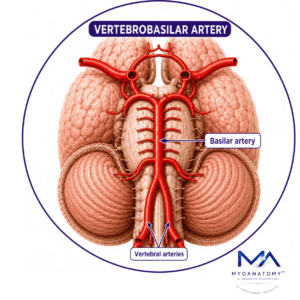
Vertebrobasilar Artery

MYO CORE

Functional Significance

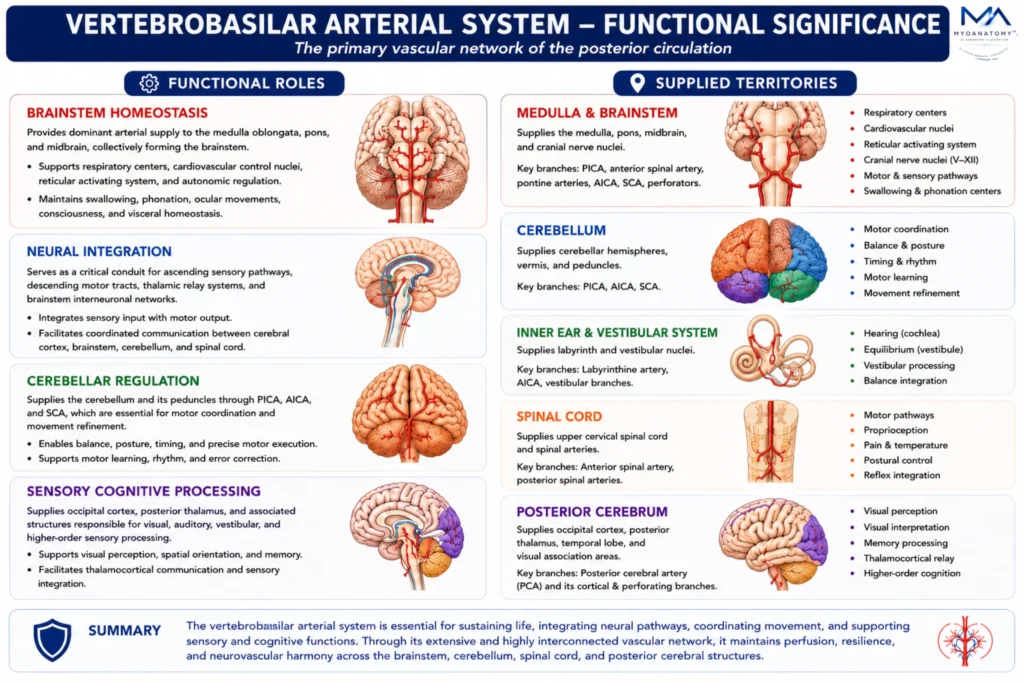
The vertebrobasilar system forms the principal arterial supply of the posterior circulation, maintaining perfusion of the brainstem, cerebellum, thalamus, occipital lobes, and associated neural pathways essential for autonomic regulation, coordination, balance, vision, and consciousness.

FUNCTIONAL SIGNIFICANCE

Brainstem Homeostasis

The vertebrobasilar system provides the dominant arterial supply to the medulla oblongata, pons, and portions of the midbrain, collectively known as the brainstem. 

These regions contain the respiratory centers, cardiovascular control nuclei, reticular activating system, and numerous cranial nerve nuclei responsible for maintaining consciousness, autonomic regulation, swallowing, phonation, ocular movements, and visceral homeostasis. 

Consequently, the vertebrobasilar circulation sustains the neural mechanisms essential for both survival and continuous physiological stability.

Exam Question

Analyze how vertebrobasilar perfusion supports the brainstem nuclei responsible for respiratory, cardiovascular, autonomic, and consciousness-regulating functions.

Neural Integration

Through its supply to major ascending sensory pathways, descending motor tracts, thalamic relay systems, and brainstem interneuronal networks, the vertebrobasilar system serves as a critical conduit for information exchange throughout the central nervous system. 

Corticospinal, corticobulbar, spinothalamic, vestibular, and medial lemniscal pathways traverse vertebrobasilar territories, enabling integration of sensory input with motor output and facilitating coordinated communication between the cerebral cortex, brainstem, cerebellum, and spinal cord.

Exam Question

Evaluate the role of vertebrobasilar pathways in integrating ascending sensory information with descending motor control throughout the central nervous system.

Cerebellar Regulation

The posterior inferior cerebellar, anterior inferior cerebellar, and superior cerebellar arteries collectively supply the cerebellum and its associated peduncles, which function as the principal centers for motor coordination and movement refinement. 

Through this vascular support, the vertebrobasilar system contributes to postural control, equilibrium, motor learning, timing of movement, gait regulation, and the continuous correction of voluntary motor activity. 

It therefore plays a fundamental role in transforming intended movement into smooth, accurate, and coordinated action.

Exam Question

Explain how vertebrobasilar arterial territories support cerebellar mechanisms responsible for coordination, balance, motor learning, and movement refinement.

Sensory Cognitive Processing

Through the posterior cerebral arteries and associated vertebrobasilar branches, the system supplies the occipital cortex, posterior thalamus, inferomedial temporal lobe, visual association areas, vestibular apparatus, and auditory pathways. 

These territories are responsible for visual perception, auditory processing, spatial orientation, memory formation, sensory integration, and higher-order thalamocortical communication. 

As a result, the vertebrobasilar circulation supports not only basic neurological function but also the complex perceptual and cognitive processes that underlie awareness, interpretation of sensory information, and interaction with the external environment.

Exam Question

Assess how vertebrobasilar circulation contributes to visual, auditory, vestibular, thalamic, and higher-order sensory processing networks.

SUMMARY TABLE

Scroll to Top