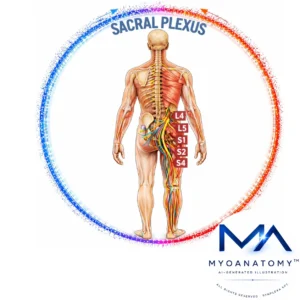
Sacral Plexus
MYO CORE
Innervation
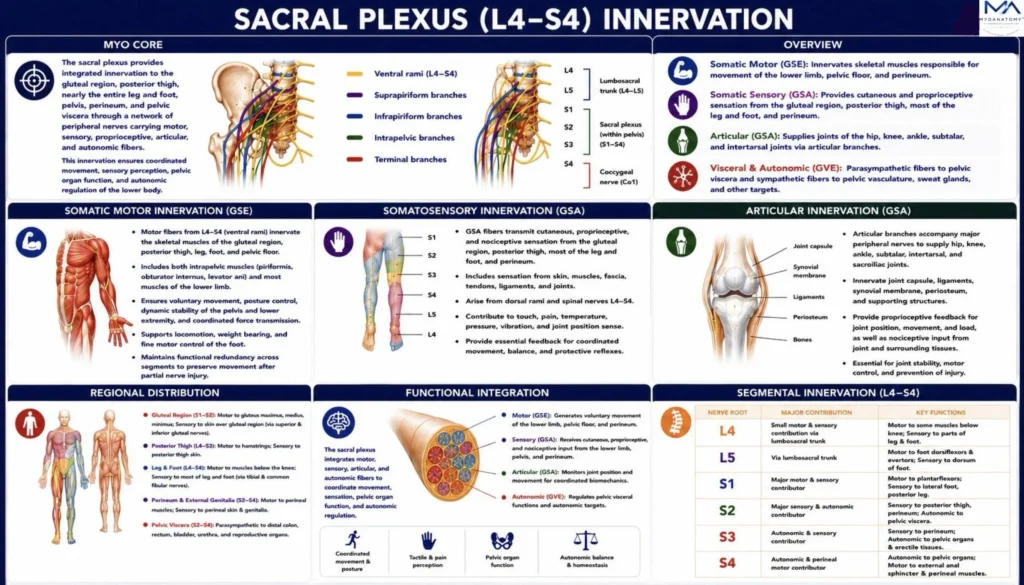
The sacral plexus provides integrated general somatic efferent (GSE), general somatic afferent (GSA), articular afferent, and general visceral efferent (GVE) innervation to the gluteal region, posterior thigh, nearly the entire leg and foot, pelvis, perineum, and pelvic viscera. As the principal peripheral neural network of the posterior pelvis, it coordinates locomotion, pelvic floor function, visceral regulation, and lower-limb biomechanics.
OVERVIEW
Through redistribution of fibers from the lumbosacral trunk (L4 – L5) and ventral rami of S1- S4, the sacral plexus reorganizes segmental spinal fibers into multisegmental peripheral nerves supplying the pelvis and lower limb.
Rather than maintaining independent segmental pathways, extensive intraplexal fascicular integration combines somatic motor, somatic sensory, proprioceptive, articular, and autonomic fibers within individual peripheral nerves, generating functionally specialized neural pathways for coordinated locomotion, postural stability, pelvic floor activity, continence, sexual function, and visceral regulation.
Functional continuity with the lumbar plexus through the lumbosacral trunk establishes a unified lumbosacral neural network that synchronizes pelvic and lower-limb biomechanics while preserving segmental overlap, precise neuroanatomical localization, multisegmental integration, and functional redundancy.
This integrated organization optimizes neuromuscular coordination, sensorimotor control, and somatovisceral communication while enhancing the precision of clinical localization and the resilience of lower-limb and pelvic function following partial segmental injury.
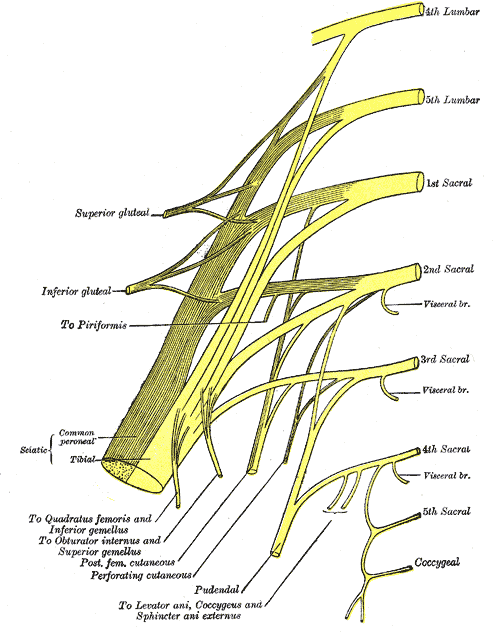
Plan of sacral and pudendal plexuses (Gray828)” – Henry Vandyke Carter, Gray’s Anatomy: Anatomy of the Human Body. Source: Wikimedia Commons. Public Domain.
Exam Question
Explain how redistribution and intraplexal fascicular integration within the sacral plexus reorganize segmental spinal fibers into multisegmental peripheral nerves, and discuss how this organization establishes coordinated somatic and autonomic function, segmental overlap, functional redundancy, and clinically relevant neuroanatomical localization.
ANATOMY
Somatic Motor Innervation
The sacral plexus distributes general somatic efferent (GSE) fibers to the gluteal musculature, deep lateral rotators of the hip, hamstrings, and – through the sciatic nerve and its terminal divisions – the vast majority of the intrinsic and extrinsic muscles of the leg and foot.
Additional motor branches innervate the piriformis, obturator internus, quadratus femoris, pelvic floor, and perineal musculature, integrating voluntary movement of the pelvis and lower limb with pelvic support and sphincter control.
Multisegmental motor redistribution from L4–S4 ensures coordinated muscle recruitment, efficient force transmission, dynamic joint stabilization, and functional redundancy, preserving locomotion and postural control despite partial segmental injury.
Exam Question
Explain how the multisegmental somatic motor organization of the sacral plexus coordinates locomotion, pelvic stability, lower-limb biomechanics, and pelvic floor function while preserving motor performance following partial segmental injury.
Somatic Sensory Innervation
The sacral plexus distributes general somatic afferent (GSA) fibers through multisegmental peripheral nerves to the gluteal region, posterior thigh, most of the leg and foot, and the perineum.
These fibers convey cutaneous, proprioceptive, mechanoreceptive, nociceptive, and thermoreceptive information from the skin, muscles, tendons, fascia, ligaments, periosteum, and deep connective tissues to the central nervous system. Through intraplexal fascicular redistribution, sensory fibers from multiple spinal segments converge within individual peripheral nerves, providing continuous afferent feedback.
This multisegmental organization enhances the accuracy of postural regulation and protective somatic reflexes while preserving functional redundancy and facilitating precise neuroanatomical localization following partial root or peripheral nerve injury.
Exam Question
Explain how multisegmental redistribution of general somatic afferent fibers within the sacral plexus integrates cutaneous, proprioceptive, mechanoreceptive, and nociceptive information to coordinate sensorimotor control, postural regulation, adaptive locomotion, and neurological localization.
Articular Innervation
The sacral plexus distributes general somatic afferent (GSA) articular fibers primarily through the nerve to quadratus femoris, sciatic nerve, tibial nerve, common fibular (peroneal) nerve, and pudendal nerve to the hip, sacroiliac, knee, ankle, subtalar, and selected joints of the foot.
These articular branches terminate within the fibrous capsule, synovial membrane, ligaments, periosteum, and periarticular connective tissues, where specialized mechanoreceptors, proprioceptors, and nociceptors continuously monitor joint position, capsular tension, mechanical loading, and potentially injurious stimuli.
Integrated articular afferent input modulates spinal and supraspinal motor circuits to regulate dynamic joint stability, coordinated movement, postural adaptation, and protective reflexes, while providing the neurophysiological basis for segmental and referred pain arising from the lower limb and pelvis.
Exam Question
Explain the articular innervation provided by the sacral plexus and discuss how articular afferent fibers contribute to proprioception, dynamic joint stability, reflex modulation, coordinated locomotion, and the development of referred pain.
Regional Distribution
The sacral plexus distributes peripheral innervation throughout the gluteal region, posterior thigh, nearly the entire leg and foot, pelvis, perineum, and pelvic viscera, establishing the principal neural network of the posterior pelvis and lower limb.
Rather than supplying isolated anatomical structures, its multisegmental peripheral nerves integrate muscles, joints, fascia, skin, and pelvic organs into coordinated functional and biomechanical units.
This regional organization synchronizes locomotion with pelvic stabilization, lower-limb movement with pelvic floor support, and somatic function with visceral control, ensuring efficient force transmission, postural stability, coordinated gait, and integrated pelvic organ function.
Exam Question
Describe the regional distribution of sacral plexus innervation and explain how its multisegmental organization integrates the pelvis, perineum, and lower limb into coordinated biomechanical, sensorimotor, and visceral functional units.
Functional Integration
The sacral plexus functions as an integrated sensorimotor and autonomic network, coordinating general somatic efferent (GSE), general somatic afferent (GSA), proprioceptive, articular, and general visceral efferent (GVE) pathways within multisegmental peripheral nerves.
Continuous interaction between descending motor output and ascending sensory and visceral afferent feedback synchronizes voluntary movement with reflex activity, postural control, pelvic floor function, continence, sexual function, and visceral regulation.
Functional continuity with the lumbar plexus through the lumbosacral trunk establishes a unified lumbosacral neural network that integrates pelvic stability with lower-limb biomechanics while optimizing sensorimotor coordination, functional adaptability, and neuromuscular efficiency.
Exam Question
Explain how multisegmental integration within the sacral plexus coordinates somatic motor, sensory, proprioceptive, articular, and autonomic pathways, and discuss its biomechanical and clinical significance.
Segmental Innervation
Despite redistribution into peripheral nerves, the sacral plexus preserves the intrinsic segmental organization of the spinal cord by integrating fibers from the lumbosacral trunk (L4-L5) and S1-S4 into overlapping multisegmental motor, sensory, articular, and autonomic territories.
Consequently, individual muscles, joints, cutaneous regions, and pelvic viscera receive convergent innervation from multiple spinal segments, ensuring coordinated neuromuscular function, segmental overlap, and substantial functional redundancy.
Correlation of myotomes, dermatomes, reflex pathways, autonomic segments, and peripheral nerve territories enables precise neuroanatomical localization and reliable differentiation between radiculopathy, plexopathy, peripheral neuropathy, and focal nerve lesions, despite overlapping neurological deficits.
Exam Question
Explain how the segmental organization of the sacral plexus enables multisegmental peripheral innervation and facilitates neuroanatomical localization and differentiation of radiculopathy, plexopathy, peripheral neuropathy, and focal nerve lesions.
SUMMARY TABLE