Lumbar Plexus
MYO CORE
Innervation
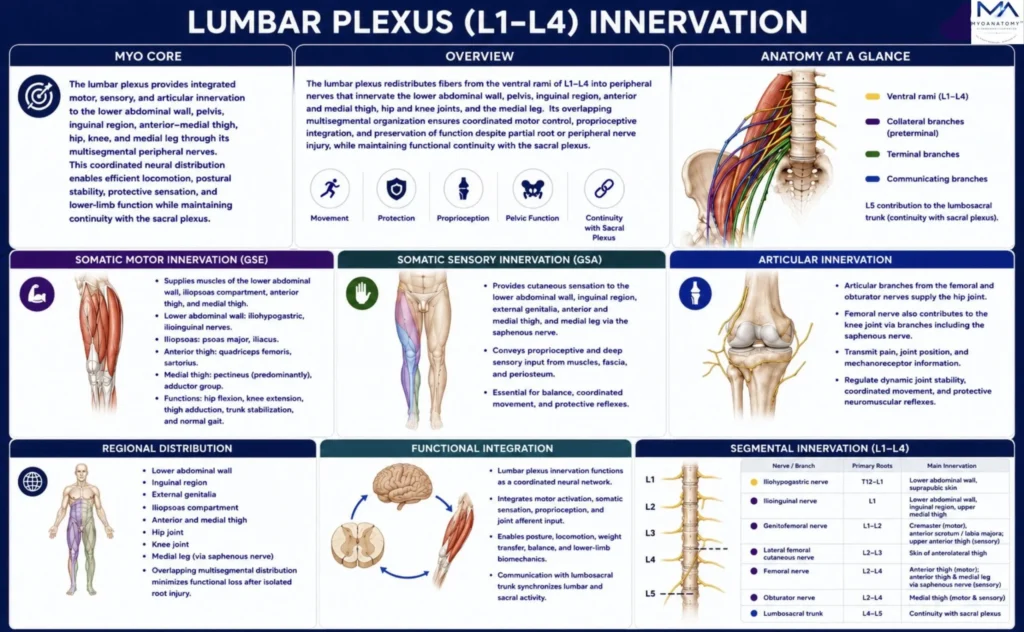
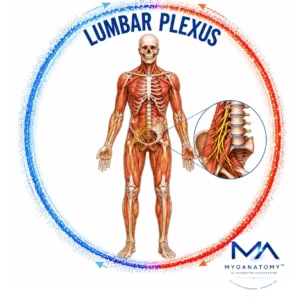
The lumbar plexus provides integrated motor, sensory, articular, and autonomic innervation to the lower abdominal wall, pelvis, and anterior – medial lower limb through multisegmental peripheral nerves.
OVERVIEW
By redistributing fibers from L1 – L4 into functionally coordinated neural pathways, lumbar plexus synchronizes lumbopelvic stability, locomotion, proprioception, joint function, and lower-limb biomechanics while maintaining neural continuity with the sacral plexus.
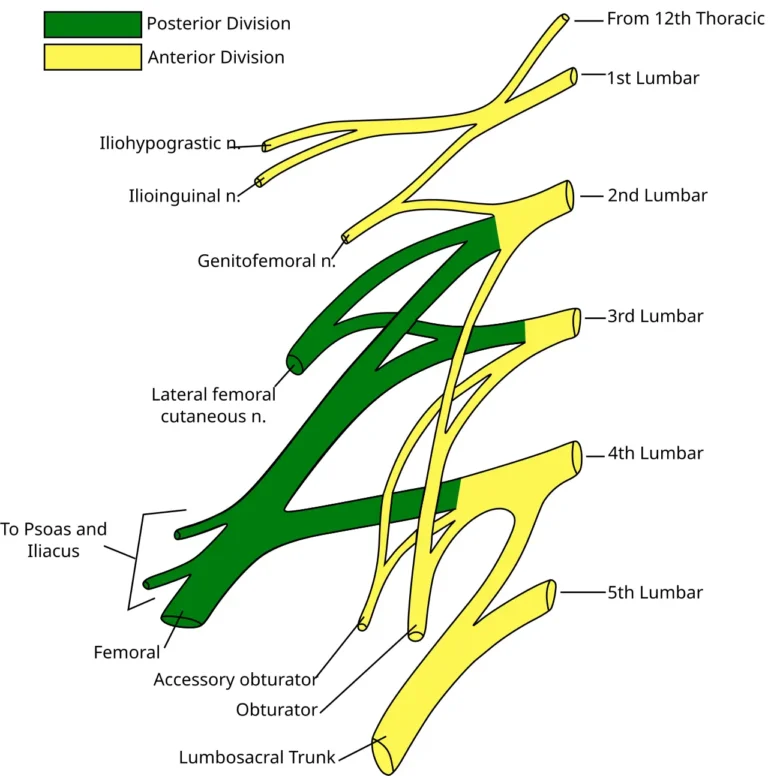
Also, it converts segmental spinal output into coordinated peripheral innervation by redistributing fibers from the ventral rami of L1–L4 into multisegmental peripheral nerves.
Rather than preserving isolated dermatomes or myotomes, this organization integrates motor output with cutaneous, proprioceptive, and articular afferent input to generate coordinated movement, postural control, and adaptive lower-limb biomechanics. Its continuity with the lumbosacral trunk and lumbar sympathetic trunk functionally links the lumbar and sacral plexuses into a unified neural network controlling the pelvis and lower extremity.
Lumbar Plexus. Adapted from Gray822_es.svg by Gray; derivative work by Ninovolador and Mcstrother. Licensed under CC BY 3.0 via Wikimedia Commons.
Exam Question
How does the lumbar plexus integrate multisegmental spinal output into coordinated peripheral innervation that supports posture, locomotion, proprioception, and lower-limb biomechanics?
ANATOMY
Somatic Motor Innervation
The lumbar plexus distributes general somatic efferent (GSE) fibers to the musculature of the lower abdominal wall, iliopsoas compartment, and anterior and medial compartments of the thigh through multisegmental peripheral nerves.
Rather than functioning as isolated motor pathways, these fibers establish coordinated neuromuscular synergies that integrate lumbopelvic stabilization with lower-limb movement.
Sequential activation of the iliopsoas, quadriceps femoris, sartorius, pectineus, and adductor complex regulates hip flexion, controlled knee extension, pelvic stabilization, frontal-plane balance, and weight transfer throughout the gait cycle.
Overlapping segmental innervation enables graded motor recruitment, preserves biomechanical efficiency following partial root injury, and maintains coordinated locomotion through functional redundancy and spinal motor integration.
Exam Question
How does the multisegmental organization of lumbar plexus motor pathways coordinate lumbopelvic stabilization, hip flexion, knee extension, and dynamic weight transfer during the gait cycle, and why are these functions preserved following partial segmental injury?
Somatic Sensory Innervation
The lumbar plexus conveysgeneral somatic afferent (GSA) fibers from the lower abdominal wall, inguinal region, external genitalia, anterior-medial thigh, medial leg, and associated musculoskeletal structures.
These fibers transmit cutaneous sensation together with proprioceptive, mechanoreceptive, and nociceptive information originating from muscles, tendons, fascia, periosteum, ligaments, and connective tissues.
Continuous integration of peripheral afferent input provides the central nervous system with real-time information concerning limb position, muscle length, mechanical loading, and joint movement, thereby regulating postural equilibrium, adaptive locomotion, segmental reflexes, and protective somatic responses.
Exam Question
How does integration of cutaneous, proprioceptive, mechanoreceptive, and nociceptive afferent input through the lumbar plexus contribute to postural regulation, locomotor adaptation, and protective somatic reflexes?
Articular Innervation
Articular branches arising principally from the femoral and obturator nerves provide sensory innervation to the anterior hip capsule and the knee joint.
Their afferent fibers terminate within the fibrous capsule, synovium, ligaments, periosteum, and periarticular connective tissues, where specialized mechanoreceptors, proprioceptors, and nociceptors continuously monitor joint position, capsular tension, and mechanical loading.
This sensory information modulates spinal and supraspinal motor circuits regulating periarticular muscle tone, dynamic joint stability, and coordinated movement while providing the neurophysiological basis for segmental and referred pain.
Exam Question
How do articular afferents of the femoral and obturator nerves regulate dynamic hip and knee stability, and how does segmental convergence explain referred pain originating from these joints?
Regional Distribution
The lumbar plexus distributes peripheral innervation throughout the lower abdominal wall, inguinal region, external genitalia, iliopsoas compartment, anterior and medial thigh, hip joint, knee joint, and medial leg.
These territories represent integrated functional units rather than isolated anatomical regions, allowing muscles, joints, fascia, and cutaneous structures participating in common biomechanical tasks to receive coordinated neural control.
Such organization permits efficient force transmission, postural stabilization, and synchronized lower-limb movement despite the complexity of multijoint locomotion.
Exam Question
How does the regional distribution of lumbar plexus innervation integrate the abdominal wall, pelvis, hip, thigh, and knee into a coordinated biomechanical system rather than isolated anatomical territories?
Functional Integration
The lumbar plexus functions as an integrated sensorimotor network linking descending supraspinal motor commands with ascending proprioceptive, cutaneous, and articular feedback.
Continuous reciprocal interaction between efferent and afferent pathways permits anticipatory postural adjustment, reflex modulation, balance correction, adaptive muscle recruitment, and coordinated gait mechanics.
Functional continuity through the lumbosacral trunk synchronizes lumbar-mediated pelvic stabilization with sacral-mediated distal limb control, enabling efficient propulsion, shock absorption, and dynamic postural control throughout the locomotor cycle.
Exam Question
How does functional integration between lumbar and sacral sensorimotor pathways coordinate anticipatory postural control, adaptive gait mechanics, lower-limb propulsion, and dynamic balance during locomotion?
Segmental Innervation
Although redistributed through peripheral nerves, the lumbar plexus preserves the intrinsic segmental organization of the spinal cord by integrating fibers from L1 – L4 into overlapping motor and sensory territories.
Individual muscles, joints, and cutaneous regions therefore receive convergent innervation from multiple spinal segments, creating substantial functional redundancy while maintaining precise neuroanatomical localization.
Correlation of myotomes, dermatomes, deep tendon reflexes, and peripheral nerve territories permits accurate differentiation between radiculopathy, plexopathy, and distal peripheral neuropathy despite overlapping neurological deficits.
Exam Question
How does multisegmental fiber redistribution within the lumbar plexus preserve neuromuscular function while enabling accurate localization of spinal root, plexus, and peripheral nerve lesions?
SUMMARY TABLE