Peripheral Nerves

MYO CORE

Clinical Relevance

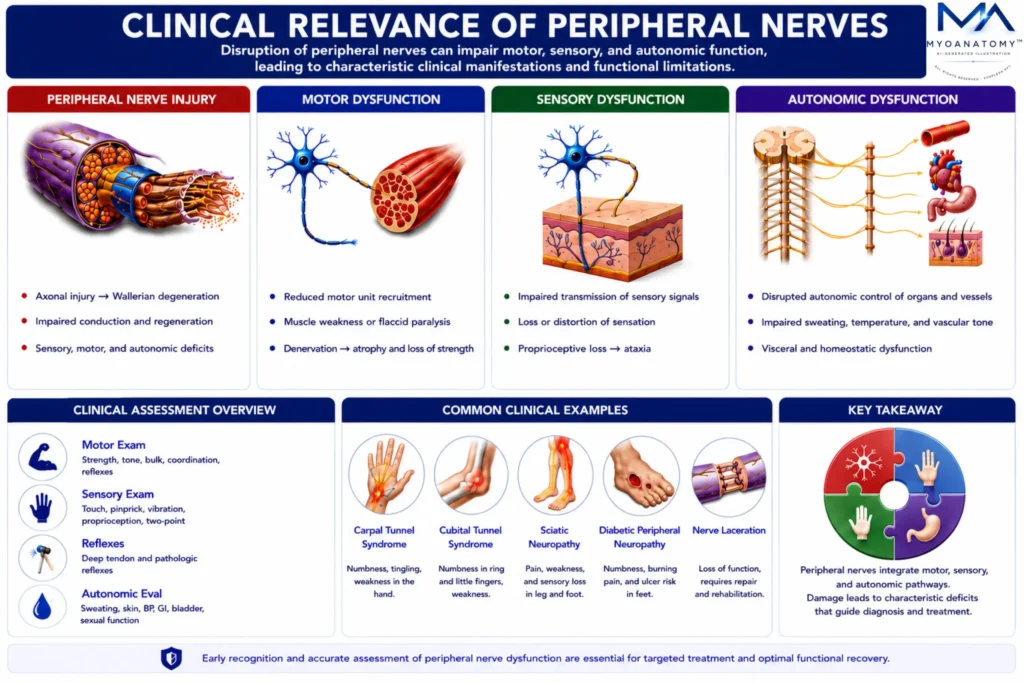
Peripheral nerve disorders impair the integrated motor, sensory, and autonomic functions required for normal neuromuscular and visceral activity. Disruption of axonal conduction, myelin integrity, or neuronal continuity produces characteristic patterns of weakness, sensory dysfunction, autonomic impairment, and functional disability.

CLINICAL RELEVANCE

Peripheral Nerve Injury

Peripheral nerve injury results from compression, traction, laceration, ischemia, metabolic disorders, or inflammatory neuropathies, disrupting axonal continuity, Schwann cell integrity, and impulse conduction. The severity of injury determines the degree of functional impairment, ranging from transient conduction block (neurapraxia) to complete transection (neurotmesis).

Axonal disruption initiates Wallerian degeneration distal to the lesion, followed by macrophage-mediated debris clearance and Schwann cell proliferation, which establish regenerative pathways for axonal sprouting. Functional recovery depends on preserved connective tissue sheaths, accurate target reinnervation, and the intrinsic regenerative capacity of peripheral neurons.

Motor Dysfunction

Motor fiber injury interrupts α- and γ-motor neuron efferent pathways, impairing neuromuscular transmission, motor unit recruitment, and excitation-contraction coupling. Progressive denervation reduces muscle force generation, voluntary movement, postural stability, and reflex activity, producing weakness, hyporeflexia, flaccid paralysis, and loss of coordinated motor control.

Chronic denervation induces muscle atrophy, fiber-type transformation, motor end-plate degeneration, and connective tissue remodeling, resulting in persistent functional deficits and diminished neuromuscular efficiency even after partial reinnervation.

Sensory Dysfunction

Sensory fiber injury disrupts transmission from mechanoreceptors, proprioceptors, nociceptors, and thermoreceptors, impairing somatosensory integration within the central nervous system. Clinical manifestations include hypoesthesia, anesthesia, paresthesia, dysesthesia, allodynia, hyperalgesia, neuropathic pain, and proprioceptive deficits, depending on the affected fiber populations.

Loss of afferent feedback compromises protective sensation, tactile discrimination, joint position sense, balance, and sensorimotor coordination, increasing susceptibility to gait instability, repetitive trauma, chronic ulceration, and delayed recognition of tissue injury.

Autonomic Dysfunction

Autonomic fiber injury disrupts sympathetic and parasympathetic innervation of vascular smooth muscle, sweat glands, cardiac muscle, and visceral organs, producing widespread impairment of involuntary physiological regulation. Dysfunction alters vasomotor control, glandular secretion, gastrointestinal motility, urinary function, pupillary responses, and cardiovascular reflexes.

Clinically, autonomic neuropathy may present with orthostatic hypotension, abnormal sweating, impaired thermoregulation, gastrointestinal dysmotility, bladder dysfunction, erectile dysfunction, and reduced cardiovascular adaptability, reflecting failure of autonomic homeostasis and neurovascular regulation.

SUMMARY TABLE

Scroll to Top