Peripheral Nerves

MYO CORE

Nerve Fiber

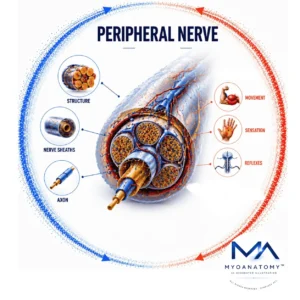
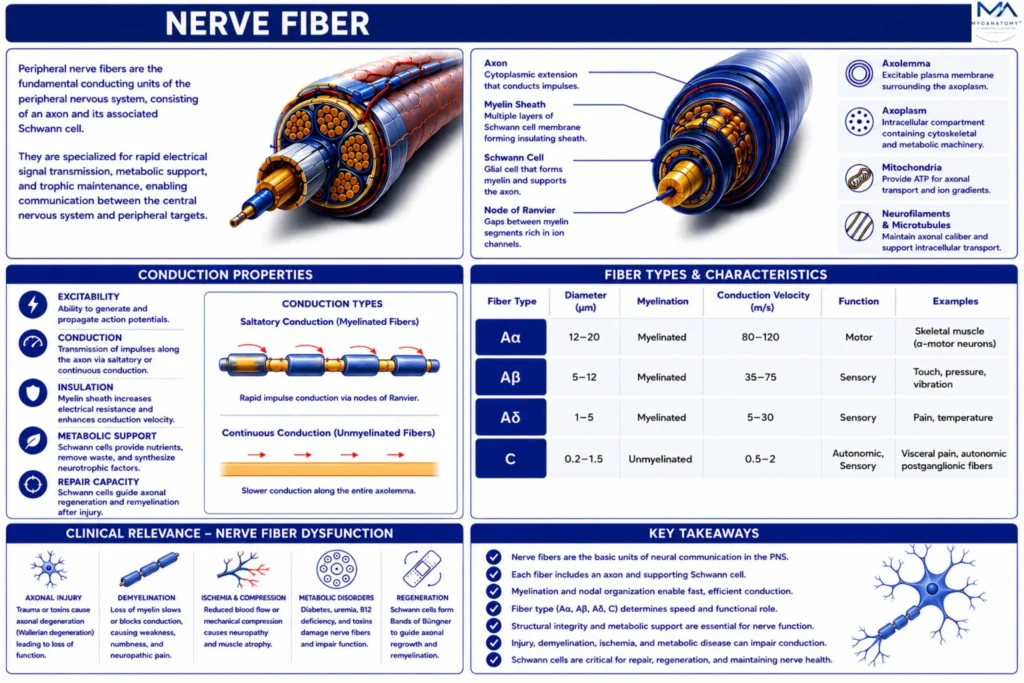
Peripheral nerve fibers are the fundamental conducting units of the peripheral nervous system, consisting of an axon and its associated Schwann cell. 

OVERVIEW

Each peripheral nerve fibers comprises an excitable axolemma surrounding axoplasm, which contains the cytoskeletal framework, organelles, and transport machinery required for long-term neuronal maintenance. 

Schwann cells provide structural, metabolic, and trophic support and, in most fibers, form the multilamellar myelin sheath interrupted by the nodes of Ranvier, enabling rapid saltatory conduction. 

Variations in axonal diameter, myelin thickness, and internodal architecture determine conduction efficiency, electrophysiological performance, and the functional specialization of peripheral nerve fibers, ensuring precise neural communication between the central nervous system and peripheral tissues.

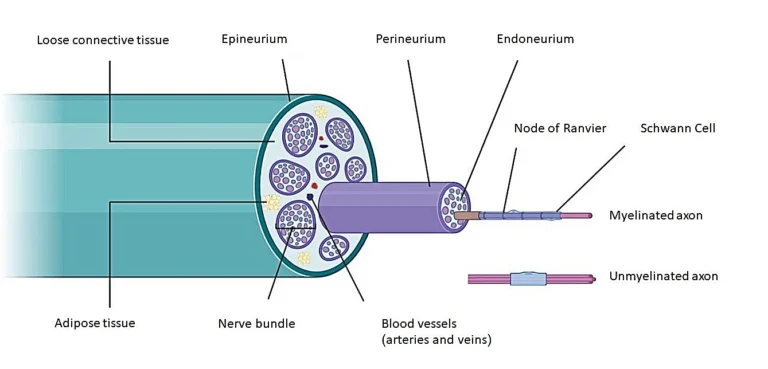
Graphical Abstract of a Peripheral Nerve” – Klimovich P., Rubina K., Sysoeva V., Semina E.; via Wikimedia Commons. Licensed under CC BY 4.0.

Exam Question

How do the structural specializations of peripheral nerve fibers collectively optimize conduction efficiency and functional specialization?

ANATOMY

Nerve Fiber

A peripheral nerve fiber is the fundamental structural and conducting unit of the peripheral nervous system, comprising a neuronal axon, its associated Schwann cell, and the surrounding extracellular matrix. 

Each fiber represents a highly specialized neuroglial complex in which membrane specialization, cytoskeletal organization, and glial support are integrated to preserve structural integrity, maintain axonal homeostasis, and facilitate long-distance neural communication throughout the body.

Exam Question

How does the anatomical organization of a peripheral nerve fiber establish the structural foundation for efficient neural communication?

Axon

The axon is a polarized cytoplasmic extension originating from the neuronal cell body and terminating at peripheral effector organs or sensory receptors. 

Its internal architecture is supported by a highly organized cytoskeleton composed of microtubules, neurofilaments, and actin microfilaments, which maintain axonal caliber, preserve mechanical stability, and provide the intracellular scaffold required for organelle trafficking, protein transport, and long-distance cellular communication.

Exam Question

How does the cytoskeletal organization of the axon preserve structural integrity while supporting long-distance intracellular transport?

Membrane System

The axolemma is the specialized excitable plasma membrane that surrounds the axon, whereas the axoplasm forms the intracellular cytoplasmic compartment containing cytoskeletal proteins, mitochondria, transport vesicles, ribonucleoproteins, enzymes, and metabolic substrates essential for neuronal maintenance. 

Together, these highly specialized structures maintain ionic homeostasis, membrane excitability, intracellular metabolism, and the structural continuity required for impulse propagation.

Exam Question

How do the anatomical specializations of the axolemma and axoplasm maintain neuronal homeostasis and support efficient impulse propagation?

Schwann Cells

Schwann cells are the principal neuroglial cells of the peripheral nervous system and establish an intimate structural relationship with every peripheral axon. 

They provide metabolic and trophic support, synthesize the peripheral myelin sheath, maintain the extracellular microenvironment, remove cellular debris following injury, and create the regenerative pathway that guides axonal repair during peripheral nerve regeneration.

Exam Question

How do Schwann cells integrate structural support, myelination, and regenerative mechanisms to maintain peripheral nerve integrity?

Myelin Sheath

The myelin sheath consists of multiple concentric lamellae of compact Schwann cell membrane wrapped around the axon to form a highly specialized insulating structure. 

This multilamellar organization electrically isolates the axolemma, increases membrane resistance, reduces capacitance, and markedly enhances the speed, precision, and metabolic efficiency of impulse conduction along peripheral nerve fibers.

Exam Question

How does the ultrastructural organization of the myelin sheath optimize the efficiency and reliability of peripheral nerve conduction?

Nodes of Ranvier

The nodes of Ranvier are regularly spaced interruptions between adjacent myelin internodes where the axolemma is exposed and densely populated by voltage-gated sodium channels. 

These highly specialized excitable domains regenerate the action potential and permit rapid saltatory conduction, thereby maximizing conduction velocity while minimizing metabolic energy expenditure.

Exam Question

Why are the nodes of Ranvier indispensable for rapid, efficient, and metabolically economical impulse propagation?

Conduction Properties

The conduction properties of peripheral nerve fibers are determined by the integrated structural characteristics of the axon, including axon diameter, myelin thickness, internodal length, and the distribution of nodes of Ranvier

Large-diameter, heavily myelinated fibers exhibit rapid, temporally precise impulse transmission through saltatory conduction, whereas small-diameter, unmyelinated fibers conduct impulses more slowly by continuous propagation. 

These structural adaptations optimize conduction velocity, transmission fidelity, and functional specialization, enabling peripheral nerve fibers to meet the diverse sensory, motor, and autonomic demands of the peripheral nervous system.

Exam Question

How do axonal diameter, myelin architecture, internodal organization, and nodal distribution collectively determine the conduction properties and functional specialization of peripheral nerve fibers?

Fiber Types & Characteristic

Peripheral nerve fibers are classified by axonal diameter, myelination, and conduction velocity.

Myelinated fibers conduct impulses rapidly through saltatory conduction, whereas  unmyelinated fibers conduct more slowly and are adapted for autonomic regulation and nociceptive signaling.

The Erlanger–Gasser classification identifies Aα, Aβ, Aδ, and C fibers, each optimized for specific physiological modalities.

Aα fibers mediate somatic motor function and proprioception;

Aβ fibers transmit discriminative touch, vibration, and pressure;

Aδ fibers convey fast pain and cold sensation; while

Unmyelinated C fibers conduct slow pain, warmth, itch, and postganglionic autonomic impulses. 

Exam Question

How do axonal diameter, myelination, and Erlanger–Gasser fiber classification collectively determine conduction velocity, electrophysiological performance, and functional specialization in peripheral nerve fibers?

SUMMARY TABLE

Scroll to Top