Nerves Anatomy

Nerve anatomy explores the organization, distribution, and function of peripheral nerves and neural plexuses that transmit sensory, motor, and autonomic information throughout the body.

watermark

Peripheral Nerves

MYO CORE

Overview

Peripheral nerves form the interface between the central nervous system (CNS) and peripheral tissues, enabling rapid bidirectional transmission for motor control, sensory processing, and autonomic regulation.

OVERVIEW

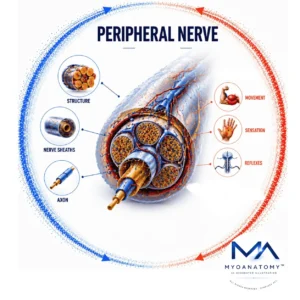
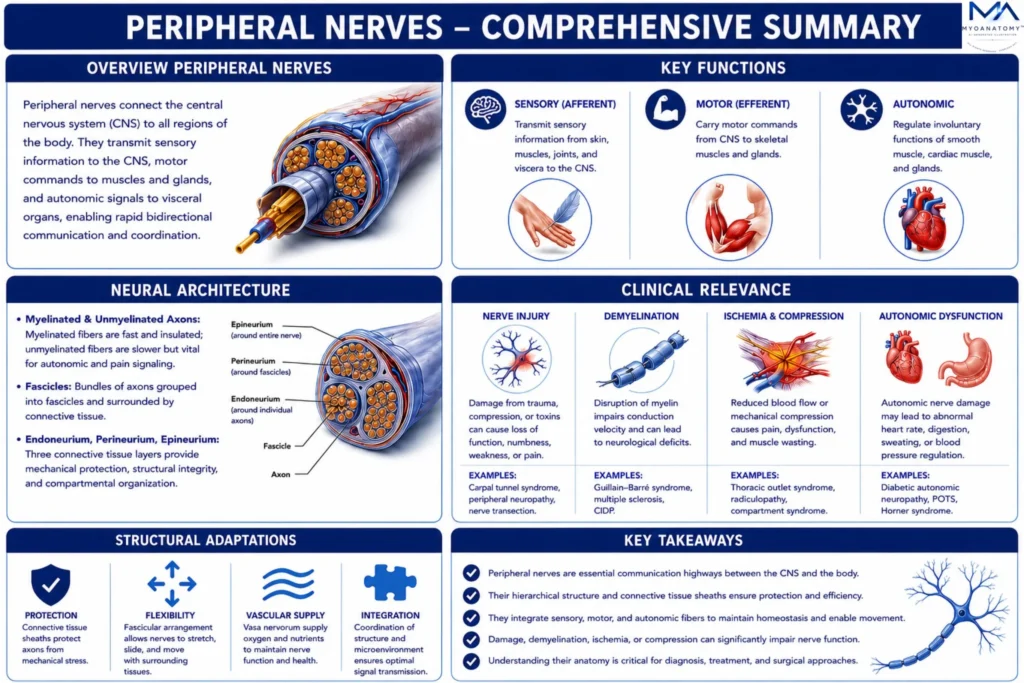
Peripheral nerves are highly organized neurovascular structures that connect the central nervous system with skeletal muscle, skin, glands, and visceral organs. 

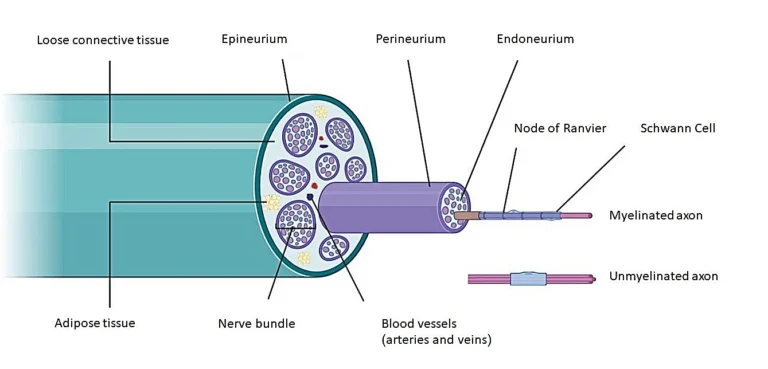
They consist of myelinated and unmyelinated axons arranged into fascicles and enclosed by endoneurium, perineurium, and epineurium, which provide mechanical protection, maintain the blood–nerve barrier, and preserve the microenvironment required for impulse conduction.

Functionally, peripheral nerves integrate sensory (afferent), motor (efferent), and autonomic fibers, enabling bidirectional communication between the central nervous system and peripheral tissues. Signal transmission depends on axonal diameter, myelination, and saltatory conduction through the nodes of Ranvier, ensuring rapid and coordinated neural communication.

Clinically, peripheral nerve dysfunction results from demyelination, axonal injury, compression, ischemia, or metabolic disease, leading to impaired sensory, motor, or autonomic function.

Overall, peripheral nerves constitute a dynamic communication network that maintains movement, sensation, autonomic regulation, and musculoskeletal homeostasis.

Graphical Abstract of a Peripheral Nerve” – Klimovich P., Rubina K., Sysoeva V., Semina E.; via Wikimedia Commons. Licensed under CC BY 4.0.

Exam Question

How does the hierarchical structural organization of peripheral nerves-including axons, Schwann cells, fascicles, connective tissue sheaths, and neurovascular support-integrate to ensure rapid impulse conduction, mechanical protection, and coordinated sensory, motor, and autonomic function in health and disease?

ANATOMY

Neural Architecture

Peripheral nerves are complex neurovascular organs composed of myelinated and unmyelinated axons hierarchically organized into fascicles. 

This compartmentalized architecture minimizes mechanical stress, preserves fascicular independence, and optimizes the spatial organization required for efficient neural communication throughout the peripheral nervous system.

Exam Question

How does the hierarchical organization of peripheral nerves optimize structural compartmentalization, mechanical resilience, and efficient neural communication?

Nerves Sheath

The endoneurium, perineurium, and epineurium form a continuous connective tissue scaffold surrounding individual axons, fascicles, and the entire nerve. 

Beyond mechanical support, these specialized layers establish distinct anatomical compartments that preserve fascicular integrity, maintain extracellular homeostasis, and facilitate independent fascicular mobility during physiological movement.

Exam Question

How do the anatomical specializations of the endoneurium, perineurium, and epineurium collectively preserve peripheral nerve integrity and compartmentalization?

Neurovascular Integration

Peripheral nerves possess an intrinsic vascular network supplied by the vasa nervorum, while the multilamellar perineurium forms the highly selective blood–nerve barrier. 

Together, these structures maintain metabolic support, regulate the endoneurial microenvironment, and protect neural tissue from ischemic, mechanical, and biochemical injury.

Exam Question

How do the blood–nerve barrier and vasa nervorum integrate to preserve the structural and metabolic homeostasis of peripheral nerves?

Structural Adaption

Peripheral nerve architecture is biomechanically adapted to tolerate elongation, compression, torsion, and repetitive limb movement without compromising fascicular organization. 

The coordinated interaction of connective tissue sheaths, Schwann cells, extracellular matrix, and vascular support preserves structural continuity, conduction reliability, and long-term functional integrity under physiological and pathological conditions.

Exam Question

How do the biomechanical and microstructural adaptations of peripheral nerves preserve conduction fidelity and structural integrity during physiological loading and pathological stress?

SUMMARY TABLE

Scroll to Top