Peripheral Nerves

MYO CORE

Functional Siginifcance

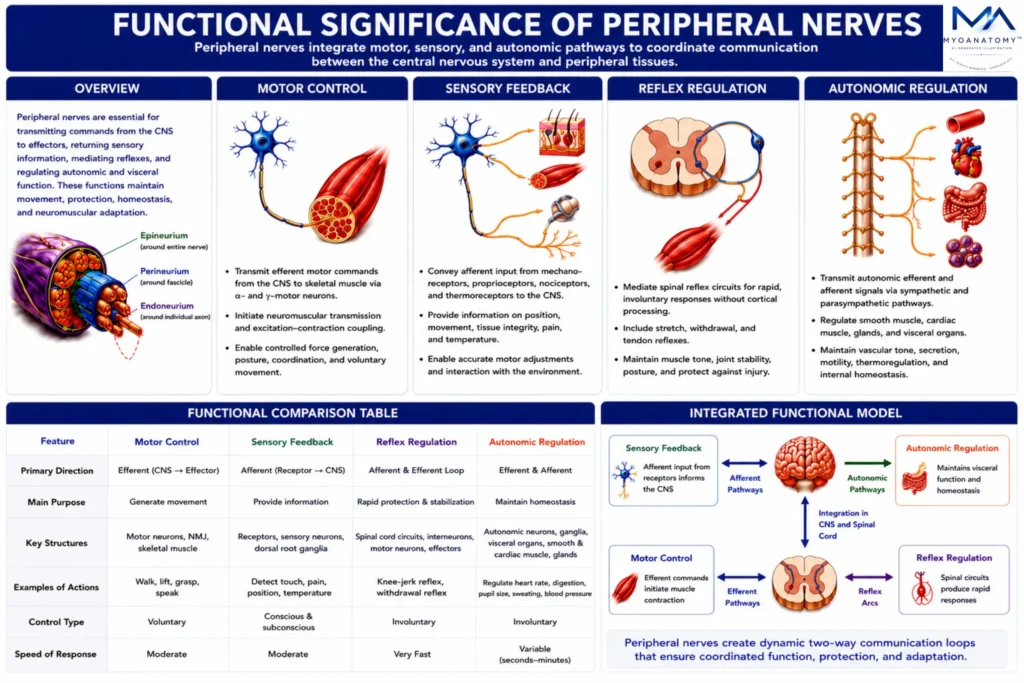
Peripheral nerves integrate motor, sensory, and autonomic pathways to coordinate communication between the central nervous system and peripheral tissues. They transmit efferent commands, return afferent sensory information, mediate spinal reflexes, and regulate visceral function, thereby maintaining movement, protection, homeostasis, and neuromuscular adaptation.

FUNCTIONAL SIGNIFICANCE

Motor Control

Peripheral nerves provide the efferent interface between the CNS and skeletal muscle, enabling controlled force generation via α-motor neuron activation and acetylcholine-mediated neuromuscular transmission. This initiates excitation–contraction coupling and mechanical force production.

Force output is precisely regulated through motor unit recruitment and rate coding, allowing graded contraction, coordinated movement, joint stabilization, and maintenance of posture under dynamic mechanical demands.

Sensory feedback

Peripheral nerves transmit continuous afferent input from mechanoreceptors, proprioceptors, and nociceptors to the CNS, encoding information on tissue deformation, position, and load. Muscle spindles detect changes in length and velocity, while Golgi tendon organs monitor tension.

This sensory input is integrated at spinal and supraspinal levels (including cerebellar circuits), enabling real-time modulation of motor output, ensuring accuracy, coordination, and adaptive control of movement.

Reflex Regulation

Peripheral nerves mediate spinal reflex circuits that generate rapid, automatic responses independent of conscious control. The stretch reflex maintains baseline muscle tone and postural stability, while withdrawal reflexes protect against noxious stimuli.

These reflexes operate through tightly regulated sensorimotor loops, allowing immediate neuromechanical adjustments and safeguarding tissues from excessive mechanical stress or injury.

Autonomic Regulation

Peripheral nerves contain visceral efferent and afferent fibers that integrate sympathetic and parasympathetic pathways to regulate the involuntary activity of smooth muscle, cardiac muscle, glands, and visceral organs. 

Through continuous autonomic signaling, they dynamically maintain vascular tone, cardiovascular performance, visceral motility, glandular secretion, thermoregulation, and internal homeostasis while adapting organ function to changing physiological and environmental demands.

SUMMARY TABLE

Scroll to Top