Peripheral Nerves
MYO CORE
Nerve Sheaths
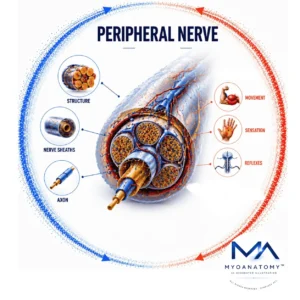
Nerve sheaths are concentric connective tissue layers that structurally compartmentalize peripheral nerves into individual axons, fascicles, and the entire nerve trunk. Together, the endoneurium, perineurium, and epineurium provide mechanical protection, electrical insulation, vascular support, and microenvironmental regulation, preserving impulse conduction, axonal homeostasis, and peripheral nerve regeneration.
OVERVIEW
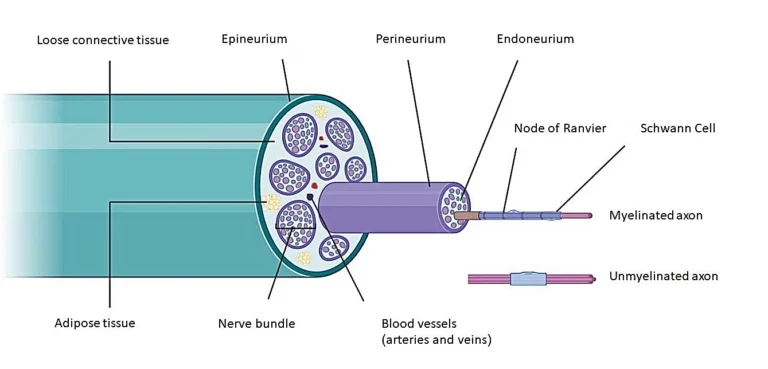
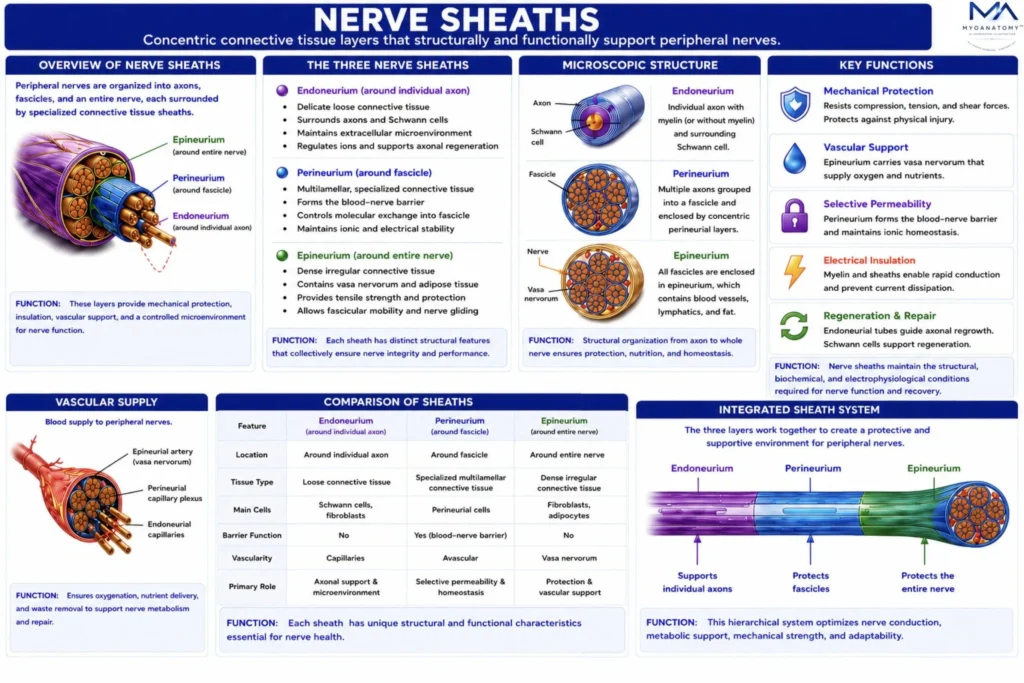
Peripheral nerve sheaths form a hierarchical connective tissue framework that surrounds individual nerve fibers, fascicles, and the entire nerve.
The endoneurium maintains the extracellular microenvironment of individual axons, the perineurium establishes the blood–nerve barrier and preserves ionic homeostasis within fascicles, while the epineurium provides tensile strength, mechanical protection, and carries the vasa nervorum supplying the nerve.
Beyond structural support, these specialized connective tissue layers compartmentalize neural tissue, regulate selective molecular exchange, dissipate mechanical stress, and maintain the biochemical and electrophysiological conditions required for rapid impulse propagation.
Their integrated architecture is essential for nerve elasticity, metabolic support, injury resistance, surgical integrity, and successful peripheral nerve repair following trauma.

“Graphical Abstract of a Peripheral Nerve” by Klimovich P, Rubina K, Sysoeva V, Semina E., via Wikimedia Commons. Licensed under CC BY 4.0.
Exam Question
How do the structural specializations of the peripheral nerve sheaths integrate mechanical protection, blood–nerve barrier function, ionic regulation, and vascular support to maintain normal peripheral nerve conduction and repair?
ANATOMY
Endoneurium
The endoneurium is a specialized, delicate loose connective tissue that invests individual axon–Schwann cell units, forming the immediate microenvironment for nerve fibers. It is composed of longitudinally oriented type I and III collagen fibrils, endoneurial fibroblasts, resident macrophages, and a dense network of non-fenestrated capillaries with tight junctions, contributing to a controlled extracellular milieu.
Each Schwann cell is enveloped by a basal lamina (rich in laminin and type IV collagen), which is critical for axonal support, regeneration, and guidance following injury.
Functionally, the endoneurium maintains a highly regulated endoneurial fluid compartment, ensuring stable ionic gradients and extracellular composition required for axonal excitability and impulse propagation. Its compliant structure allows limited deformation while protecting individual fibers from mechanical stress.
Exam Question
Analyze the cellular and extracellular composition of the endoneurium, and explain how its structural properties maintain the ionic microenvironment and regenerative capacity of peripheral nerve fibers.
Perineurium
The perineurium is a multilamellar, highly specialized connective tissue sheath that encloses nerve fascicles. It consists of concentric layers of flattened perineurial cells (modified myofibroblast-like cells) interconnected by tight junctions (zonula occludens) and supported by a basal lamina and collagenous matrix.
This structure forms the principal blood–nerve barrier, providing selective permeability to ions, macromolecules, and toxins, while maintaining osmotic and ionic stability within the fascicular compartment.
It also serves as an electrical insulator, preventing current dissipation and preserving action potential propagation. The integrity of the perineurium is essential for maintaining conduction velocity and electrophysiological stability.
Exam Question
Critically evaluate the role of the perineurium as a blood–nerve barrier, and discuss how its structural organization contributes to electrical insulation, ionic regulation, and preservation of conduction velocity.
Epineurium
The epineurium is a dense irregular connective tissue forming the outermost sheath of peripheral nerves, composed of abundant type I collagen bundles, elastic fibers, fibroblasts, adipocytes, mast cells, and the larger vessels of the vasa nervorum. It organizes multiple fascicles into a cohesive nerve trunk and provides both structural support and mechanical adaptability.
Functionally, the epineurium confers tensile strength, allows fascicular mobility, and dissipates compressive, tensile, and shear forces encountered during limb movement. It also serves as a conduit for vascular supply, ensuring metabolic support to deeper nerve compartments. It is subdivided into interfascicular epineurium and external epineurium, enhancing both internal cohesion and external protection.
Exam Question
Explain the structural composition of the epineurium and analyze how it contributes to mechanical protection, vascular support, and functional integrity of peripheral nerves under dynamic physiological conditions.
SUMMARY TABLE