Peripheral Nerves
MYO CORE
Axonal Transport
Axonal transport is the ATP-dependent intracellular transport system that maintains neuronal viability by moving organelles, proteins, lipids, RNA, and signaling molecules along polarized microtubules. Coordinated anterograde transport by kinesin and retrograde transport by dynein preserve axonal integrity, synaptic transmission, neuronal homeostasis, and regenerative signaling across the extensive length of peripheral nerve fibers.
OVERVIEW
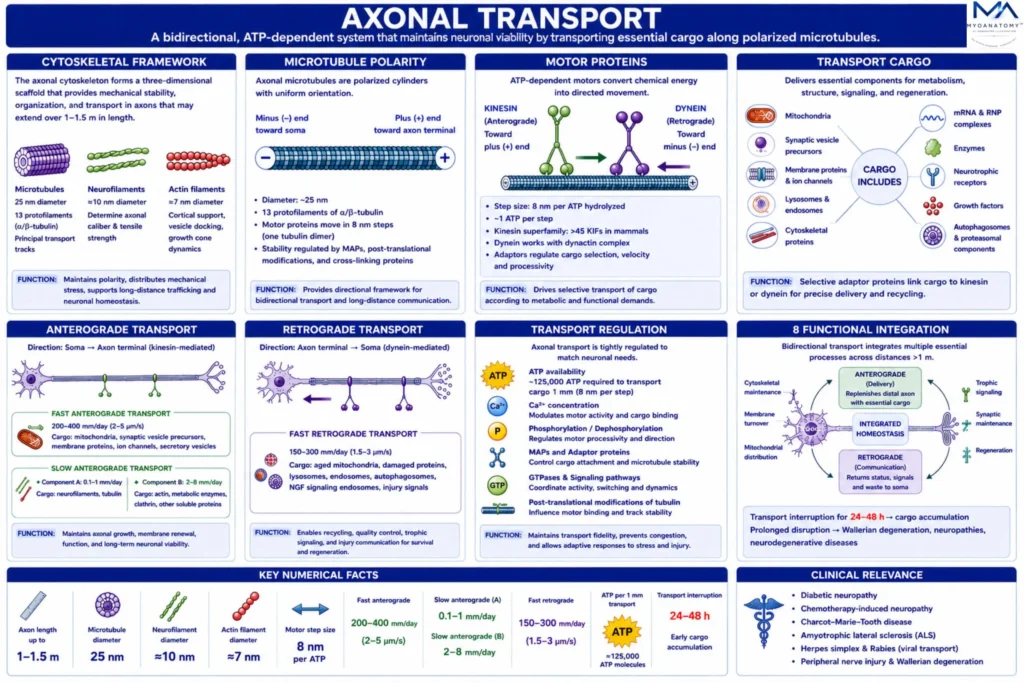
Axonal transport is a bidirectional, ATP-dependent process that enables the continuous movement of organelles, proteins, membrane components, and signaling complexes between the neuronal cell body and distal axon.
Transport occurs along polarized microtubules, whose plus (+) ends are oriented toward the axon terminal and minus (−) endstoward the soma, providing directional tracks for intracellular trafficking.
Movement is mediated primarily by kinesin(anterograde transport) and dynein (retrograde transport), with activity regulated by intracellular signaling pathways and cytoskeletal-associated proteins.
AI Generated Illustration MyoAnatomy.
Exam Question
How do microtubule polarity, ATP-dependent motor proteins, and bidirectional axonal transport collectively maintain neuronal polarity, synaptic function, long-distance cellular homeostasis, and peripheral nerve integrity?
ANATOMY
Cytoskeletal Framework
The axonal cytoskeleton forms a highly organized three-dimensional scaffold that provides mechanical stability, intracellular organization, and long-distance transport throughout peripheral nerve fibers, which may exceed 1–1.5 min length. This dynamic framework maintains structural integrity and continuous metabolic communication between the neuronal soma and distal axon.
It comprises 25 nm microtubules, 10 nm neurofilaments, and 7 nm actin microfilaments, each with distinct structural and functional roles.
Microtubules, formed by 13 protofilaments of α/β-tubulin dimers, constitute the principal ATP-dependent transport tracks; neurofilaments determine axonal caliber, tensile strength, and conduction efficiency; whereas actin microfilaments organize the cortical cytoskeleton, regulate growth-cone dynamics, and facilitate vesicle docking and membrane remodeling.
These cytoskeletal networks preserve neuronal polarity, maintain axonal architecture, distribute mechanical stress, and support continuous intracellular trafficking throughout the peripheral nervous system.
Exam Question
How does the ultrastructural organization of the axonal cytoskeleton integrate mechanical support, long-distance intracellular transport, and neuronal homeostasis?
Microtubule Polarity
Axonal microtubules are polarized cylindrical polymers composed of α- and β-tubulin heterodimers assembled into 13 protofilaments with an external diameter of approximately 25 nm.
Unlike dendrites, axons display uniform polarity, with plus (+) ends directed toward the distal axon and minus (−) ends toward the soma.
This organization establishes the directional framework for bidirectional intracellular trafficking. Kinesin and dynein advance in discrete 8 nm ATP-dependent steps, transporting cargo with remarkable precision along the microtubule lattice.
Transport efficiency is further regulated by microtubule-associated proteins (MAPs), tubulin post-translational modifications, and cross-linking proteins that stabilize the cytoskeleton during neuronal activity and regeneration.
Exam Question
How does microtubule polarity establish directional intracellular trafficking and maintain long-distance neuronal communication?
Motor Proteins
Axonal transport is powered by ATP-dependent molecular motors that convert chemical energy into directed movement along polarized microtubules. Each kinesin or dynein step hydrolyzes approximately 1 ATP molecule, producing an 8 nm displacement corresponding to one tubulin dimer.
Kinesin mediates anterograde transport toward the microtubule plus end, whereas cytoplasmic dynein, together with the dynactin complex, drives retrograde transport toward the minus end. The mammalian kinesin superfamily comprises more than 45 KIF proteins, each specialized for distinct intracellular cargo.
Motor proteins interact with adaptor proteins and signaling complexes that regulate cargo recognition, transport velocity, motor processivity, and intracellular distribution according to neuronal metabolic demands.
Exam Question
How do ATP-dependent motor proteins and adaptor complexes coordinate selective intracellular trafficking within peripheral nerve fibers?
Transport Cargo
Axonal transport delivers the molecular components required for neuronal metabolism, electrophysiological function, and regeneration. Cargo includes mitochondria, synaptic vesicle precursors, membrane proteins, ion channels, lysosomes, endosomes, autophagosomes, cytoskeletal proteins, mRNA, ribonucleoprotein complexes, enzymes, neurotrophic receptors, growth factors, and signaling endosomes.
Because mature axons may exceed 1 m in length and contain few ribosomes beyond the soma, nearly all structural proteins and membrane constituents require continuous transport. Selective adaptor proteins couple individual cargoes to kinesin or dynein, maintaining membrane renewal, ATP production, calcium homeostasis, protein turnover, and intracellular signaling.
Exam Question
How does selective cargo recognition maintain the metabolic, structural, and electrophysiological homeostasis of peripheral nerve fibers?
Anterograde Transport
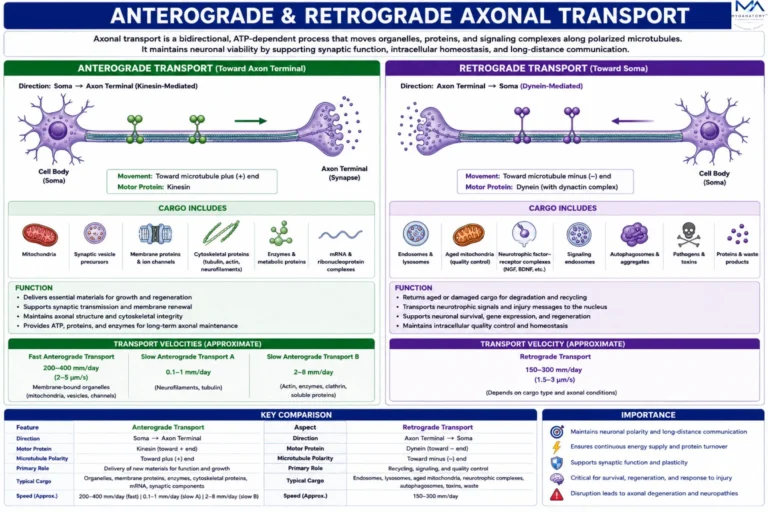
Anterograde transport conveys newly synthesized organelles and macromolecules from the neuronal soma to the distal axon through kinesin-mediated movement along polarized microtubules.
Fast anterograde transport proceeds at 200–400 mm/day (2–5 μm/s), delivering mitochondria, membrane proteins, ion channels, synaptic vesicle precursors, and secretory vesicles required for synaptic transmission.
Slow anterograde transport occurs in two components:
slow component A: 0.1–1 mm/day – primarily neurofilaments and tubulin
slow component B: 2–8 mm/day – actin, metabolic enzymes, clathrin, and other soluble proteins.
Together, these transport systems maintain axonal growth, membrane renewal, cytoskeletal integrity, and long-term neuronal function.
Exam Question
How do the distinct velocities and cargo compositions of fast and slow anterograde transport maintain peripheral nerve structure and function?
Retrograde Transport
Retrograde transport returns intracellular cargo from the distal axon to the neuronal soma through dynein-mediatedmovement at approximately 150–300 mm/day (1.5–3 μm/s).
This pathway removes aged mitochondria, damaged proteins, lysosomes, endosomes, and autophagosomes while transporting neurotrophic signaling endosomes containing receptors for NGF and other growth factors.
Following axonal injury, retrograde transport also conveys injury signals that activate transcriptional programs required for neuronal survival and regeneration.
Consequently, retrograde transport integrates intracellular recycling, trophic communication, quality control, and regenerative signaling into a unified homeostatic system.
Exam Question
How does retrograde transport integrate intracellular recycling, trophic signaling, and injury communication to regulate neuronal survival and regeneration?
Transport Regulation
Axonal transport is regulated by ATP availability, intracellular calcium, MAPs, cargo adaptor proteins, GTPases, phosphorylation-dependent signaling pathways, and post-translational tubulin modifications.
Motor proteins advance in repeated 8 nm ATP-dependent steps, and transport over 1 mm requires approximately 125,000 ATP molecules, highlighting the substantial metabolic demand of long-distance intracellular trafficking.
These regulatory mechanisms coordinate cargo attachment, transport velocity, directional switching, and motor activity according to neuronal metabolism and physiological stress.
Exam Question
How do intracellular signaling pathways regulate motor protein activity and transport dynamics to maintain efficient bidirectional axonal transport?
Functional Integration
Axonal transport is the principal intracellular homeostatic system linking the neuronal soma with distal targets over distances exceeding 1 m. Continuous bidirectional trafficking integrates cytoskeletal maintenance, membrane turnover, mitochondrial distribution, protein replacement, trophic signaling, synaptic maintenance, and regenerative responses into a unified transport network.
Fast anterograde transport continuously replenishes distal axons, whereas retrograde transport communicates metabolic status, trophic support, and injury signals back to the nucleus. Interruption of transport for only 24-48 hours results in distal cargo accumulation and organelle dysfunction, while prolonged impairment contributes to Wallerian degeneration, peripheral neuropathies, and neurodegenerative disease.
Exam Question
How does bidirectional axonal transport integrate structural maintenance, organelle homeostasis, intracellular signaling, and regenerative mechanisms to preserve long-term peripheral nerve function?
SUMMARY TABLE