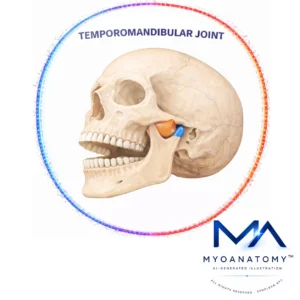
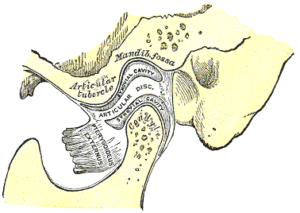
Although the majority of articulations within the skull are fibrous sutures and the cranial base contains temporary cartilaginous joints (synchondroses), a small number of true synovial joints exist within the craniofacial skeleton. These joints represent the only freely movable articulations of the skull, permitting localized motion necessary for several essential physiological processes.
Temporomandibular joint
CORE
Clinical Relevance
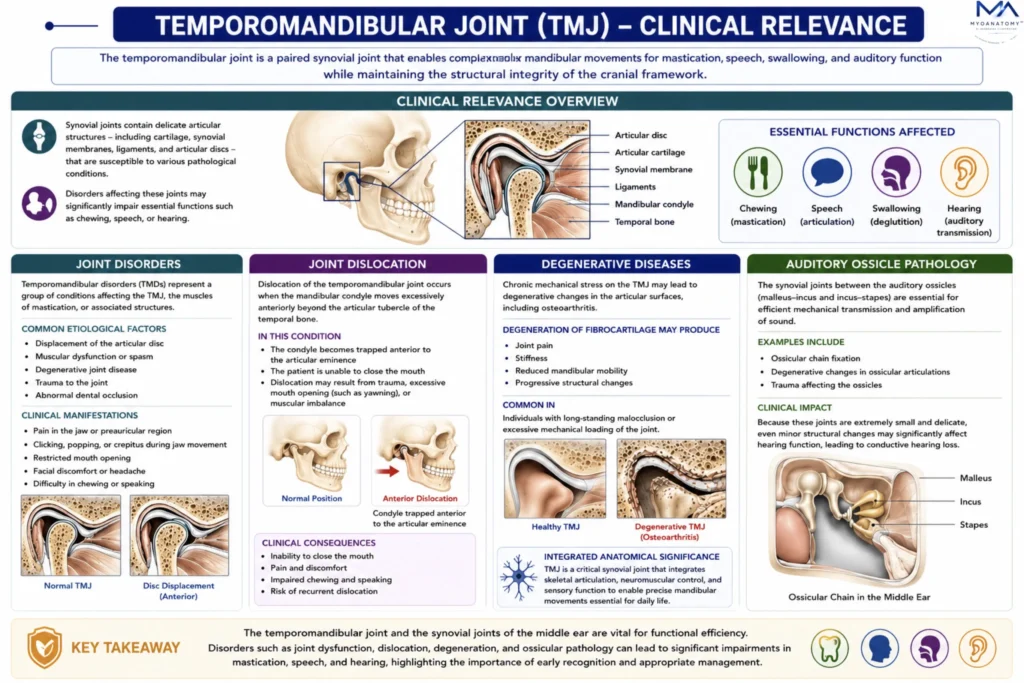
Because synovial joints contain delicate articular structures -including cartilage, synovial membranes, ligaments, and articular discs- they are susceptible to various pathological conditions.
Disorders affecting these joints may significantly impair essential functions such as chewing, speech, or hearing.

ANATOMY
Joint Disorders
Temporomandibular disorders represent a group of conditions affecting the TMJ, the muscles of mastication, or associated structures.
Common etiological factors include:
displacement of the articular disc
muscular dysfunction or spasm
degenerative joint disease
trauma to the joint
abnormal dental occlusion
Patients with Temporomandibular Joint may present
with symptoms such as:
pain in the jaw or preauricular region
clicking, popping, or crepitus during jaw movement
restricted mouth opening
headaches or facial pain
Because the TMJ shares innervation with other craniofacial structures through branches of the trigeminal nerve, pain may be referred to the ear, temporal region, or teeth.
Exam Question
Explain the pathophysiological and biomechanical mechanisms underlying temporomandibular joint disorders (TMDs), including the roles of disc displacement, muscular dysfunction, degenerative change, and abnormal occlusion in producing pain and impaired mandibular movement.
Joint Dislocation
Dislocation of the Temporomandibular Joint typically occurs when the mandibular condyle moves excessively anteriorly beyond the articular tubercle of the temporal bone.
In this condition:
the condyle becomes trapped anterior to the articular eminence
the patient is unable to close the mouth
Dislocation may result from trauma, excessive mouth opening (such as yawning), or muscular imbalance
Exam Question
Describe the anatomical and biomechanical basis of temporomandibular joint dislocation, emphasizing excessive anterior translation of the mandibular condyle beyond the articular eminence and its functional consequences.
Degenerative Diseases
Chronic mechanical stress on the TMJ may lead to degenerative changes in the articular surfaces, including osteoarthritis. Degeneration of the fibrocartilage may produce:
joint pain
stiffness
reduced mandibular mobility
Such changes are more common in individuals with long-standing malocclusion or excessive mechanical loading of the joint.
Exam Question
Discuss the mechanisms through which chronic mechanical stress and fibrocartilaginous degeneration contribute to osteoarthritic change within the temporomandibular joint and progressive impairment of mandibular biomechanics.
Auditory Ossicle Pathology
Examples include:
ossicular chain fixation
degenerative changes in ossicular articulations
trauma affecting the ossicles
Because the ossicular joints are extremely small and delicate, even minor structural changes may significantly affect hearing function.
Integrated Anatomical Significance
Synovial joints of the skull illustrate the functional specialization of the craniofacial skeleton. While most cranial bones are rigidly united to provide protection for the brain, the presence of carefully positioned synovial articulations introduces selective mobility within this otherwise immobile framework.
Through the temporomandibular joint and the ossicular joints of the middle ear, the skull integrates:
skeletal articulation; neuromuscular control; sensory function
These joints enable critical physiological processes –including mastication, speech, swallowing, and hearing -while preserving the structural stability required for protection of the central nervous system
Thus, synovial joints represent the dynamic functional components of the craniofacial skeleton, linking mechanical movement with sensory and neurological systems of the head.

Exam Question
Analyze the functional importance of the synovial articulations between the auditory ossicles and explain how fixation, degeneration, or trauma may disrupt mechanical sound transmission within the middle ear.
SUMMARY TABLE