Synovial Joint
MYO CORE
Biomechanics
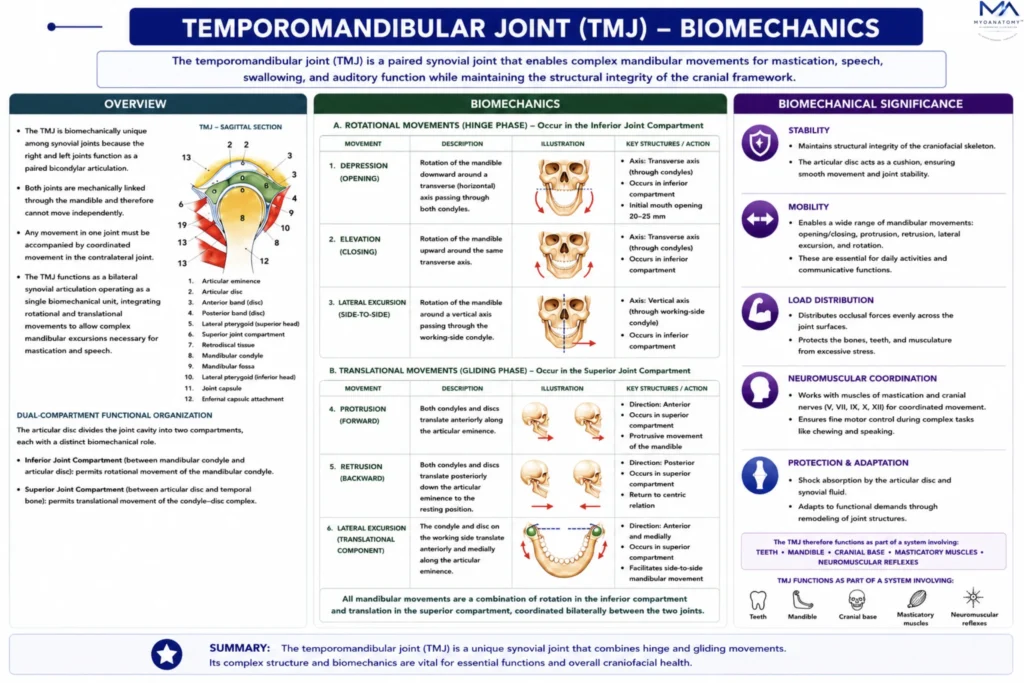
The temporomandibular joint is a unique paired bicondylar synovial articulation in which both joints function as a single biomechanical unit. Coordinated rotational and translational movements, guided by the articular disc and muscles of mastication, enable chewing, speech, swallowing, and occlusal stability while distributing mechanical loads across the craniofacial skeleton.
OVERVIEW
The temporomandibular joint (TMJ) is biomechanically unique among synovial joints because the right and left joints function as a paired bicondylar articulation. Both joints are mechanically linked through the mandible and therefore cannot move independently. Any movement occurring in one joint must be accompanied by coordinated movement in the contralateral joint.
The TMJ therefore functions as a bilateral synovial articulation operating as a single biomechanical unit, integrating rotational and translational movements to allow complex mandibular excursions necessary for mastication and speech.
Dual-Compartment Functional Organization
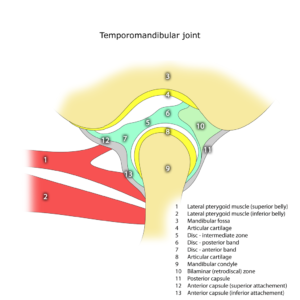
The presence of the articular disc divides the joint cavity into two compartments, each responsible for a different biomechanical mechanism.
Inferior Joint Compartment (between mandibular condyle and articular disc) – permits rotational movement of the mandibular condyle.
Superior Joint Compartment (between articular disc and temporal bone) permits translational movement of the condyle-disc complex.
This dual-compartment arrangement allows the TMJ to combine hinge mechanics and gliding mechanics, producing the wide range of mandibular motion required for functional activities.
MOVEMENTS
Rotational Movement
Hinge Phase
The first phase of mandibular opening occurs primarily through rotation of the mandibular condyle within the inferior joint compartment.
During this movement:
the condyle rotates beneath the articular disc
the disc remains relatively stationary within the mandibular fossa
the axis of rotation passes through both mandibular condyles
This rotational movement produces approximately 20–25 mm of mouth opening.
Mechanical Significance
This initial hinge motion allows rapid opening of the mouth with minimal displacement of the articular disc. The condylar rotation occurs around a transverse horizontal axis, permitting efficient early jaw movement during speech and swallowing.
Exam Question
“Explain the biomechanical sequence of rotational (hinge) movement within the temporomandibular joint, including the role of the inferior joint compartment, transverse condylar axis, condyle–disc relationship, and its functional significance during the initial phase of mandibular depression.”
Translational Movement
Gliding Phase
Further opening of the mouth requires anterior translation of the condyle-disc complex along the articular eminence of the temporal bone.
During this phase:
the condyle and articular disc move together
the entire complex glides anteriorly and inferiorly
the disc maintains contact with the articular tubercle
This movement occurs within the superior joint compartment and enables maximal mouth opening, which may reach 40–50 mm in healthy adults.
Mechanical Significance
Translation allows the mandible to move beyond the limitations of hinge motion, providing sufficient opening for:
mastication/ yawning
dental procedures
The articular eminence functions as a guiding surface, directing condylar movement and preventing posterior displacement of the mandible.
Integrated Condylar Movement
During normal mandibular opening:
- Rotation occurs first.
- Translation follows progressively.
- Both joints move simultaneously.
Exam Question
“Describe the biomechanics of translational movement in the temporomandibular joint, emphasizing anterior condylar translation along the articular eminence, superior joint compartment dynamics, coordinated disc-condyle motion, and the mechanical basis of maximal mandibular opening.”
MANDIBULAR KINEMATICS
Eleveation/Depression
Movement plane – Sagittal plane
Axis of movement – Transverse (horizontal) axis
Mechanism – during the early phase of mouth opening, the mandibular condyle rotates within the inferior compartment of the TMJ.
Depression – opening of the mouth
Elevation – closing of the mouth
The transverse axis passes through both mandibular condyles, allowing symmetrical hinge-like movement.
Muscular control
Depression:
lateral pterygoid; digastric
mylohyoid; geniohyoid
Elevation:
masseter; temporalis
medial pterygoid
Exam Question
“Analyze the kinesiological organization of mandibular elevation and depression in relation to sagittal-plane movement, transverse condylar axis mechanics, compartmental TMJ function, and coordinated muscular control during mastication and speech.”
Protrusion/Retraction
Movement plane – Horizontal (transverse) plane
Axis of movement – Primarily gliding without a fixed rotational axis
Mechanism – during protrusion, both mandibular condyles translate anteriorly along the articular eminence of the temporal bone within the superior joint compartment.
Protrusion – anterior displacement of the mandible
Retrusion – posterior return of the mandible to resting position
Muscular control
Protrusion:
lateral pterygoid; medial pterygoid
Retrusion:
posterior fibers of temporalis
deep part of masseter
Exam Question
“Discuss the anatomical and biomechanical mechanisms underlying mandibular protrusion and retrusion, including bilateral condylar translation, articular eminence guidance, horizontal-plane dynamics, and the integrated actions of the pterygoid, temporalis, and masseter muscles.”
Lateral Excursion
Movement plane – Horizontal plane
Axis of movement –Vertical axis passing through the working-side condyle
Mechanism-during lateral excursion:
the working-side condyle rotates around a vertical axis.
the contralateral condyle translates anteriorly and medially along the articular eminence.
This coordinated movement produces the grinding motion required during mastication.
Muscular control
ipsilateral temporalis and masseter stabilize the working side
contralateral pterygoid muscles drive translation
integrated Biomechanics
Because the mandible is a single bone articulating with the skull at two synovial joints, the TMJs function as a paired bicondylar joint system.
Consequently:
movement in one joint is always accompanied by movement in the other
rotational and translational movements occur simultaneously
mandibular motion occurs in multiple planes simultaneously
This complex biomechanics allows the TMJ to perform powerful chewing movements while maintaining precise control required for speech articulation.
Exam Question
“Explain the biomechanical basis of lateral excursion within the temporomandibular joint, including working-side condylar rotation, contralateral condylar translation, vertical-axis mechanics, and the coordinated muscular actions responsible for grinding movements during mastication.”
SUMMARY TABLE