Cartilaginous Joint
MYO CORE
Pubic Symphysis
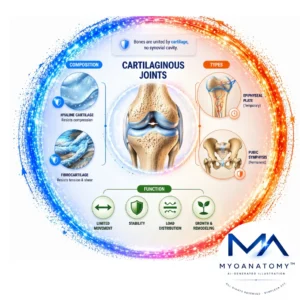
Symphyses are secondary cartilaginous joints in which adjacent bones are united by a fibrocartilaginous disc interposed between hyaline cartilage–covered articular surfaces. They are permanent articulations specialized for load transmission, combining high tensile strength with limited, controlled mobility, thereby forming semi-rigid, energy-dissipating interfaces in weight-bearing regions.
OVERVIEW
A symphysis consists of opposing bone surfaces covered by hyaline cartilage, connected by a central fibrocartilaginous disc rich in type I collagen fibers arranged in lamellar patterns to resist tensile and shear forces.
In structures such as the intervertebral disc, the annulus fibrosus forms concentric collagen layers with alternating fiber orientation, conferring multidirectional tensile resistance, while the nucleus pulposus, a proteoglycan-rich hydrated core, behaves as a hydrostatic unit that redistributes compressive loads radially.
Surrounding ligaments reinforce the joint, and the entire complex exhibits viscoelastic behavior, allowing deformation under load and recovery upon unloading.

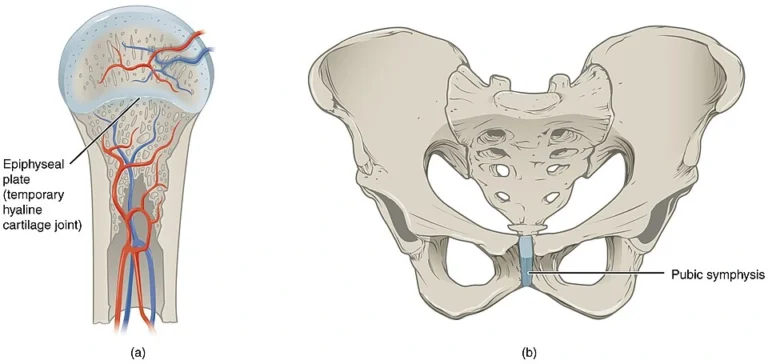
“Cartilaginous Joints” by OpenStax College, from Anatomy & Physiology, via Wikimedia Commons. Licensed under CC BY 3.0
How does the composite structural organization of a symphysis enable it to function as a stable load-transmitting articulation while simultaneously permitting controlled physiological mobility in weight-bearing regions of the skeleton?
Exam Question
ANATOMY
Structural Organization
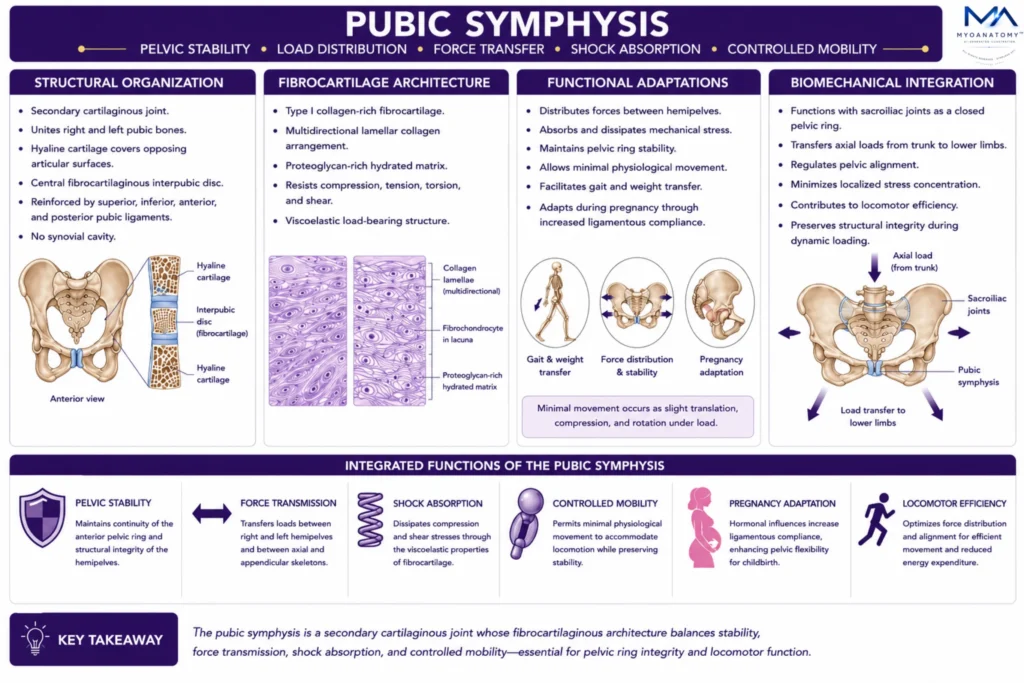
The pubic symphysis is a secondary cartilaginous joint uniting the right and left pubic bones. Opposing osseous surfaces are covered by hyaline cartilage and connected by a central fibrocartilaginous interpubic disc.
The joint lacks a synovial cavity and functions as a highly specialized anterior stabilizer of the pelvic ring. Strong superior, inferior, anterior, and posterior pubic ligaments reinforce the articulation and maintain skeletal continuity.
How does the structural organization of the pubic symphysis enable it to function as a mechanically stable secondary cartilaginous joint while maintaining continuity between the right and left hemipelves?
Exam Question
Fibrocartilage Architecture
The interpubic disc consists predominantly of type I collagen-rich fibrocartilage arranged in multidirectional lamellae.
Proteoglycan-rich extracellular matrix retains water, creating a viscoelastic structure capable of resisting compression, tension, torsion, and shear forces. This unique microarchitecture permits controlled deformation under load while preserving long-term structural integrity.
Analyze how the collagen composition, extracellular matrix organization, and viscoelastic properties of the interpubic fibrocartilaginous disc contribute to resistance against compressive, tensile, torsional, and shear stresses.
Exam Question
Functional Adaptions
The pubic symphysis functions as a load-distributing biomechanical interface between the two hemipelves. It absorbs and redistributes forces generated during standing, gait, running, and lifting while allowing minimal physiological motion.
This controlled mobility prevents stress concentration within the pelvic ring and contributes to efficient force transmission between the axial and appendicular skeletons.
Explain how the pubic symphysis balances pelvic stability with controlled physiological mobility, and discuss the biomechanical significance of this adaptation during weight-bearing and locomotion.
Exam Question
Biomechanical Integration
The pubic symphysis operates synergistically with the sacroiliac joints to form a closed pelvic stability system. During weight-bearing activities, compressive and rotational forces are dispersed throughout the pelvis, minimizing local overload.
In pregnancy, temporary increases in ligamentous compliance enhance pelvic adaptability while preserving overall mechanical stability. Consequently, the pubic symphysis serves as a critical regulator of pelvic alignment, force transfer, shock absorption, and locomotor efficiency.
Evaluate the functional relationship between the pubic symphysis and sacroiliac joints in maintaining pelvic ring integrity, force transmission, shock absorption, and efficient locomotor biomechanics.
Exam Question
SUMMARY TABLE