Cartilaginous Joint
MYO CORE
Synchondrosis
Synchondroses are primary cartilaginous joints in which adjacent bones are united by a continuous layer of hyaline cartilage, forming a structurally integrated, load-bearing interface without a synovial cavity.
OVERVIEW
They function predominantly as temporary developmental articulations, serving as essential growth centers that permit longitudinal skeletal expansion while preserving mechanical continuity and alignment between adjacent skeletal segments.
In a synchondrosis, articulating bone surfaces are connected by hyaline cartilage composed of type II collagen and a proteoglycan-rich matrix specialized for resistance to compressive forces.
In growth plates, this cartilage is organized into distinct zones of chondrocyte proliferation, hypertrophy, and matrix mineralization, driving endochondral ossification. With maturation, vascular invasion and ossification progressively replace cartilage with bone, resulting in synostosis.
The intrinsic stiffness of hyaline cartilage limits motion, ensuring structural stability during growth.

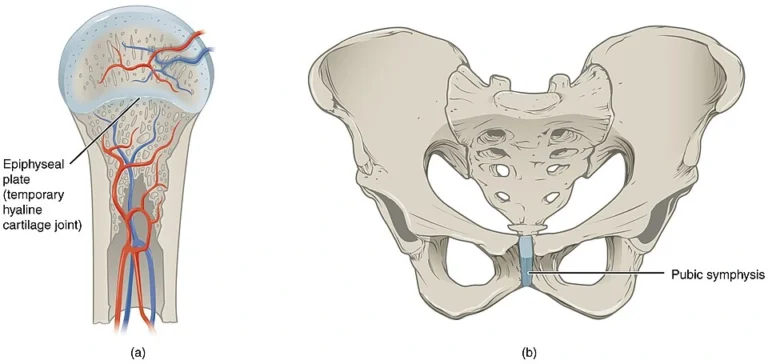
“Cartilaginous Joints” by OpenStax College, from Anatomy & Physiology, via Wikimedia Commons. Licensed under CC BY 3.0
How does the unique relationship between hyaline cartilage architecture, chondrocyte activity, and endochondral ossification enable a synchondrosis to function simultaneously as a developmental growth center and a mechanically stable skeletal articulation?
Exam Question
ANATOMY
Structural Organization
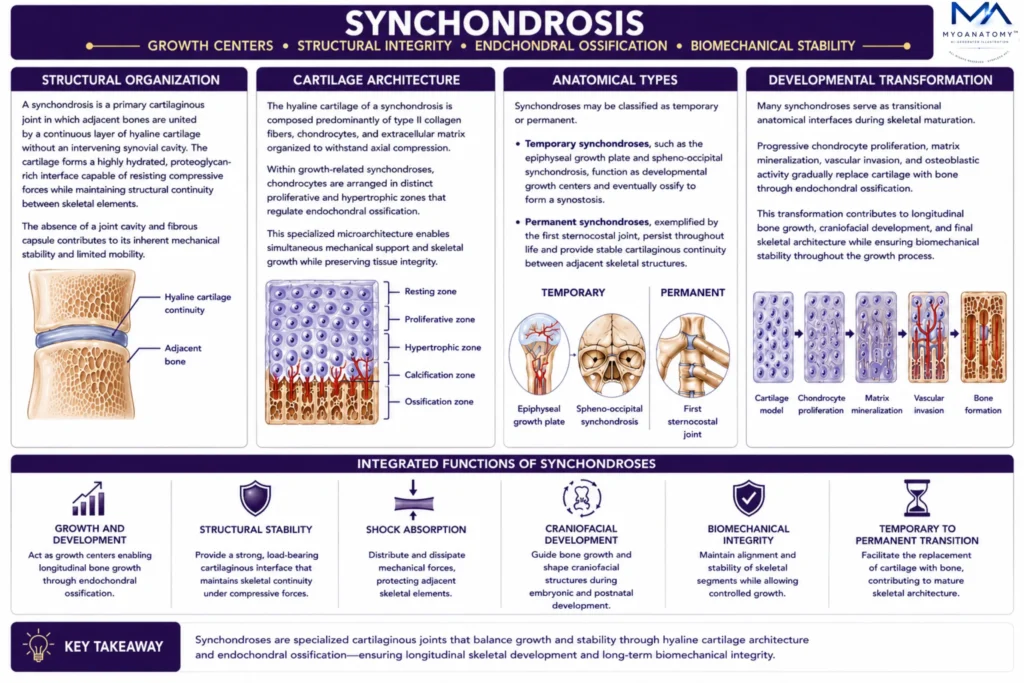
A synchondrosis is a primary cartilaginous joint in which adjacent bones are united by a continuous layer of hyaline cartilage without an intervening synovial cavity.
The cartilage forms a highly hydrated, proteoglycan-rich interface capable of resisting compressive forces while maintaining structural continuity between skeletal elements. The absence of a joint cavity and fibrous capsule contributes to its inherent mechanical stability and limited mobility.
How does the structural organization of a synchondrosis enable it to function as a mechanically stable cartilaginous articulation while maintaining continuity between adjacent skeletal elements?
Exam Question
Cartilage Architecture
The hyaline cartilage of a synchondrosis is composed predominantly of type II collagen fibers, chondrocytes, and extracellular matrix organized to withstand axial compression. Within growth-related synchondroses, chondrocytes are arranged in distinct proliferative and hypertrophic zones that regulate endochondral ossification.
This specialized microarchitecture enables simultaneous mechanical support and skeletal growth while preserving tissue integrity.
How do the cellular and extracellular matrix components of hyaline cartilage contribute to the compressive resistance, growth potential, and biomechanical behavior of a synchondrosis?
Exam Question
Anatomical Types
Synchondroses may be classified as temporary or permanent. Temporary synchondroses, such as the epiphyseal growth plate and spheno-occipital synchondrosis, function as developmental growth centers and eventually ossify to form a synostosis.
Permanent synchondroses, exemplified by the first sternocostal joint, persist throughout life and provide stable cartilaginous continuity between adjacent skeletal structures.
Compare temporary and permanent synchondroses in terms of anatomical structure, developmental significance, biomechanical function, and long-term skeletal contribution.
Exam Question
Development Transformation
Many synchondroses serve as transitional anatomical interfaces during skeletal maturation. Progressive chondrocyte proliferation, matrix mineralization, vascular invasion, and osteoblastic activity gradually replace cartilage with bone through endochondral ossification.
This transformation contributes to longitudinal bone growth, craniofacial development, and final skeletal architecture while ensuring biomechanical stability throughout the growth process.
How does endochondral ossification transform a developmental synchondrosis into a synostosis, and what is the significance of this process for skeletal growth and maturation?
Exam Question
SUMMARY TABLE