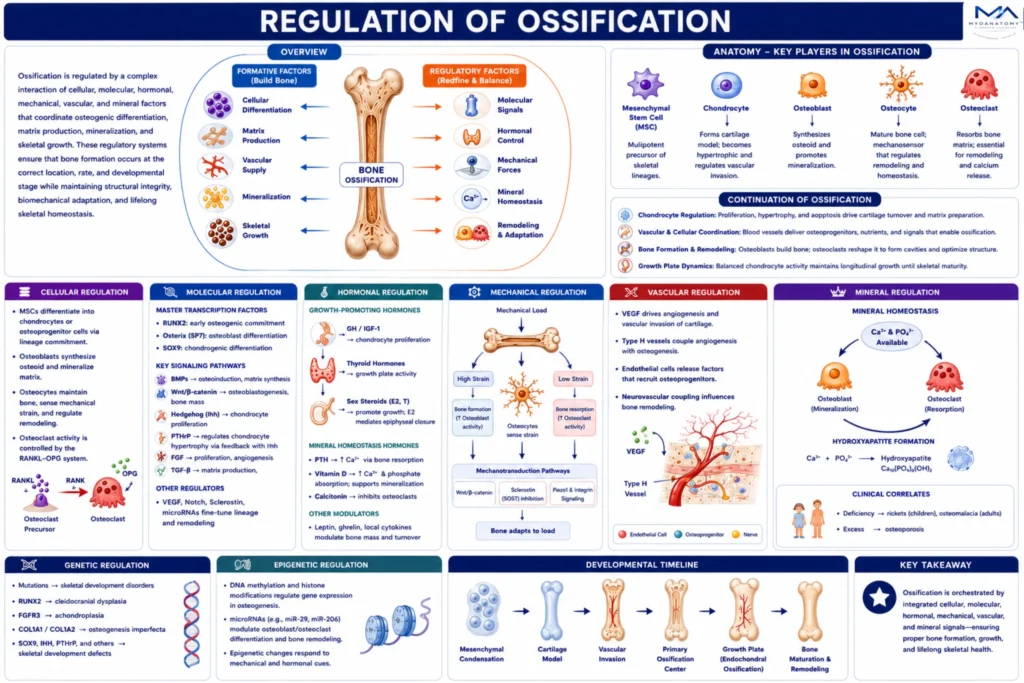
Bone Ossification
MYO CORE
Regulation of Ossification
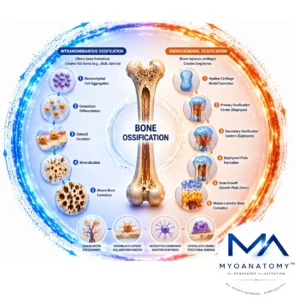
Ossification is regulated by a complex interaction of cellular, molecular, hormonal, mechanical, vascular, and mineral factors that coordinate osteogenic differentiation, matrix production, mineralization, and skeletal growth. These regulatory systems ensure that bone formation occurs at the correct location, rate, and developmental stage while maintaining structural integrity, biomechanical adaptation, and lifelong skeletal homeostasis.
OVERVIEW
Regulation of ossification is governed by an integrated network of cellular, molecular, hormonal, mechanical, vascular, and mineral factors that coordinate skeletal development from embryonic mesenchyme to mature bone.
Through precise interactions among osteogenic cells, signaling pathways, endocrine regulators, biomechanical stimuli, angiogenic mechanisms, and mineral homeostasis systems, bone formation is initiated, guided, mineralized, remodeled, and adapted throughout life.
This highly coordinated regulatory framework ensures accurate skeletal patterning, controlled growth plate activity, appropriate ossification center development, optimal biomechanical strength, and lifelong maintenance of skeletal structure and function while preserving calcium-phosphate homeostasis and tissue integrity.
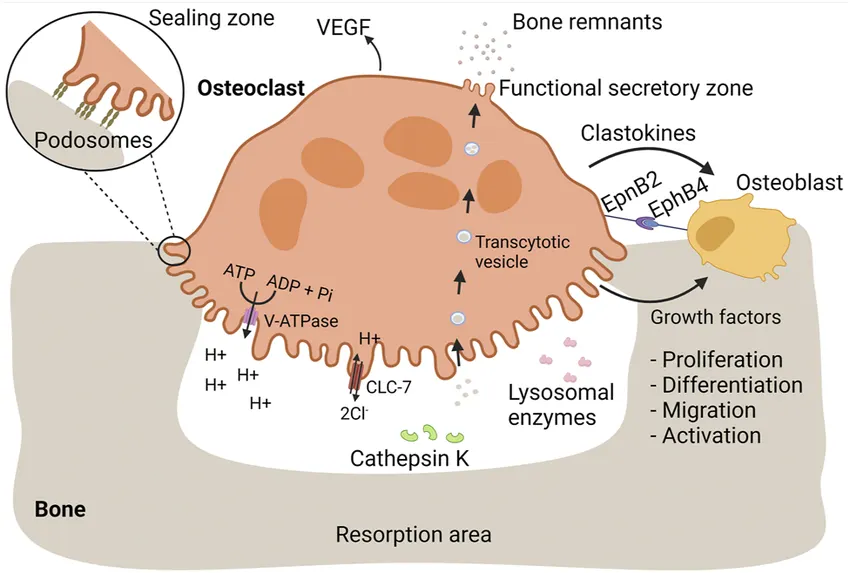
“Osteoclasts Mediate Bone Resorption and Proper Bone Replacement by Osteoblasts” – Ahmadzadeh K. et al. (2022) via Wikimedia Commons. Licensed under CC BY 4.0.
Exam Question
How do cellular, molecular, hormonal, mechanical, vascular, and mineral regulatory mechanisms integrate to coordinate osteogenic differentiation, matrix mineralization, skeletal growth, biomechanical adaptation, and lifelong bone homeostasis during ossification?
ANATOMY
Celular Regulation
Cellular regulation of ossification is driven by a hierarchically organized network of skeletal cells that controls lineage commitment, cartilage development, osteogenesis, matrix mineralization, mechanoadaptation, and tissue remodeling.
Mesenchymal stem cells establish osteogenic and chondrogenic lineages; chondrocytes regulate cartilage maturation and skeletal growth; osteoprogenitor cells sustain osteogenic potential; osteoblasts generate and mineralize bone matrix; osteocytes integrate mechanical and metabolic signals; and osteoclasts sculpt, renew, and optimize skeletal architecture.
Through tightly coupled cellular communication, these populations coordinate the formation, maturation, adaptation, and lifelong maintenance of skeletal tissue.
Exam Question
How does the hierarchical interaction of osteogenic, chondrogenic, mechanosensory, and resorptive cell populations coordinate ossification, skeletal maturation, and lifelong bone homeostasis?
Molecular Regulation
Molecular regulation of ossification is controlled by an interconnected network of transcription factors, growth factors, and signaling pathways that direct skeletal cell differentiation, cartilage maturation, osteogenesis, angiogenesis, and matrix mineralization.
RUNX2 and Osterix govern osteogenic lineage commitment, BMPs initiate osteoinduction, Wnt/β-catenin signaling promotes osteoblast differentiation and bone formation, while IHH and PTHrP coordinate growth plate development and chondrocyte maturation. VEGF regulates vascular invasion essential for skeletal tissue formation.
Together, these molecular pathways synchronize the transition from embryonic mesenchyme to mature bone, ensuring precise control of skeletal development, growth, and ossification.
Exam Question
How do transcriptional regulators, osteogenic signaling pathways, and angiogenic factors integrate to coordinate skeletal differentiation, growth plate maturation, and bone formation during ossification?
Hormonal Regulation
Hormonal regulation of ossification integrates skeletal development with systemic growth, mineral metabolism, and physiological maturation.
Growth hormone, IGF-1, thyroid hormones, estrogen, testosterone, parathyroid hormone, calcitonin, and vitamin D collectively regulate chondrocyte proliferation, osteoblast differentiation, matrix mineralization, growth plate activity, and calcium-phosphate homeostasis.
Through coordinated endocrine signaling, these hormones control the rate, timing, and extent of bone formation while ensuring normal skeletal growth, maturation, and mineralized tissue development.
Exam Question
How do endocrine regulators coordinate skeletal growth, growth plate maturation, mineral homeostasis, and bone formation during ossification?
Mechanical Regulation
Mechanical regulation of ossification enables skeletal development and growth to adapt continuously to functional demands and biomechanical forces.
Through mechanotransduction, skeletal cells detect mechanical loading, strain, compression, and muscle-generated forces, converting these stimuli into biological signals that regulate cellular differentiation, matrix production, mineralization, and bone formation.
By aligning skeletal architecture with mechanical requirements, this regulatory system optimizes structural strength, load distribution, and biomechanical efficiency throughout development and maturation.
Exam Question
How does mechanotransduction coordinate cellular activity and bone formation to adapt skeletal architecture to functional and biomechanical demands during ossification?
Vascular Regulation
Vascular regulation couples angiogenesis with osteogenesis to direct the progression of ossification. Central to this process is VEGF, produced primarily by hypertrophic chondrocytes and osteogenic cells, which stimulates vascular invasion of developing skeletal tissue.
These vessels deliver oxygen, nutrients, mineral substrates, osteoprogenitor cells, osteoclast precursors, and regulatory growth factors while coordinating chondrocyte maturation, matrix remodeling, and osteogenic differentiation.
Through VEGF-mediated angiogenesis and endothelial-skeletal cell signaling, vascular regulation governs ossification center formation and the transformation of avascular templates into mature skeletal tissue.
Exam Question
How does VEGF-mediated angiogenesis coordinate vascular invasion, osteogenic cell recruitment, chondrocyte maturation, and ossification center formation during skeletal development?
Mineral Regulation
Mineral regulation governs the availability and incorporation of calcium and phosphate required for skeletal mineralization. Through the Vitamin D–PTH axis, mineral homeostasis is maintained to support the formation of hydroxyapatite crystals, which transform osteoid into rigid, load-bearing bone.
By regulating mineral availability, crystal deposition, and matrix mineralization, this system ensures normal ossification, skeletal strength, growth plate function, and biomechanical competence.
Exam Question
How does the Vitamin D–PTH axis regulate calcium-phosphate homeostasis and hydroxyapatite formation to ensure successful skeletal mineralization during ossification?
SUMMARY TABLE