Brachial Plexus
MYO CORE
Innervation
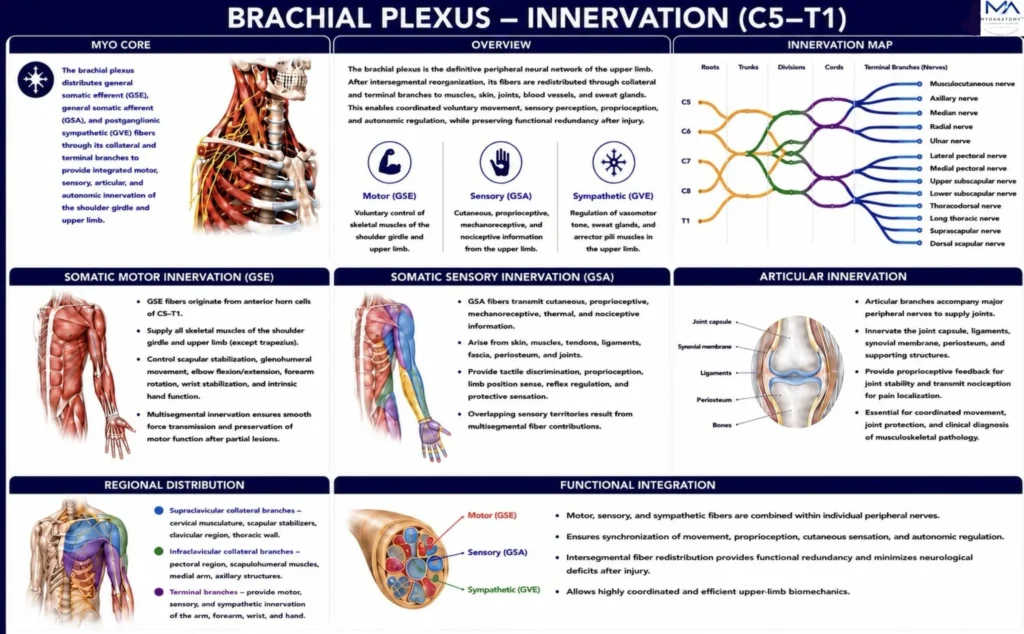
The brachial plexus constitutes the principal neural distribution network of the upper limb, redistributing general somatic efferent (GSE), general somatic afferent (GSA), and postganglionic sympathetic general visceral efferent (GVE) fibers from the anterior (ventral) rami of C5-Th1 into collateral and terminal peripheral nerves, thereby establishing integrated motor, sensory, articular, and autonomic innervation of the shoulder girdle and upper extremity.
OVERVIEW
The innervation pattern of the brachial plexus represents the definitive peripheral redistribution of segmental spinal nerve fibers following their hierarchical reorganization within the plexus.
Through extensive intersegmental integration, individual peripheral nerves contain axons derived from multiple spinal cord segments rather than a single spinal root, enabling coordinated neuromuscular activation, overlapping sensory representation, proprioceptive regulation, and sympathetic autonomic control throughout the upper extremity.
This multisegmental organization optimizes upper-limb biomechanics, provides functional redundancy following partial neural injury, and forms the anatomical basis for accurate neurological localization, electrodiagnostic interpretation, and surgical reconstruction of brachial plexus and peripheral nerve lesions.
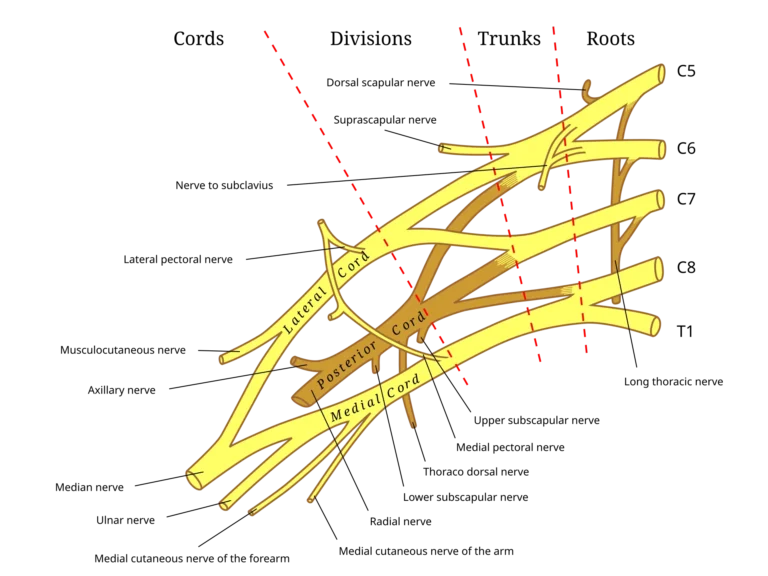
Source: Gray’s Anatomy (1918), illustration by Henry Vandyke Carter. Vector adaptation by Mattopaedia and MissMJ via Wikimedia Commons. Public Domain.
Exam Question
How does the hierarchical redistribution of segmental spinal nerve fibers within the brachial plexus establish multisegmental peripheral innervation, and why is this organization fundamental for coordinated upper-limb biomechanics, neurological resilience, and clinical localization of brachial plexus and peripheral nerve lesions?
ANATOMY
Somatic Motor Innervation
General somatic efferent (GSE) fibers originate from motor neurons within the anterior horn of spinal cord segments C5- Th1 and are redistributed through the brachial plexus to innervate nearly all skeletal muscles of the shoulder girdle and upper limb, excluding the trapezius.
Through collateral and terminal branches, these fibers coordinate scapular stabilization, glenohumeral movement, elbow flexion and extension, forearm pronation and supination, wrist stabilization, digital movement, and the highly specialized intrinsic functions of the hand.
Multisegmental motor innervation ensures smooth force transmission, coordinated muscle recruitment, and preservation of function despite partial segmental injury.
Exam Question
How does multisegmental redistribution of GSE fibers within the brachial plexus optimize coordinated upper-limb movement and preserve motor function following partial root lesions?
Somatic Sensory Innervation
General somatic afferent (GSA) fibers convey cutaneous, proprioceptive, mechanoreceptive, thermal, and nociceptive information from the skin, fascia, muscles, tendons, ligaments, periosteum, and joints of the upper limb.
Sensory fibers are distributed through overlapping peripheral nerve territories, continuously transmitting afferent information required for tactile discrimination, limb position sense, movement accuracy, reflex regulation, and protective sensory responses.
Integration of multiple spinal segments enhances sensory reliability and explains the overlapping dermatomal and peripheral nerve sensory patterns observed clinically.
Exam Question
Why does the multisegmental organization of GSA fibers produce overlapping sensory deficits rather than complete anesthesia after isolated peripheral nerve injury?
Articular Innervation
Articular branches derived from the brachial plexus accompany major peripheral nerves to supply the glenohumeral, acromioclavicular, elbow, radioulnar, wrist, carpometacarpal, metacarpophalangeal, and interphalangeal joints.
These fibers innervate the joint capsule, synovial membrane, periosteum, supporting ligaments, and adjacent osseous structures, providing proprioceptive feedback for dynamic joint stability while transmitting nociceptive stimuli associated with inflammation, instability, degeneration, and traumatic injury.
Articular innervation is fundamental for coordinated movement, joint protection, and musculoskeletal pain localization.
Exam Question
How does articular innervation integrate proprioception and nociception to maintain joint stability while facilitating clinical localization of upper-limb pathology?
Regional Distribution
The brachial plexus supplies virtually the entire upper limb through a precisely organized regional distribution.
Supraclavicular collateral branches primarily innervate the cervical musculature, scapular stabilizers, clavicular region, and thoracic wall.
Infraclavicular collateral branches supply the pectoral region, scapulohumeral musculature, medial arm, and axillary structures.
Terminal branches extend distally to provide comprehensive motor, sensory, and sympathetic innervation of the arm, forearm, wrist, and hand. This proximodistal organization establishes continuous neural integration from the cervical spinal cord to the distal digits.
Exam Question
How does the regional distribution of supraclavicular, infraclavicular, and terminal branches facilitate anatomical localization of brachial plexus lesions?
Functional Integration
The brachial plexus functions as an integrated neurofunctional network in which motor (GSE), sensory (GSA), and sympathetic (GVE) fibers are combined within individual peripheral nerves before reaching their target tissues.
This hierarchical organization synchronizes voluntary movement, proprioceptive feedback, cutaneous sensation, autonomic vascular regulation, and coordinated muscular activation across the upper limb.
Intersegmental fiber redistribution provides functional redundancy, minimizes neurological deficits following partial injuries, and permits highly coordinated execution of complex upper-limb movements.
Exam Question
Why is functional integration of GSE, GSA, and GVE fibers within individual peripheral nerves essential for normal upper-limb biomechanics and neurological resilience?
Segmental Organization
The innervation of the brachial plexus preserves the segmental identity of C5 – T1 fibers while redistributing them through multisegmental peripheral nerves.
Consequently, individual muscles, cutaneous territories, and joints receive overlapping contributions from multiple spinal cord segments rather than a single root.
This segmental organization provides coordinated neuromuscular recruitment, overlapping sensory representation, functional redundancy, and characteristic patterns of motor and sensory deficit that form the anatomical basis for neurological localization and interpretation of upper-limb innervation.
Exam Question
How does the segmental organization of the brachial plexus preserve spinal root identity while establishing multisegmental peripheral innervation, and why is this organization fundamental for neurological localization and coordinated upper-limb function?
SUMMARY TABLE