Fibrous Joint
MYO CORE
Sutures
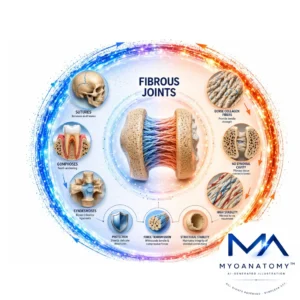
Sutures are specialized fibrous joints that unite adjacent cranial bones through dense connective tissue. They function as growth sites, force-distribution interfaces, and stabilizing articulations that permit cranial expansion during development while maintaining structural integrity and protecting the brain throughout life.
OVERVIEW
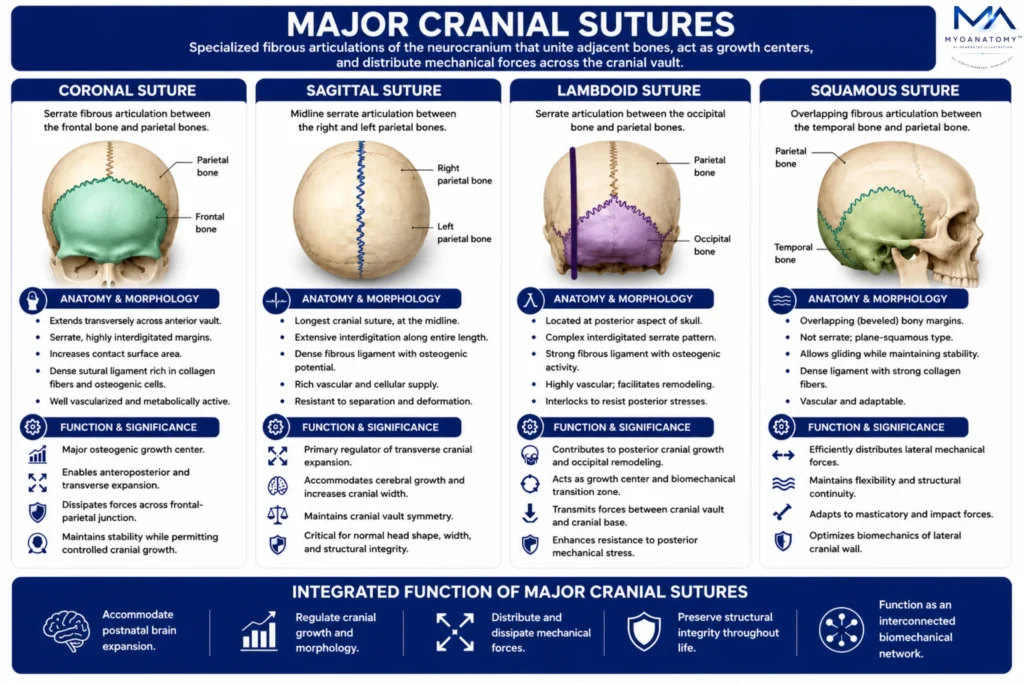
The major cranial sutures are specialized fibrous articulations that unite adjacent bones of the neurocranium through biologically active connective tissue interfaces.
Composed of opposing cranial bone fronts, a dense fibrous sutural ligament, osteogenic cells, vascular networks, extracellular matrix components, and molecular regulatory systems, they function as dynamic growth centers and biomechanical interfaces rather than passive junctions. Their morphology ranges from simple to highly interdigitated configurations, enhancing mechanical interlocking, force distribution, and resistance to displacement.
Collectively, the coronal, sagittal, lambdoid, and squamous sutures form an integrated network that accommodates postnatal brain expansion, regulates cranial growth and morphology, dissipates mechanical stresses across the cranial vault, and preserves structural integrity throughout development and adulthood.

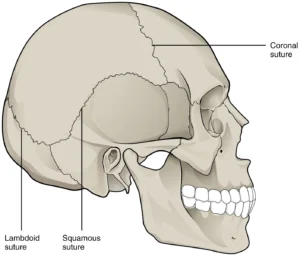
“Skull Sutures” – OpenStax College, Anatomy & Physiology (Connexions Web Site) via Wikimedia Commons. Licensed under CC BY 3.0.
Exam Question
How do major cranial sutures balance cranial expansion with biomechanical stability during development and adulthood?
ANATOMY
Coronal Suture
The coronal suture is a highly interdigitated serrate articulation between the frontal and parietal bones that functions as a major osteogenic growth center of the anterior neurocranium.
By maintaining a biologically active interface between adjacent bones, it accommodates rapid cerebral expansion during development while regulating frontal and parietal growth.
Its complex morphology increases contact surface area, enhances mechanical interlocking, and dissipates stresses generated across the cranial vault, thereby balancing developmental expansion with structural stability.
Exam Question
How does the coronal suture integrate osteogenic growth activity with biomechanical force dissipation to regulate anterior cranial development?
Sagital Suture
The sagittal suture is the principal midline articulation of the neurocranium, joining the paired parietal bones through an extensive serrate interface.
As the longest cranial suture, it serves as a dominant growth site for transverse expansion of the cranial vault in response to increasing cerebral volume.
Its highly interdigitated architecture provides resistance to separation and deformation while permitting coordinated enlargement of the neurocranium, making it a critical regulator of cranial shape, width, and structural integrity.
Exam Question
Why is the sagittal suture considered the primary regulator of transverse neurocranial growth and cranial vault morphology?
Lambdoid Suture
The lambdoid suture is a complex serrate articulation between the occipital and parietal bones that contributes to posterior cranial growth and remodeling.
Positioned at the junction between the cranial vault and occipital region, it functions as both a growth center and a biomechanical transition zone.
Its intricate interdigitations enhance resistance to posterior mechanical stresses while facilitating coordinated expansion of the occipital portion of the neurocranium during development.
Exam Question
How does the lambdoid suture function as both a posterior cranial growth center and a biomechanical stabilizer of the occipital region?
Squamous Suture
The squamous suture is a specialized overlapping articulation between the temporal and parietal bones characterized by beveled bony margins rather than serrated interlocking surfaces.
This unique morphology allows efficient transmission and dissipation of lateral cranial forces while preserving flexibility along the lateral cranial wall.
By combining structural continuity with adaptive force distribution, the squamous suture accommodates the complex biomechanical demands generated by mastication, cranial loading, and lateral impact forces.
Exam Question
How does the distinctive overlapping architecture of the squamous suture optimize lateral force transmission and biomechanical adaptation within the cranial vault?
SUMMARY TABLE