Fibrous Joint
MYO CORE
Gomphosis
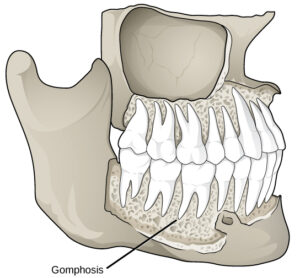
A gomphosis is a specialized dentoalveolar fibrous joint in which a tooth is suspended within its alveolar socket by the periodontal ligament rather than directly fused to bone. This unique structural arrangement combines exceptional stability with microscopic physiological mobility, allowing efficient shock absorption, force redistribution, proprioceptive feedback, and adaptive remodeling.
OVERVIEW
A gomphosis is the only fibrous joint specifically designed for tooth-to-bone attachment. It forms a peg-and-socket articulation in which the tooth root is anchored within the alveolar socket of the maxilla or mandible by the periodontal ligament.
Unlike rigid skeletal unions, the tooth is suspended rather than fused to surrounding bone, permitting microscopic physiological movement under functional loading. This specialized organization enables the joint to withstand repetitive compressive, tensile, and shear forces generated during mastication while preserving precise dental alignment.
Consequently, the gomphosis functions as a biologically active and mechanically adaptive articulation that integrates stability, shock absorption, sensory feedback, and continuous structural remodeling.
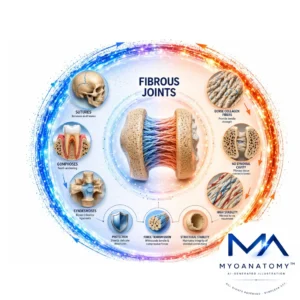
“Gomphosis” – CNX OpenStax Biology via Wikimedia Commons. Licensed under CC BY 4.0
Exam Question
How does the unique tooth–periodontal ligament–alveolar bone complex enable the gomphosis to maintain dental stability while simultaneously providing shock absorption, proprioceptive feedback, adaptive remodeling, and resistance to repetitive masticatory loading?
ANATOMY
Tooth Root
The tooth root forms the primary anchoring component of the gomphosis and is covered by cementum, a specialized mineralized connective tissue that serves as the insertion site for periodontal ligament fibers.
Rather than establishing direct osseous fusion, the root remains suspended within the alveolus through collagenous attachments, creating a stable yet mechanically responsive interface.
This arrangement permits microscopic physiological displacement under functional loading while preserving precise tooth alignment and occlusal integrity.
Exam Question
How does the cementum-covered tooth root function as a biomechanically responsive anchoring structure, and why is suspension within the alveolus superior to direct osseous fusion for maintaining long-term dental function?
Alveolar Socket
The alveolar socket (alveolus) is a specialized osseous recess of the maxilla or mandible that houses the tooth root and forms the skeletal component of the articulation.
Its inner surface, the alveolar bone proper, provides attachment for periodontal ligament fibers and undergoes continuous remodeling in response to masticatory forces, eruption dynamics, and orthodontic adaptation.
Consequently, the socket functions not merely as a passive receptacle but as a biologically active structure that contributes to long-term mechanical stability.
Exam Question
How does continuous remodeling of the alveolar socket contribute to load adaptation, periodontal stability, and preservation of tooth support throughout life?
Periodontal Ligament
The periodontal ligament (PDL) is the principal fibrous element of the gomphosis and the key determinant of its biomechanical behavior.
Composed predominantly of highly organized type I collagen fibers, it extends between cementum and alveolar bone, forming a specialized suspensory apparatus that stabilizes the tooth while permitting controlled physiological mobility.
Rich vascular, cellular, and neural networks enable the ligament to function as a shock absorber, force distributor, proprioceptive organ, and adaptive remodeling interface. Through these combined mechanical and biological roles, the PDL transforms the gomphosis from a simple attachment into a dynamic load-regulating articulation.
Exam Question
How does the unique cellular, vascular, neural, and collagenous architecture of the periodontal ligament transform the gomphosis from a static attachment into a dynamic load-regulating articulation?
Cementum
Cementum is a specialized avascular mineralized connective tissue that covers the root surface and forms the primary attachment substrate for periodontal ligament fibers.
Through insertion of Sharpey’s fibers, it establishes a secure mechanical linkage between the tooth and surrounding alveolar bone. Unlike bone, cementum is resistant to physiological resorption and undergoes continuous deposition throughout life, thereby maintaining periodontal attachment, compensating for occlusal wear, and contributing to the long-term structural stability of the gomphosis.
Exam Question
How does cementum function as the biological attachment interface of the gomphosis, and what role does its lifelong appositional growth play in maintaining periodontal integrity and tooth stability?
Alveolar Bone Proper
The alveolar bone proper is the specialized compact bone lining the alveolar socket and forming the osseous attachment site for periodontal ligament fibers.
As the skeletal component of the gomphosis, it receives and redistributes functional loads transmitted through the periodontal ligament while undergoing continuous remodeling in response to masticatory forces, eruption, and orthodontic movement.
This adaptive capacity enables maintenance of skeletal support and biomechanical integrity throughout life.
Exam Question
How does the alveolar bone proper integrate force transmission, adaptive remodeling, and structural support within the gomphotic articulation?
Periodontal Fibers
The periodontal fibers groups constitute the principal structural framework of the gomphosis.
Organized into alveolar crest, horizontal, oblique, apical, and interradicular fibers, these collagen bundles connect cementum to alveolar bone and are strategically oriented to resist specific mechanical stresses.
Collectively, they stabilize the tooth against displacement, distribute occlusal forces, and transform the periodontal ligament into a highly efficient suspensory and shock-absorbing system capable of maintaining tooth position during functional loading.
Exam Question
How does the specialized organization of periodontal fiber groups provide multidirectional stabilization, force distribution, and biomechanical resilience within the gomphosis?
SUMMARY TABLE