Fibrous Joint

MYO CORE

Syndesmoses

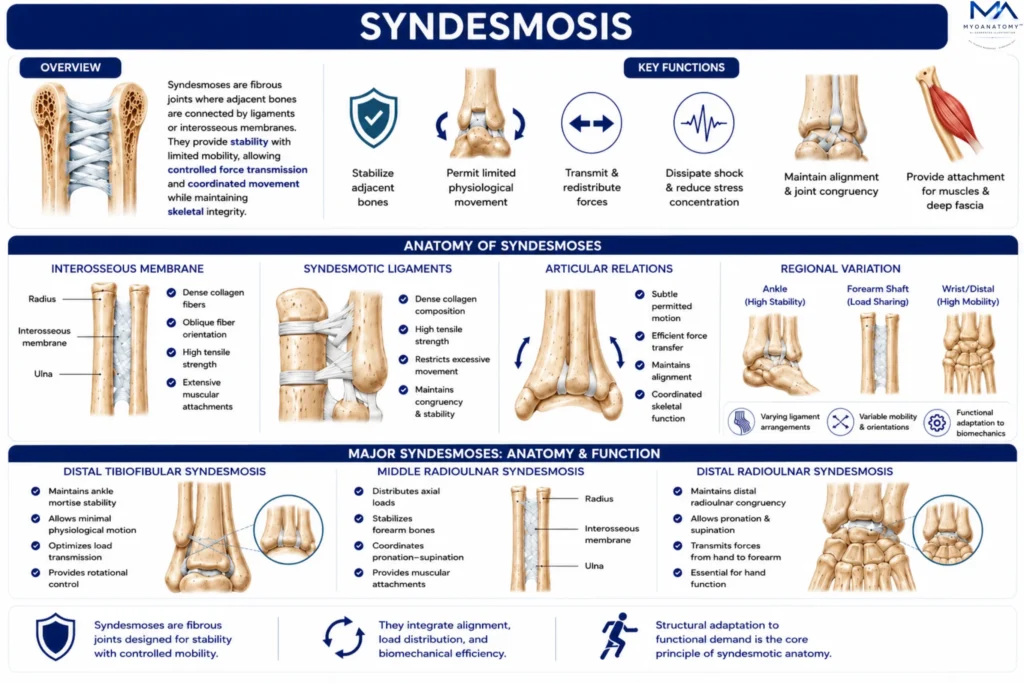
Syndesmoses are specialized fibrous joints in which adjacent bones are united by ligaments or interosseous membranes rather than direct bony contact. They provide a biomechanical balance between stability and limited mobility, allowing controlled force transmission, shock distribution, and coordinated movement while maintaining skeletal integrity. 

OVERVIEW

A syndesmosis is a specialized fibrous joint in which adjacent bones are united by dense connective tissue, typically organized as syndesmotic ligaments or an interosseous membrane. Unlike rigid fibrous articulations, syndesmoses permit limited physiological movement that enhances functional flexibility while preserving skeletal stability. 

Their structural organization creates a dynamic biomechanical interface capable of transmitting, distributing, and regulating compressive, tensile, rotational, and shear forces between adjacent skeletal elements. The degree of mobility is determined by the architecture, orientation, composition, and elasticity of the connecting tissues, allowing adaptation to region-specific mechanical demands. 

Consequently, syndesmoses function as specialized load-sharing systems that integrate skeletal alignment, controlled mobility, force transmission, and biomechanical efficiency throughout the musculoskeletal system.

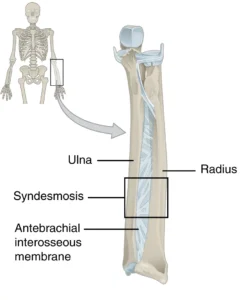
“Syndesmosis (Antebrachial Interosseous Membrane)” – OpenStax College, Anatomy & Physiology (Connections Web Site) via Wikimedia Commons. Licensed under CC BY 3.0.

Exam Question

How does the structural organization of a syndesmosis optimize controlled mobility, force transmission, skeletal stability, and biomechanical adaptation within the musculoskeletal system?

ANATOMY

Interosseous Membrane

The interosseous membrane is the principal fibrous component of many syndesmoses, connecting adjacent long bones through highly organized collagen fibers. 

It functions as a dynamic load-sharing interface that maintains alignment, facilitates force transmission, coordinates skeletal movement, and provides extensive muscular attachment while permitting controlled physiological mobility.

Exam Question

How does the architecture of the interosseous membrane optimize force transmission, skeletal stability, and coordinated movement between adjacent bones?

Syndesmotic Ligaments

Syndesmotic ligaments are dense collagenous structures that reinforce fibrous articulations and regulate the magnitude and direction of permitted movement. 

By resisting excessive separation, rotation, and displacement, they maintain anatomical congruency while balancing flexibility with biomechanical stability during functional loading.

Exam Question

How do syndesmotic ligaments preserve joint stability while permitting the controlled mobility required for normal biomechanics?

Articular Relations

The articular relations of a syndesmosis define the functional interaction between adjacent bones connected by fibrous tissue. 

These relationships permit subtle physiological motion, facilitate efficient force transfer, and maintain skeletal alignment, allowing connected bones to function as a coordinated biomechanical unit.

Exam Question

How do articular relations within a syndesmosis integrate force transfer, alignment, and coordinated skeletal function?

Regional Variation

Regional variation in syndesmotic anatomy reflects adaptation to specific biomechanical demands. 

Differences in ligament arrangement, membrane structure, collagen orientation, and permitted mobility allow each syndesmosis to optimize stability, force distribution, and movement according to its anatomical location and functional role.

Exam Question

How do regional variations in syndesmotic architecture reflect adaptation to distinct biomechanical and functional requirements?

TYPES

Distal Radioulnar Syndesmosis

The distal radioulnar syndesmosis stabilizes the distal relationship between the radius and ulna while permitting the rotational movements required for pronation and supination. 

By maintaining distal radioulnar congruency during dynamic upper-limb activity, it enables efficient force transfer from the hand to the forearm and preserves the mechanical precision necessary for grasping and manipulation.

Exam Question

How does the distal radioulnar syndesmosis preserve distal forearm stability while facilitating the rotational mobility essential for hand function?

Middel Radiolunar Syndesmosis

The middle radioulnar syndesmosis consists primarily of the interosseous membrane connecting the radius and ulna. 

Acting as a dynamic biomechanical linkage, it distributes loads between the forearm bones, stabilizes their relationship during movement, and coordinates pronation–supination mechanics. 

Its organized fiber architecture optimizes force transfer while preserving functional forearm mobility.

Exam Question

How does the interosseous membrane of the middle radioulnar syndesmosis integrate force transmission, forearm stability, and rotational movement?

Distal Tibiofubular Syndesmosis

The distal tibiofibular syndesmosis is a highly specialized fibrous articulation that maintains the integrity of the ankle mortise through the coordinated action of the tibiofibular ligaments and distal interosseous complex. 

It permits only minimal physiological motion, allowing adaptation to talar movement while preserving tibiofibular congruency. This balance between rigidity and flexibility is essential for load transmission, rotational control, and ankle stability during weight-bearing and locomotion.

Exam Question

How does the distal tibiofibular syndesmosis balance mechanical stability with physiological mobility to maintain normal ankle biomechanics?

SUMMARY TABLE

Scroll to Top