Fibrous Joint
MYO CORE
Overview
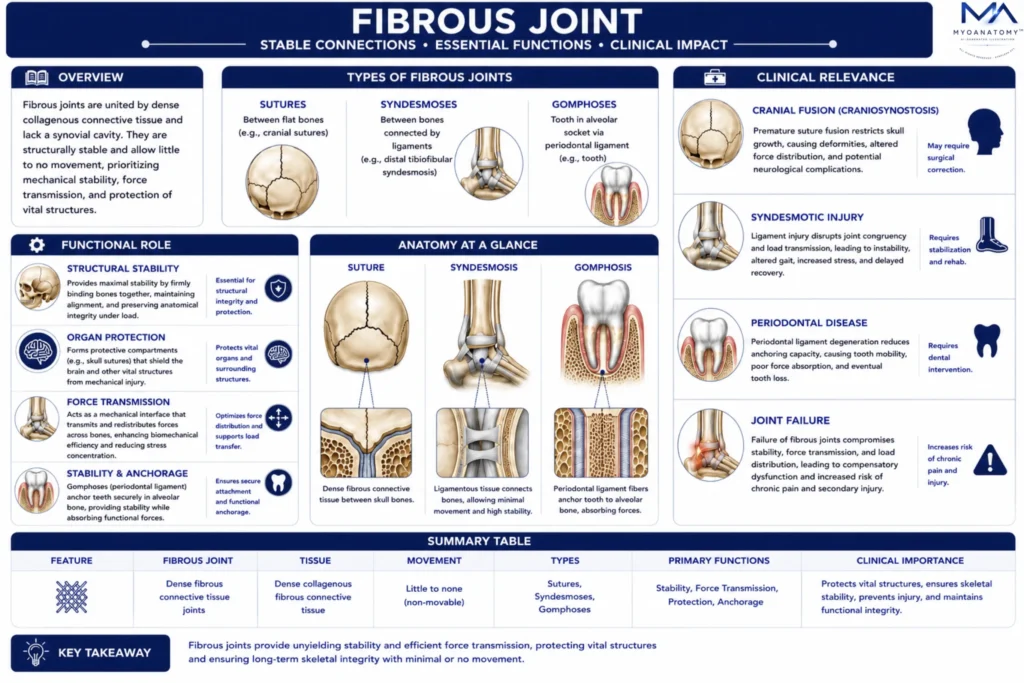
Fibrous joints are structurally stable articulations in which adjacent bones are united by dense collagen-rich connective tissue, without the presence of a synovial cavity. This architectural organization severely restricts or abolishes movement, thereby prioritizing mechanical stability, force transmission, and protection of critical anatomical structures.
OVERVIEW
In contrast to synovial joints, fibrous joints lack articular cartilage, a joint capsule, and synovial membrane. The intervening fibrous tissue – predominantly composed of type I collagen fibers – is arranged to resist tensile stress, enabling efficient load distribution across skeletal elements while maintaining structural integrity under mechanical demand.
Biomechanically, fibrous joints function as rigid or near-rigid units, optimized to withstand tensile and compressive forces without displacement. Their minimal compliance contributes to the preservation of spatial relationships between bones, particularly in regions requiring stability and protection, such as the cranial vault and dentoalveolar articulations.
Functionally and structurally, fibrous joints are classified into three principal subtypes – sutures, syndesmoses, and gomphoses – each reflecting variations in fiber organization, degree of permitted movement, and biomechanical role within the skeletal system.
Exam Question
How do the structural characteristics of fibrous joints enable resistance to mechanical stress, maintenance of skeletal stability, and efficient load transmission despite their limited mobility?
FUNCTIONAL ROLE
Structural Stability
Fibrous joints provide maximal mechanical stability by firmly binding adjacent bones through dense collagenous connective tissue.
This rigidity is essential for maintaining precise anatomical alignment and preventing displacement under physiological and pathological loads, particularly in regions where movement would compromise structural integrity (e.g., cranial sutures).
Organs Protection
Fibrous articulations contribute directly to the formation of protective osseous compartments, particularly within the axial skeleton.
Cranial sutures interlock to create a continuous, mechanically integrated structure, enabling the skull to function as a unified load-bearing unit. External forces are thereby distributed across the entire cranial vault, reducing focal stress and protecting underlying neural tissue from mechanical injury.
This structural integration transforms individual bones into a functional protective system rather than isolated elements.
Force Transmission
Syndesmoses and interosseous membranes act as dynamic force-transmitting interfaces, facilitating the redistribution of mechanical loads between adjacent bones during movement.
Their collagen fibers are oriented along principal stress lines, enabling efficient load sharing and reduction of peak stress on individual skeletal elements. This enhances biomechanical efficiency, particularly during locomotion and weight-bearing activities, by coordinating force propagation across limb segments.
Thus, fibrous joints contribute not only to stability but also to integrated kinetic chain function.
Adaptive Anchoring
Fibrous joints provide secure yet adaptable anchorage, balancing fixation with controlled micro-mobility where required.
The gomphosis exemplifies this principle: the periodontal ligament introduces a viscoelastic interface that permits slight displacement under load. This micro-mobility enables absorption and dissipation of masticatory forces, preventing stress concentration while preserving positional stability of the tooth.
Such adaptive behavior reflects a key principle of fibrous joints – structural rigidity modulated by localized compliance to optimize both durability and function.
CLINICAL RELEVANCE
Cranial Fusion
Premature fusion of cranial sutures (craniosynostosis) disrupts the normal pattern of skull growth, which physiologically occurs perpendicular to suture lines. Early ossification eliminates this growth potential, resulting in compensatory expansion at remaining patent sutures and characteristic cranial deformities.
Biomechanically, loss of suture compliance reduces the skull’s ability to distribute mechanical forces, potentially contributing to elevated intracranial pressure and impaired neurodevelopment. This condition underscores the critical balance between structural stability and growth adaptability in fibrous joints.
Syndesmotic Instability
Injury to syndesmoses – most notably the distal tibiofibular syndesmosis – results in disruption of interosseous ligamentous tension and loss of joint congruency. This impairs the ability of the joint to effectively transmit and redistribute mechanical loads across the limb.
Biomechanically, instability leads to abnormal stress concentration, altered joint kinematics, and inefficient force propagation. Clinically, this manifests as persistent instability, impaired gait mechanics, and prolonged recovery, often exceeding that of typical ligamentous injuries due to the syndesmosis’ role in load-bearing integration.
Anchorage Loss
Degeneration of the periodontal ligament in the gomphosis compromises its function as a viscoelastic anchoring system, leading to progressive loss of tooth stability. As collagen fibers degrade and alveolar bone resorbs, the system loses its capacity for controlled load dissipation.
This results in tooth mobility, impaired mastication, and eventual tooth loss, reflecting failure of the delicate balance between rigidity and micro-mobility. The condition highlights the essential role of the periodontal ligament in maintaining functional anchorage under repetitive mechanical loading.
Joint Failure
Disruption of fibrous joints compromises their role in force transmission, structural stabilization, and load distribution, leading to abnormal biomechanical patterns across the musculoskeletal system.
Even minor alterations in these typically “immobile” joints can produce significant functional deficits, as forces are no longer efficiently dissipated. This results in stress redistribution to adjacent structures, compensatory movement patterns, and increased susceptibility to secondary injury.
Thus, fibrous joint failure illustrates that stability-based systems are integral to overall biomechanical efficiency, not merely passive structural elements.
SUMMARY TABLE