Bone Classification

Clinical Relevance

MYO CORE

Clinical Relevance

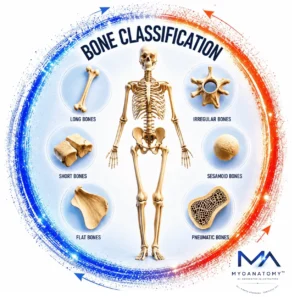
Bone classification is a fundamental concept in osteology that organizes bones according to their morphology, internal structure, and functional role within the musculoskeletal system.This framework provides a basis for understanding how skeletal elements are adapted to meet specific mechanical demands, including load transmission, protection, and movement facilitation.

CLINICAL RELEVANCE

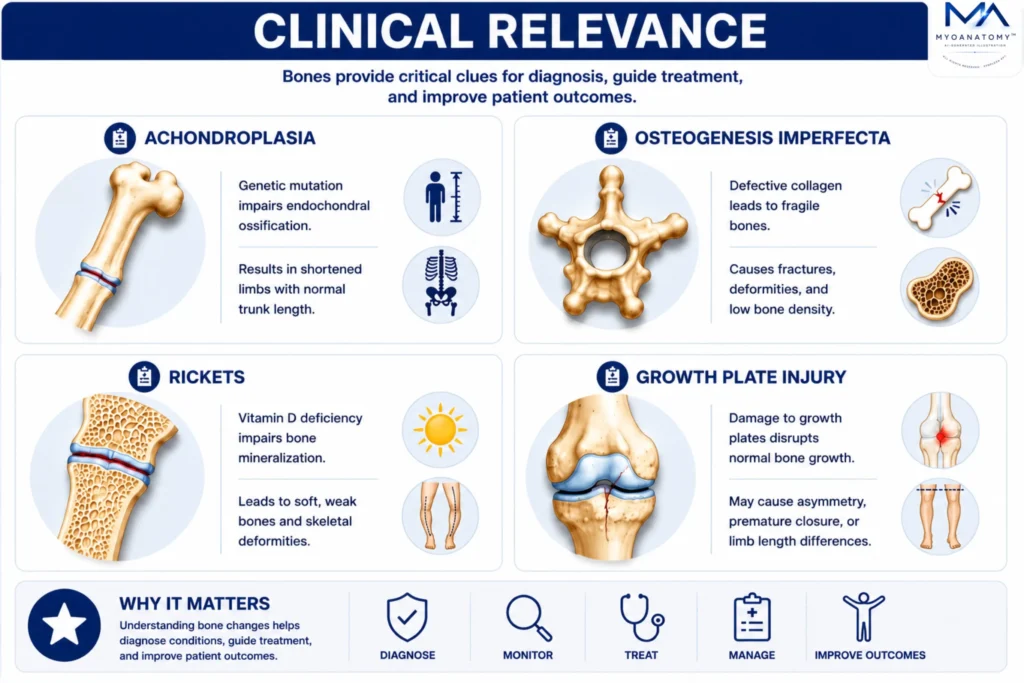
Achondroplasia

Achondroplasia is the most common form of disproportionate dwarfism and results from a mutation in the fibroblast growth factor receptor-3 (FGFR3) gene. This mutation inhibits chondrocyte proliferation within the epiphyseal growth plate, thereby impairing endochondral ossification

As a result, longitudinal bone growth is reduced, producing shortened limbs while the axial skeleton remains relatively preserved.

Osteogenesis Imperfecta

Osteogenesis imperfecta is a genetic disorder characterized by defective synthesis of type I collagen, the principal structural protein of bone matrix. Because collagen provides the scaffold for mineral deposition during ossification, defective collagen formation leads to fragile bones with reduced mechanical strength. 

Clinically, this condition presents with recurrent fractures, skeletal deformities, and decreased bone density.

Rickets

Rickets is a disorder of defective bone mineralization, most commonly caused by vitamin D deficiency. Insufficient vitamin D impairs calcium and phosphate homeostasis, preventing proper mineral deposition within the osteoid matrix produced during ossification. 

The resulting bones are soft and structurally weak, leading to skeletal deformities such as bowing of the long bones and widening of the growth plates.

Growth Plate Injury

Trauma to the epiphyseal (growth) plates during childhood can disrupt the normal process of endochondral ossification responsible for longitudinal bone growth. 

Damage to the growth plate may lead to premature closure, asymmetric growth, or permanent limb length discrepancies, highlighting the critical role of growth plate integrity in skeletal development.

SUMMARY TABLE

Scroll to Top