Bone Classification

MYO CORE

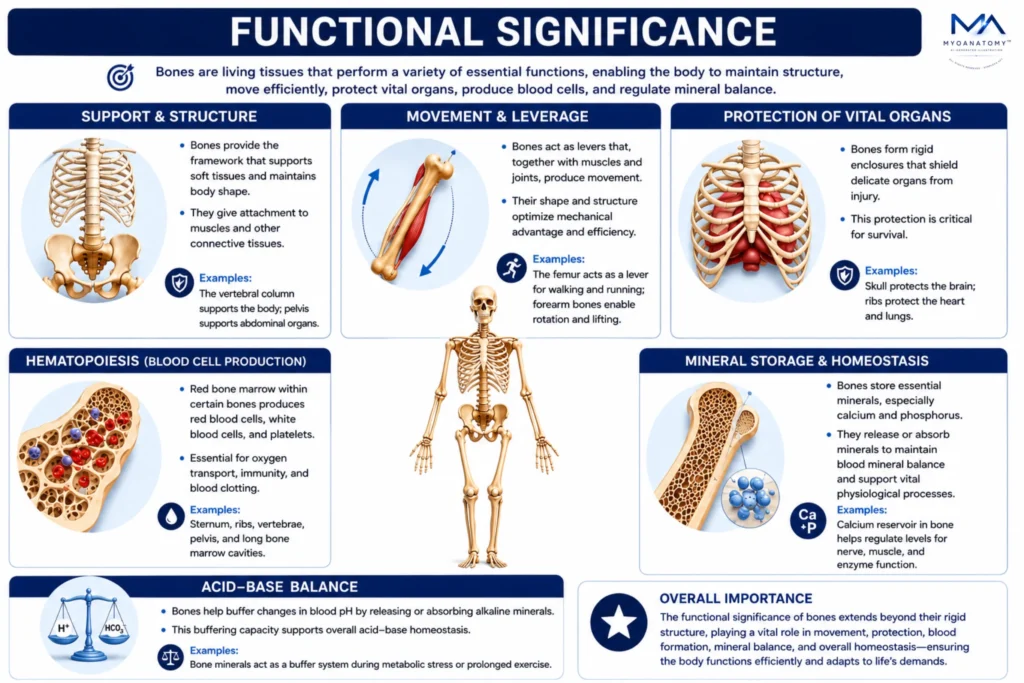
Functional Significance

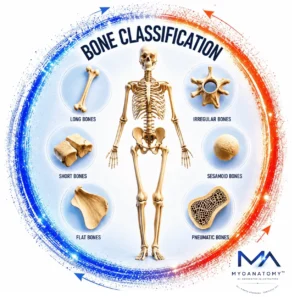
Bone classification is a fundamental concept in osteology that organizes bones according to their morphology, internal structure, and functional role within the musculoskeletal system.This framework provides a basis for understanding how skeletal elements are adapted to meet specific mechanical demands, including load transmission, protection, and movement facilitation.

FUNCTIONAL SIGNIFICANCE

Structural Importance

Ossification establishes the fundamental architectural and mechanical framework of the skeleton by transforming compliant connective tissue into rigid, mineralized bone. This transition enables the skeleton to function as a load-bearing system, capable of resisting compressive, tensile, and bending forces.

The organization of cortical and trabecular bone during ossification produces an optimized structure that balances strength, weight, and mechanical efficiency, allowing maintenance of posture, stability, and coordinated movement under physiological loading conditions.

Force Transmission

Ossified bonefunctions as an effective lever system for skeletal muscles, where rigidity achieved through mineralization allows efficient transmission of muscular forcesvia tendons across joints, enabling controlled and precise movement.

The development of reinforced entheses ensures safe transfer of tensile forces from muscles and ligaments to bone, minimizing stress concentration and preventing structural failure under repetitive loading.

Joint Formation

Ossification ensures precise development of epiphyses and articular surfaces, which is essential for the formation of stable, congruent synovial joints. Proper shaping of these surfaces enables efficient load distribution and minimizes friction during movement.

This structural precision preserves long-term joint integrity and supports smooth, coordinated articulation under dynamic mechanical conditions.

Growth Adaption

Through epiphyseal (growth plate) activity, endochondral ossification enables longitudinal bone growth and ensures proportional skeletal development.

Concurrently, bone undergoes continuous remodeling via coordinated osteoblastic (bone formation) and osteoclastic (bone resorption) activity.

This dynamic process allows adaptation to mechanical loading (Wolff’s law), maintenance of structural strength, and preservation of functional integrity under changing physiological demands.

SUMMARY TABLE

Scroll to Top