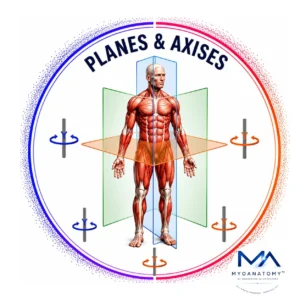
Planes & Axises
MYO CORE
Functional Significance
Anatomical planes and axes provide the fundamental spatial framework for describing, analyzing, and interpreting human movement.
OVERVIEW
By establishing standardized reference orientations, they enable precise classification of joint motion, biomechanical function, anatomical relationships, clinical assessment, medical imaging interpretation, and surgical navigation.
This system ensures consistency in anatomical communication while serving as the foundation for movement analysis, diagnostic accuracy, and safe clinical practice.
FUNCTIONAL SIGNIFICANCE
Movement Control
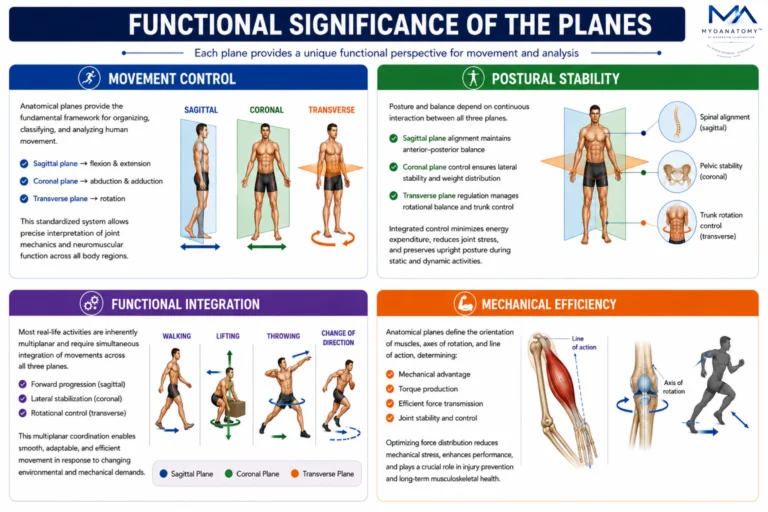
Anatomical planes provide the fundamental spatial framework through which human movement is organized, interpreted, and analyzed.
Every voluntary and involuntary movement occurs within a defined plane and around a corresponding axis of rotation, allowing precise classification of joint mechanics and neuromuscular function.
The sagittal plane primarily governs flexion and extension, the coronal plane controls lateral movements and weight distribution, while the transverse plane facilitates rotational activities.
Together, these planes transform complex motion into analyzable biomechanical components, forming the foundation of kinesiology, rehabilitation, sports medicine, and functional anatomy.

Exam Question
How do anatomical planes and their associated axes provide the biomechanical framework for the classification, analysis, and interpretation of human movement?
Postural Stability
The maintenance of posture and equilibrium depends upon continuous interaction between all three anatomical planes.
Static and dynamic balance require coordinated control of sagittal plane alignment, coronal plane stabilization, and transverse plane rotational regulation. The vertebral column, pelvis, and lower limbs function as an integrated biomechanical system that distributes gravitational forces while preserving efficient body alignment.
Precise multiplanar control minimizes energy expenditure, enhances movement efficiency, and prevents excessive mechanical loading of joints and supporting soft tissues.
Exam Question
Why is coordinated control across the sagittal, coronal, and transverse planes essential for maintaining postural stability, balance, and efficient force distribution?
Functional Integration
Human movement rarely occurs within a single anatomical plane. Most daily activities and athletic actions are inherently multiplanar, requiring simultaneous integration of movements across all three planes.
Walking, running, lifting, reaching, throwing, and changing direction involve continuous interaction between forward progression, lateral stabilization, and rotational control. This multiplanar organization allows the neuromuscular system to generate smooth, coordinated, and adaptable movement patterns capable of responding to changing environmental and mechanical demands.
The ability to integrate motion across multiple planes is therefore fundamental to normal function, physical performance, and movement adaptability.
Exam Question
Why are functional human activities inherently multiplanar, and how does coordinated interaction between anatomical planes optimize movement efficiency and adaptability?
Mechanical Efficiency
Anatomical planes serve as the biomechanical reference system through which muscular forces are translated into controlled movement.
The orientation of muscles relative to specific planes and axes determines their line of action, mechanical advantage, torque production, and functional role within a movement pattern. Efficient movement depends upon precise coordination between muscular contraction, joint mechanics, and multiplanar force transmission.
By optimizing force distribution and reducing unnecessary mechanical stress, this organization enhances locomotor efficiency, preserves joint integrity, improves athletic performance, and contributes significantly to injury prevention and long-term musculoskeletal health.
Exam Question
How do anatomical planes influence muscular line of action, force transmission, torque generation, and the overall biomechanical efficiency of human movement?
SUMMARY TABLE