Planes & Axises
MYO CORE
Overview
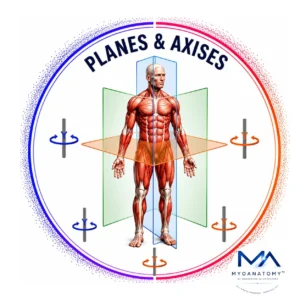
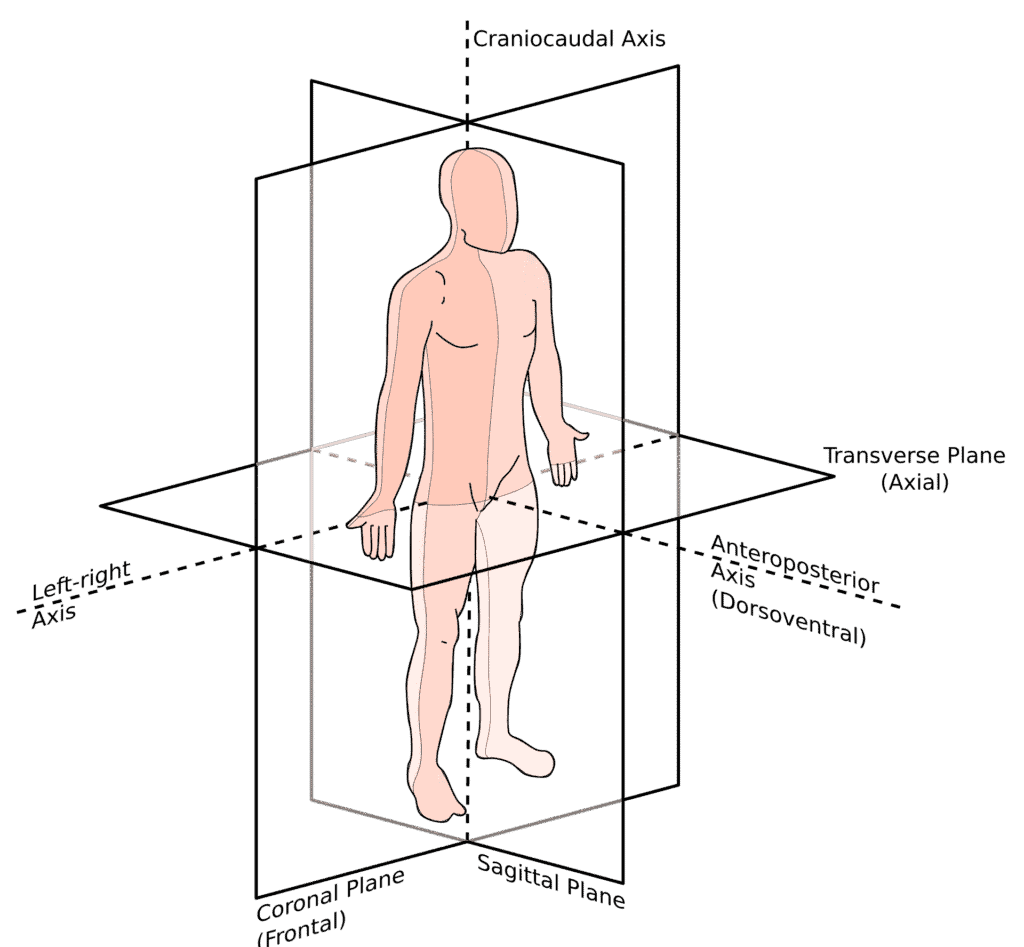
Anatomical planes are imaginary two-dimensional surfaces that divide body into sections and provide a standardized spatial framework for describing the orientation of structures and the direction of movements.
OVERVIEW
These planes are defined relative to the anatomical position, ensuring that anatomical descriptions remain consistent regardless of the variations in posture during clinical examination, imaging, or movement analysis.
In musculoskeletal anatomy and biomechanics, anatomical planes and their corresponding axis are essential for analysing joint motion, skeletal alignment, and muscular function. Each anatomical plane is associated with a perpendicular axis around which movement occurs.
"Anatomical Planes" by Edoardo, via Wikimedia Commons. Licensed under CC BY-SA 3.0
ANATOMY
Sagital Plane
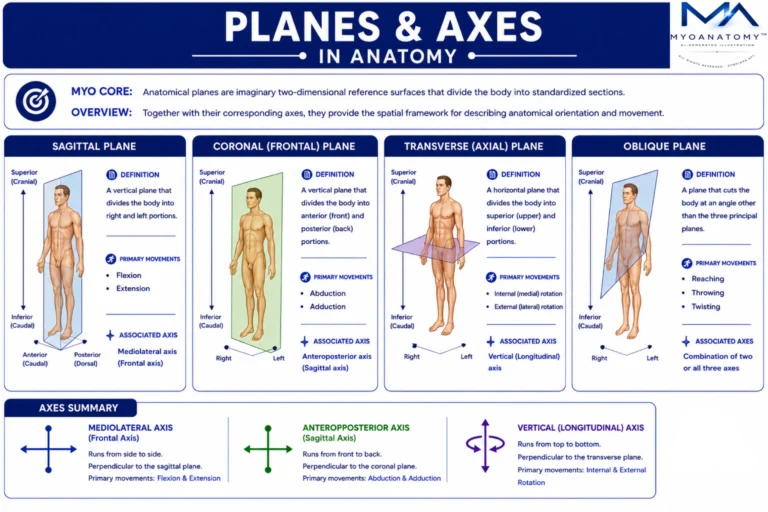
The sagittal plane is a vertical plane that divides the body into right and left portions. When it passes precisely through the midline it is termed the median (midsagittal) plane; planes parallel to it are referred to as parasagittal planes.
Movements occurring within the sagittal plane primarily involve flexion and extension, which alter the angle between adjacent skeletal segments. Typical examples include flexion and extension at the elbow, knee and hip joints; flexion and extension of the vertebral column; dorsiflexion and plantarflexion at the ankle joint.
Movements occur around a transverse ( mediolateral) axis.
Functionally, sagittal plane is particularly important for describing movement associated with forward progression such as walking and running.
Exam Question
In movement analysis, which anatomical plane defines flexion and extension of the elbow and knee, and along which axis do these movements occur?
Coronal Plane
The coronal (frontal) plane, is a vertical plane that divides the body into anterior (ventral) and posterior (dorsal) portions.
Movements in this plane involve displacement toward or away from the body’s midline. The primary movements are: abduction and adduction of the shoulder and hip joints; lateral flexion of the vertebral column and radial and ulnar deviation at the wrist.
Movements occur around an anterior posterior axis.
Functionally movements in the coronal plane are important for maintaining postural stability and balance, particularly during standing and gait.
Exam Question
In functional movement, which anatomical plane defines abduction and adduction of the shoulder and hip, and around which axis do these movements occur?
Transverse Plane
The transverse plane (horizontal or axial) plane is a horizontal plane that divides the body into superior (cranial) and inferior (caudal) portions.
Movements in this plane involve rotational motion around a vertical (longitudinal) axis.
Primary movements include: medial (internal) rotation and lateral (external) rotation, axial rotation of the vertebral column, rotation of the head and neck, and pronation and supinationof the forearm
Functionally, the transverse plane is essential for describing movements involving rotational control, coordination, and directional change, particularly in activities. requiring complex, multidirectional motion.
Exam Question
In rotational movement, which anatomical plane defines medial and lateral rotation, and around which axis do these movements occur?
Oblique Plane
Although the three principal anatomical planes form the primary reference framework, many functional movements of the musculoskeletal system occur along oblique planes, which pass through the body at angles not aligned with sagittal, coronal, or transverse planes.
Oblique planes represent combinations of the principal planes and are characteristic of natural, coordinated human movement.
Example include reaching and throwing actions, twisting movements of the trunk and combined shoulder and hip motions.
In biomechanics and clinical movement analysis, recognition of oblique plane motion is essential for understanding integrated muscle function, joint coordination, and real life movement patterns.

Exam Question
In functional movement analysis, which anatomical plane describes motions not aligned with the principal planes and representing combined multi-planar activity?
SUMMARY TABLE