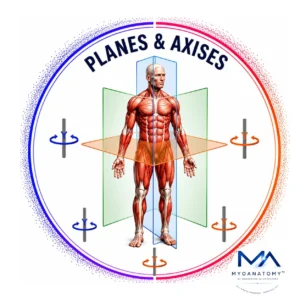
Planes & Axises

MYO CORE

Clinical Relevance

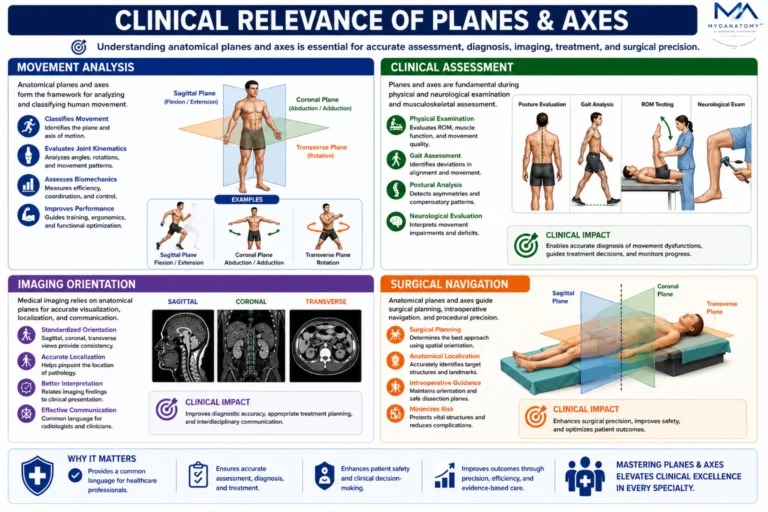
Anatomical planes and axes provide the essential clinical framework for evaluating movement, interpreting medical imaging, localizing pathology, and planning surgical interventions. 

OVERVIEW

By establishing standardized spatial references, they enable accurate assessment of musculoskeletal and neurological function, precise communication of anatomical findings, and safe execution of diagnostic and therapeutic procedures. Their application extends across clinical examination, radiology, biomechanics, rehabilitation, and surgery, making them indispensable to modern healthcare practice.

CLINICAL RELEVANCE

Movement Analysis

Anatomical planes and axes provide the clinical framework for evaluating the quality, direction, coordination, and efficiency of human movement. 

By identifying the plane in which motion occurs and the axis around which it rotates, clinicians can accurately assess joint kinematics, gait mechanics, functional performance, and movement disorders. 

Abnormal movement patterns often reflect underlying musculoskeletal injury, neurological dysfunction, or biomechanical compensation, making planes and axes fundamental to clinical movement analysis.

Exam Question

How do anatomical planes and axes enable comprehensive clinical evaluation of joint kinematics, gait mechanics, movement efficiency, and pathological movement patterns?

Clinical Assessment

Knowledge of anatomical planes and axes is essential during physical examination, neurological evaluation, postural assessment, and range-of-motion testing. 

Clinicians interpret movement relative to standardized anatomical references to identify asymmetry, instability, weakness, coordination deficits, and functional impairment. 

This systematic approach allows precise localization of dysfunction and facilitates accurate diagnosis, treatment planning, and longitudinal patient monitoring.

Exam Question

Why are anatomical planes and axes indispensable for the assessment of posture, range of motion, neuromuscular function, and movement-related pathology?

Imaging Orientation

Modern diagnostic imaging is fundamentally organized around anatomical planes. 

Sagittal, coronal, and transverse sections provide standardized visualization of anatomical structures, allowing accurate localization of pathology and consistent communication among healthcare professionals. 

Understanding spatial orientation within these planes is essential for interpreting radiographs, computed tomography, magnetic resonance imaging, and advanced image-guided diagnostic procedures.

Exam Question

How do anatomical planes enhance anatomical localization, diagnostic interpretation, and clinicoradiological correlation in contemporary medical imaging?

Surgical Navigation

Anatomical planes and axes serve as critical spatial guides during surgical planning, operative navigation, and minimally invasive procedures. 

They enable accurate identification of anatomical landmarks, determination of optimal surgical corridors, and maintenance of three-dimensional orientation throughout complex interventions. 

Mastery of these reference systems improves operative precision, minimizes injury to surrounding neurovascular structures, and enhances procedural safety and clinical outcomes.

Exam Question

How does a detailed understanding of anatomical planes and axes improve surgical orientation, procedural precision, anatomical localization, and patient safety during operative interventions?

SUMMARY TABLE

Scroll to Top