Internal Carotid Artery
MYO CORE
Clinical Relevance
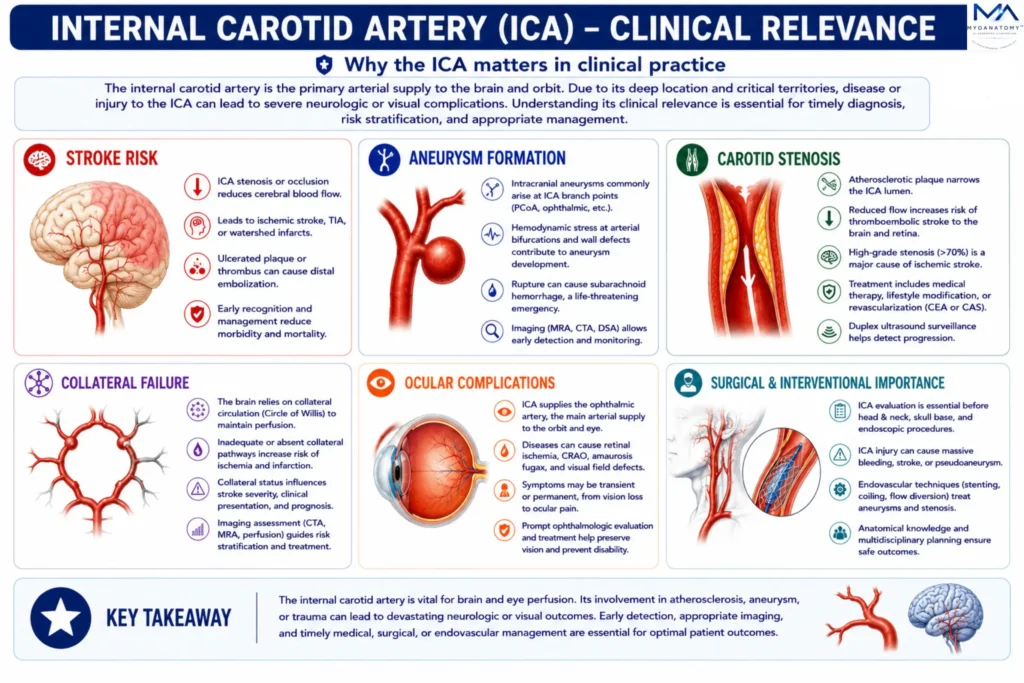
The internal carotid artery (ICA) possesses exceptional clinical importance because it supplies the majority of the anterior cerebral circulation and numerous critical cortical, subcortical, visual, and deep neurovascular structures.
OVERVIEW
Owing to its extensive vascular territory, complex branching pattern, and intimate relationships with the optic apparatus, cavernous sinus, cranial nerves, and Circle of Willis, pathology affecting the ICA may produce severe neurological, visual, and cerebrovascular deficits.
Consequently, disorders involving the ICA represent a major cause of ischemic stroke, cranial neuropathy, visual impairment, intracranial hemorrhage, and neurovascular surgical complications.
Exam Question
Evaluate why the internal carotid artery is considered one of the most clinically significant arteries of the human body, and discuss how its anatomical relationships influence neurological, visual, and cerebrovascular pathology.
CLINICAL RELEVANCE
Stroke Risk
The internal carotid artery supplies the anterior cerebral circulation through the ACA, MCA, and major branches including the ophthalmic, posterior communicating, and anterior choroidal arteries.
Therefore, ICA occlusion, severe stenosis, or thromboembolism may compromise both cortical territories and deep perforating systems, including the lenticulostriate arteries, recurrent artery of Heubner, anterior choroidal artery, and thalamostriate vessels.
Resulting ischemia may involve the basal ganglia, internal capsule, thalamus, optic pathways, and deep white matter, producing contralateral hemiplegia, hemisensory loss, aphasia, visual field defects, hemispatial neglect, cognitive impairment, and altered consciousness.
Neurological severity depends largely on collateral compensation through the Circle of Willis and leptomeningeal arterial networks.
Exam Question
Analyze how occlusion or severe stenosis of the internal carotid artery can produce both cortical and deep cerebral infarction, and explain the resulting neurological deficits based on the affected vascular territories.
Aneurism Formation
Intracranial aneurysms frequently arise at ICA branch points where chronic hemodynamic stress is concentrated.
Common locations include the ICA–posterior communicating artery junction, ophthalmic artery origin, anterior choroidal artery origin, and terminal ICA bifurcation into the ACA and MCA.
Progressive aneurysmal enlargement may compress adjacent neurovascular structures, particularly the oculomotor nerve (CN III), resulting in ptosis, diplopia, ophthalmoplegia, and pupillary dilation.
Rupture produces subarachnoid hemorrhage, a life-threatening condition associated with elevated intracranial pressure, cerebral vasospasm, hydrocephalus, secondary ischemic injury, and significant mortality.
Exam Question
Discuss the anatomical basis of internal carotid artery aneurysm formation, including common sites of occurrence, mechanisms of cranial nerve compression, and potential consequences of aneurysmal rupture.
Carotid Stenosis
Atherosclerotic disease most commonly affects the carotid bifurcation and proximal cervical ICA.
Progressive luminal narrowing may reduce blood flow through the ophthalmic artery, anterior choroidal artery, ACA, MCA, and their perforating branches while simultaneously generating distal emboli.
Advanced stenosis increases the risk of transient ischemic attacks, retinal ischemia, amaurosis fugax, and ischemic stroke through both hemodynamic insufficiency and artery-to-artery embolization.
Assessment of ICA stenosis is therefore central to stroke prevention and guides management with medical therapy, carotid endarterectomy, or carotid artery stenting.
Exam Question
Assess the pathophysiological effects of progressive internal carotid artery stenosis on cerebral and ocular perfusion, and explain its role in transient ischemic attacks, amaurosis fugax, and ischemic stroke.
Colateral Failure
The ICA contributes substantially to cerebral collateral circulation through the posterior communicating artery, anterior communicating artery, and extensive leptomeningeal anastomotic networks.
During ICA stenosis or occlusion, blood may be redistributed between ACA, MCA, and posterior cerebral territories to preserve cerebral viability.
However, anatomical variations, hypoplastic communicating arteries, or incomplete development of the Circle of Willis may limit compensatory capacity. Failure of collateral recruitment results in critical hypoperfusion of both cortical and deep perforating territories, increasing infarct size, neurological severity, and long-term disability.
Exam Question
Evaluate the importance of collateral circulation in maintaining cerebral viability during internal carotid artery compromise, and discuss the clinical consequences of inadequate collateral recruitment.
SUMMARY TABLE