Internal Carotid Artery
MYO CORE
Functional Significance
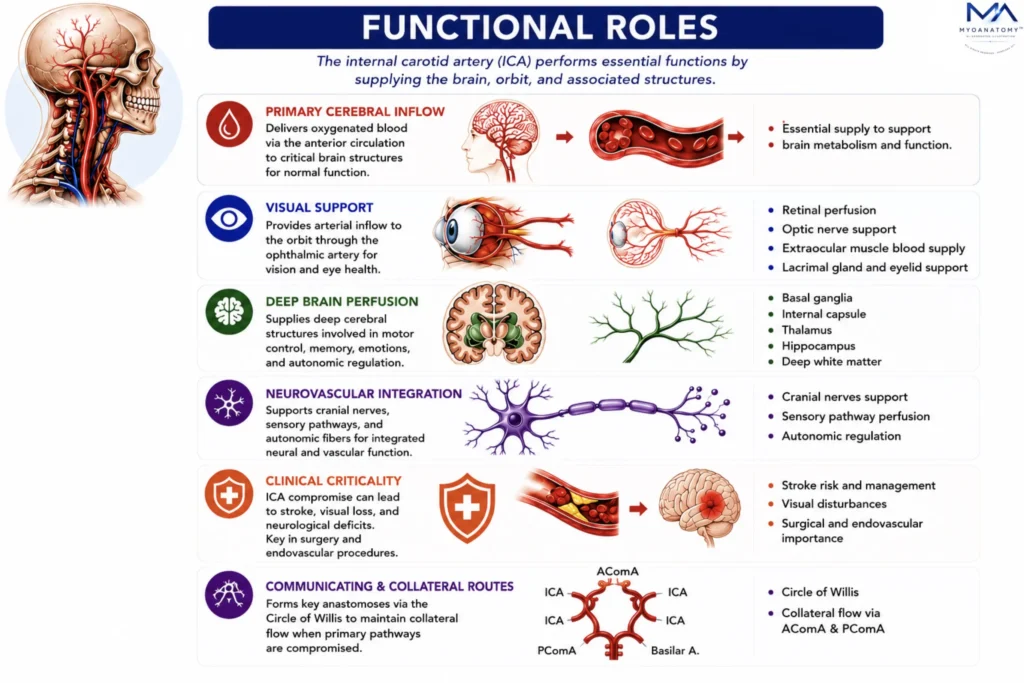
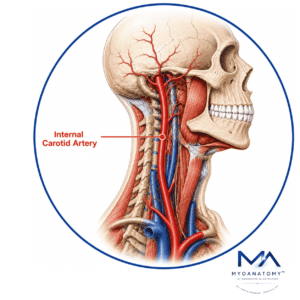
The internal carotid artery serves as the principal arterial conduit between the cervical and intracranial circulations, delivering blood to the anterior cerebral circulation and visual pathways. Through its terminal and collateral branches, it sustains higher cortical function, sensory integration, motor control, cognition, and vision.
FUNCTIONAL SIGNIFICANCE
Cerebral Perfusion
The internal carotid artery (ICA) is the principal arterial inflow of the anterior cerebral circulation, supplying the cerebral hemispheres through the anterior cerebral artery (ACA), middle cerebral artery (MCA), anterior choroidal artery, posterior communicating artery, and deep perforating branches.
Its vascular territory encompasses the frontal, parietal, and lateral temporal cortices, association areas, limbic system, hippocampus, optic pathways, basal ganglia, internal capsule, and deep white matter, thereby supporting consciousness, cognition, language, memory, executive function, emotional regulation, sensory integration, vision, and voluntary motor control.
The MCA perfuses most of the lateral cerebral hemisphere, the ACA supplies the medial frontal and parietal regions, while the anterior choroidal and perforating arteries vascularize the internal capsule, basal nuclei, optic tract, and major corticospinal, corticobulbar, and thalamocortical pathways.
Exam Question
Explain how the internal carotid artery maintains anterior cerebral circulation and analyze the consequences of compromised ICA flow on higher cortical and cognitive functions.
Visual Support
The internal carotid artery (ICA) provides the entire arterial inflow to the orbit through the ophthalmic artery, supplying the retina, optic nerve, optic disc, extraocular muscles, lacrimal gland, eyelids, orbital connective tissues, and portions of the forehead and nose.
This vascular network supports visual acuity, color discrimination, visual field perception, ocular motility, binocular coordination, and higher visual processing.
Because the retina possesses one of the highest metabolic and oxygen demands in the body and has limited collateral circulation, uninterrupted ICA perfusion is essential for retinal viability and normal visual function.
Consequently, the ICA serves as the primary vascular pathway sustaining both the sensory and motor components of the visual system, while interruption of ophthalmic blood flow may rapidly result in retinal ischemia and irreversible monocular blindness.
Exam Question
Evaluate the role of the ophthalmic artery as the principal orbital branch of the internal carotid artery and discuss the clinical implications of retinal ischemia.
Deep Brain Perfusion
Internal carotid artery (ICA) supplies the deep cerebral circulation through the anterior choroidal artery, recurrent artery of Heubner, lenticulostriate arteries, medial striate arteries, and other perforating branches.
These vessels vascularize the internal capsule, basal ganglia, caudate nucleus, globus pallidus, optic tract, hippocampus, amygdala, thalamic regions, and deep white matter, which serve as major centers for neural integration and signal transmission.
These structures contain densely concentrated corticospinal, corticobulbar, thalamocortical, and limbic pathways responsible for motor control, sensory relay, memory formation, emotional processing, motor learning, behavioral modulation, and higher-order neural integration. As many of these vessels function as end arteries with limited collateralization, even small ischemic lesions may produce profound neurological deficits disproportionate to infarct size.
Consequently, the ICA supports also the deep subcortical networks that integrate, coordinate, and refine cerebral function throughout the central nervous system.
Exam Question
Assess the importance of ICA perforating branches in supplying deep cerebral structures and explain why small infarcts in these territories may produce severe neurological deficits.
Collateral Circulation
The internal carotid artery (ICA) provides the principal collateral protection of the brain through the Circle of Willis, primarily via the anterior communicating artery (AComA) and posterior communicating artery (PComA). These vessels establish vascular connections between the right and left cerebral hemispheres and between the carotid and vertebrobasilar systems, allowing redistribution of blood flow when primary arterial pathways become compromised.
This collateral network maintains cerebral perfusion pressure, oxygen and glucose delivery, neuronal viability, and metabolic homeostasis during stenosis, thrombosis, embolic occlusion, or systemic hypoperfusion.
By preserving blood flow to ischemic territories, collateral recruitment can delay infarct progression, reduce tissue injury, and sustain neurological function until definitive reperfusion occurs.
ICA functions not only as a primary cerebral inflow vessel but also as a critical component of the brain’s hemodynamic reserve system.
Exam Question
Analyze how the Circle of Willis provides collateral compensation during ICA obstruction and explain the factors that determine the effectiveness of this protective mechanism.
SUMMARY TABLE