External Carotid Artery

MYO CORE

Functional Significance

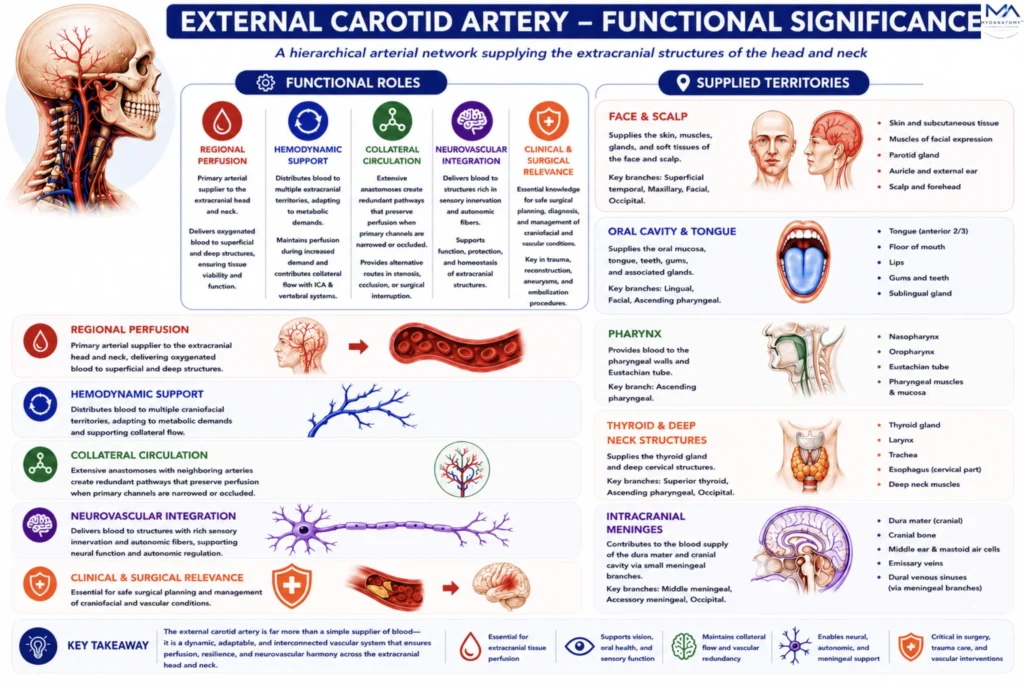
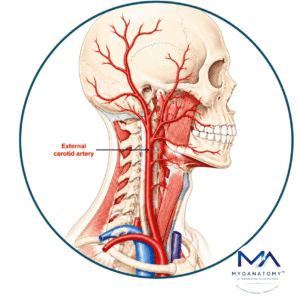
The external carotid artery (ECA) functions as the principal extracranial vascular distribution system of the head and neck, providing the arterial foundation for numerous craniofacial physiological processes. 

OVERVIEW

Functionally, the ECA supports regional perfusion, regulates hemodynamic distribution, participates in collateral circulation, and maintains neurovascular integration across multiple anatomical systems.

Consequently, it serves as a critical vascular axis that enables normal craniofacial function, physiological adaptation, tissue maintenance, and circulatory resilience throughout the extracranial head and neck.

FUNCTIONAL SIGNIFICANCE

Regional Perfusion

The external carotid artery serves as the principal arterial supply to the extracranial head and neck, providing oxygenated blood to the facial skeleton, scalp, muscles of mastication, muscles of facial expression, tongue, pharynx, larynx, salivary glands, thyroid gland, and cranial meninges. 

Through its extensive branching network, it sustains the structural and functional integrity of tissues responsible for communication, alimentation, respiration, and sensory interaction with the external environment. 

This vascular support is indispensable for maintaining normal craniofacial physiology and tissue viability.

Exam Question

Analyze how the external carotid artery maintains regional perfusion of the head and neck and discuss the functional significance of its extensive vascular territory.

Hemodynamic Support

The external carotid artery functions as a highly specialized hemodynamic distribution system, directing blood flow to multiple craniofacial territories according to regional metabolic demands. 

Its branching architecture permits efficient allocation of perfusion to anatomically distinct structures while accommodating fluctuations associated with mastication, swallowing, speech, facial expression, thermoregulation, and glandular secretion. 

Consequently, the ECA acts not merely as a conduit vessel but as a dynamic regulator of regional circulatory homeostasis within the head and neck.

Exam Question

Explain how the external carotid artery regulates hemodynamic distribution and adapts blood flow to the changing metabolic demands of craniofacial structures.

Colateral Circulation

The external carotid artery plays a critical role in collateral vascular circulation through numerous anastomotic communications with the internal carotid, vertebral, and contralateral external carotid systems

These interconnections establish alternative pathways capable of maintaining tissue perfusion when primary arterial channels become stenotic, obstructed, or surgically interrupted. 

As a result, the ECA contributes significantly to vascular resilience, helping preserve the viability of craniofacial tissues and supporting circulatory adaptation during pathological or hemodynamic stress.

Exam Question

Assess the importance of external carotid arterial anastomoses in preserving tissue perfusion during arterial stenosis, occlusion, or surgical interruption.

Neurovascular Integration

The external carotid artery forms an integral component of the craniofacial neurovascular network, accompanying cranial nerves, autonomic fibers, sensory pathways, and major anatomical spaces throughout the head and neck.

Its branches provide the vascular support necessary for the normal function of interconnected sensory, motor, glandular, and autonomic systems

Through these intimate anatomical relationships, the ECA facilitates coordinated physiological activity across multiple organ systems, reinforcing its role as a central vascular axis within the extracranial region.

Exam Question

Evaluate the role of the external carotid artery within the craniofacial neurovascular network and discuss how its vascular relationships facilitate coordinated physiological activity.

SUMMARY TABLE

Scroll to Top