External Carotid Artery
MYO CORE
Clinical Relevance
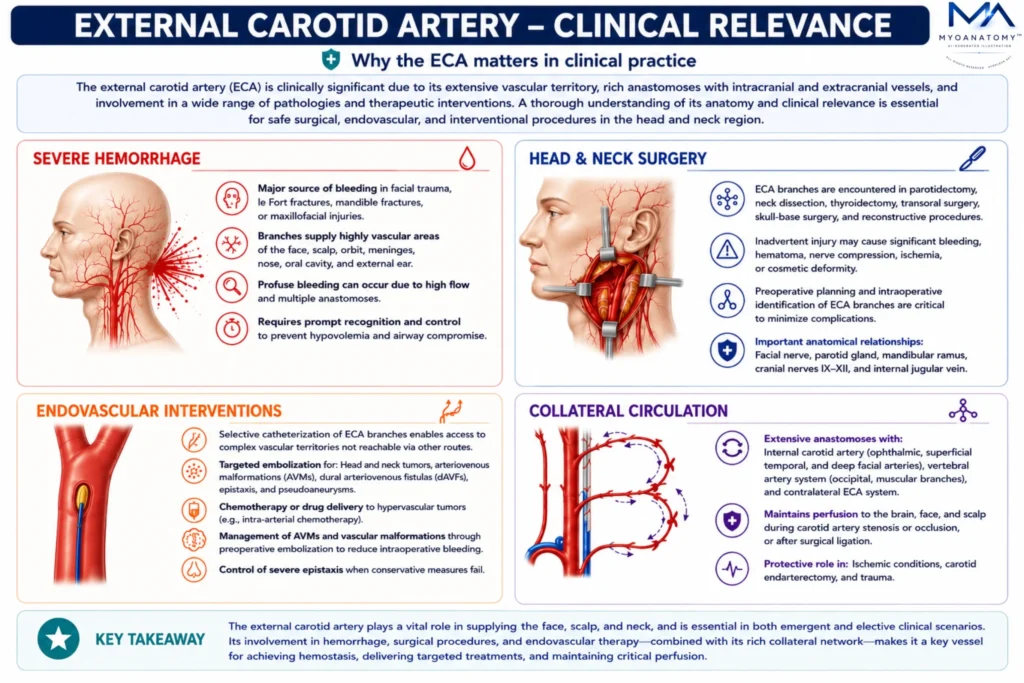
The external carotid artery is clinically significant because of its extensive vascular territory, complex branching pattern, and close relationships with major neurovascular structures.
OVERVIEW
It is frequently involved in severe hemorrhage, head and neck surgery, vascular malformations, tumor vascularization, and endovascular procedures.
Additionally, its extensive collateral networks help maintain perfusion during arterial occlusive disease.
Therefore, detailed knowledge of its anatomy is essential for accurate diagnosis, safe intervention, and prevention of serious complications.
CLINICAL RELEVANCE
Severe Hemorrhage
The external carotid artery represents the dominant arterial source of most extracranial hemorrhages involving the head and neck.
Because its branches supply highly vascular structures including the face, scalp, tongue, oral cavity, pharynx, nasal cavity, salivary glands, and thyroid gland, injury to these vessels may result in rapid blood loss with significant hemodynamic consequences.
Common causes include maxillofacial trauma, facial fractures, penetrating neck injuries, tumor invasion, postoperative bleeding, and severe posterior epistaxis.
The complex branching architecture of the external carotid artery often creates multiple potential bleeding sources, making hemorrhage localization and control particularly challenging.
Consequently, detailed anatomical knowledge is essential for selective vessel ligation, vascular reconstruction, and endovascular embolization.
Modern management increasingly relies on angiographic identification and targeted embolization of specific branches, allowing effective hemorrhage control while minimizing ischemic injury to surrounding tissues.
Exam Question
Evaluate the role of the external carotid artery in major extracranial head and neck hemorrhage and discuss how its complex branching pattern influences hemorrhage localization, vascular control, and contemporary management strategies.
Head & Neck Surgery
The external carotid artery is one of the most important vascular landmarks encountered during head and neck surgery.
Throughout its course, it maintains close anatomical relationships with the facial nerve (CN VII), glossopharyngeal nerve (CN IX), vagus nerve (CN X), accessory nerve (CN XI), hypoglossal nerve (CN XII), carotid sheath structures, pharyngeal wall, and parotid gland.
As a result, the vessel is routinely encountered during parotidectomy, thyroidectomy, neck dissection, skull-base surgery, maxillofacial reconstruction, and oncologic resections.
Injury to the artery or its branches may lead to catastrophic hemorrhage, tissue ischemia, cranial nerve deficits, or compromised flap viability in reconstructive procedures.
Therefore, precise understanding of its branching pattern and anatomical relationships is fundamental for operative safety, surgical planning, and preservation of neurovascular function.
Exam Question
Analyze the surgical significance of the external carotid artery and explain how its anatomical relationships with cranial nerves, cervical structures, and major glands influence operative planning, surgical safety, and preservation of neurovascular function.
Endovascular Intervation
The external carotid artery occupies a central role in contemporary interventional radiology and endovascular therapy.
Its branches are frequently accessed during angiographic evaluation and treatment of vascular tumors, arteriovenous malformations, dural arteriovenous fistulas, traumatic vascular injuries, and refractory hemorrhage.
Selective catheterization permits targeted embolization of pathological vessels while preserving adjacent normal circulation.
Furthermore, preoperative embolization of hypervascular tumors may significantly reduce intraoperative blood loss and improve surgical outcomes.
However, because numerous anastomoses exist between external carotid branches and intracranial vessels, inaccurate embolization may result in cerebral ischemia, visual loss, or cranial nerve injury.
Consequently, successful intervention requires comprehensive knowledge of vascular anatomy, collateral pathways, and dangerous extracranial–intracranial communications.
Exam Question
Assess the importance of the external carotid artery in modern endovascular therapy and discuss the anatomical principles that govern selective catheterization, therapeutic embolization, and prevention of procedure-related neurological complications.
Collateral Circulation
The external carotid artery contributes substantially to collateral perfusion within both the craniofacial and cerebrovascular circulatory systems.
Extensive anastomotic networks connect its branches with the internal carotid artery, vertebral artery, and contralateral cervical vessels, creating alternative pathways for blood flow when major arterial channels become narrowed or occluded.
Particularly important are communications involving the facial, maxillary, superficial temporal, occipital, and ophthalmic arterial systems.
In patients with carotid stenosis or occlusive vascular disease, these collateral pathways may help maintain tissue viability and partially support cerebral perfusion.
Thus, the external carotid artery functions not merely as a regional supply vessel but as an important protective component of vascular compensation, enhancing circulatory resilience during pathological vascular compromise.
Exam Question
Critically discuss the contribution of the external carotid artery to craniofacial and cerebrovascular collateral circulation and evaluate its role in maintaining tissue viability and perfusion during carotid occlusive disease or vascular compromise.
SUMMARY TABLE