Arterial Supply

MYO CORE

Functional Siginificance

Arteries ensure continuous tissue perfusion by delivering oxygenated blood according to metabolic demand. Their elastic properties, smooth muscle regulation, and collateral pathways maintain blood pressure, optimize organ perfusion, and protect tissues from ischemia during altered blood flow.

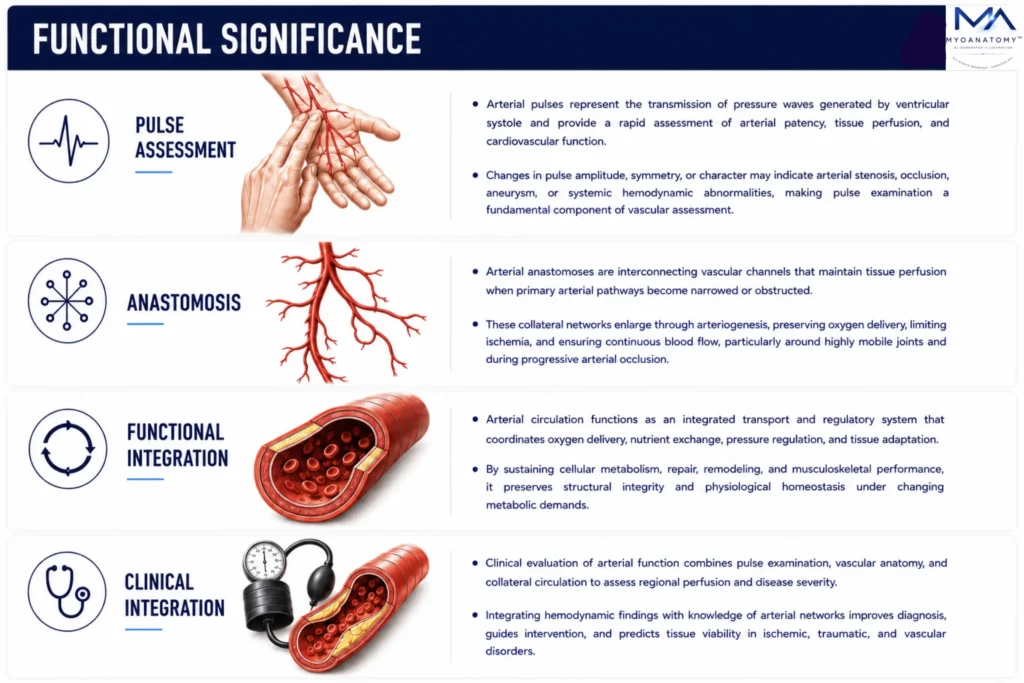
FUNCTIONAL SIGNIFICANCE

Pulsse Assessment

Arterial pulses represent the transmission of pressure waves generated by ventricular systole and provide a rapid assessment of arterial patency, tissue perfusion, and cardiovascular function. 

Changes in pulse amplitude, symmetry, or character may indicate arterial stenosis, occlusion, aneurysm, or systemic hemodynamic abnormalities, making pulse examination a fundamental component of vascular assessment.

Anastomosis

Arterial anastomoses are interconnecting vascular channels that maintain tissue perfusion when primary arterial pathways become narrowed or obstructed. 

These collateral networks enlarge through arteriogenesis, preserving oxygen delivery, limiting ischemia, and ensuring continuous blood flow, particularly around highly mobile joints and during progressive arterial occlusion.

Functional Integration

Arterial circulation functions as an integrated transport and regulatory system that coordinates oxygen delivery, nutrient exchange, pressure regulation, and tissue adaptation. 

By sustaining cellular metabolism, repair, remodeling, and musculoskeletal performance, it preserves structural integrity and physiological homeostasis under changing metabolic demands.

Clinical Integration

Clinical evaluation of arterial function combines pulse examination, vascular anatomy, and collateral circulation to assess regional perfusion and disease severity. 

Integrating hemodynamic findings with knowledge of arterial networks improves diagnosis, guides intervention, and predicts tissue viability in ischemic, traumatic, and vascular disorders.

SUMMARY TABLE

Scroll to Top