Muscle Movement
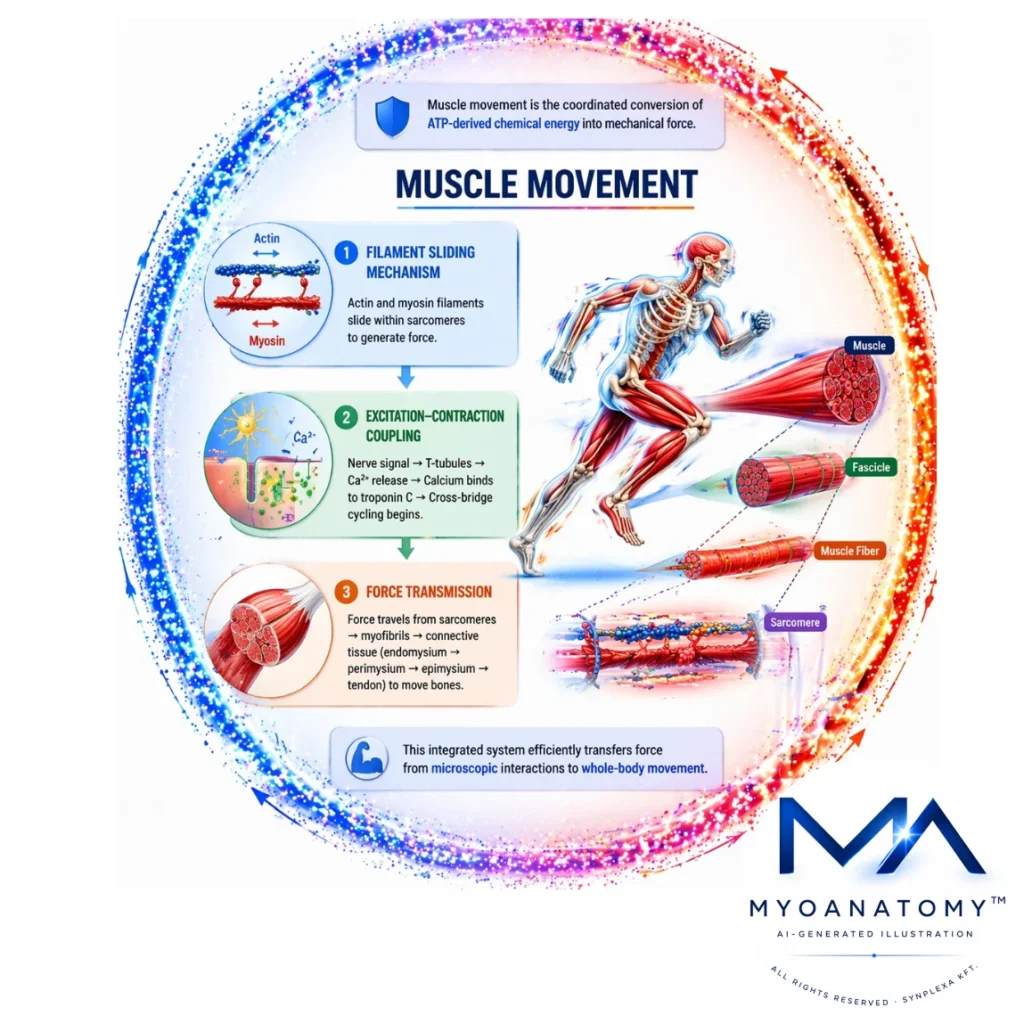
Muscle movement is the coordinated conversion of ATP-derived chemical energy into mechanical force, producing controlled displacement of skeletal elements across joints. It is driven by the sliding filament mechanism, where cyclic interactions between actin and myosin generate force within sarcomeres.
At the cellular level, contraction is initiated by excitation–contraction coupling: sarcolemmal depolarization propagates via T-tubules, triggering Ca²⁺ release from the sarcoplasmic reticulum. Calcium binding to troponin C exposes myosin-binding sites on actin, enabling ATP-dependent cross-bridge cycling and force generation.
Force generated at the sarcomere is transmitted along myofibrils and through a continuous connective tissue network (endomysium → perimysium → epimysium → tendon), allowing efficient transfer from microscopic to macroscopic levels.
Functionally, muscles act in coordinated groups:
Agonists; Antagonist; Synergists; Fixators
Thus, muscle movement represents a multiscale integration of molecular kinetics, cellular activation, connective tissue mechanics, and joint biomechanics, enabling precise and adaptable motion.
MECHANICAL BASIS
AI -Generated Illustration-MyoAnatomy
Muscle Movement
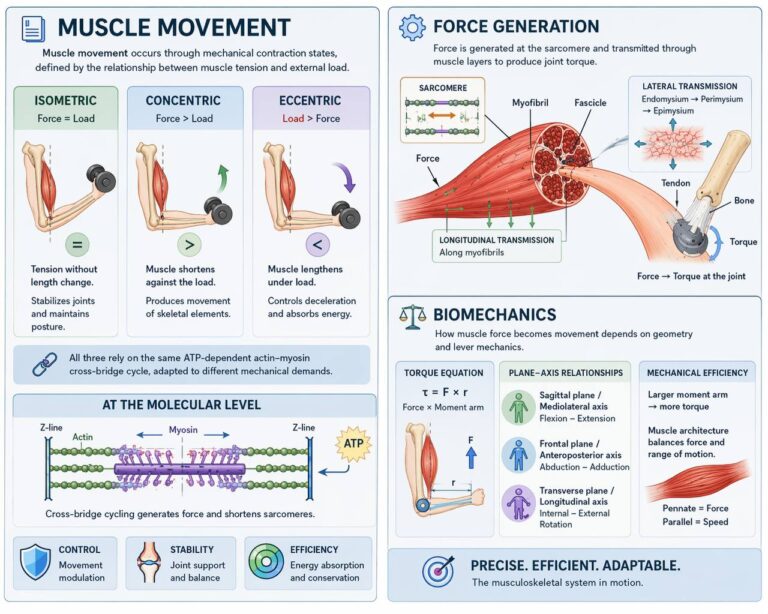
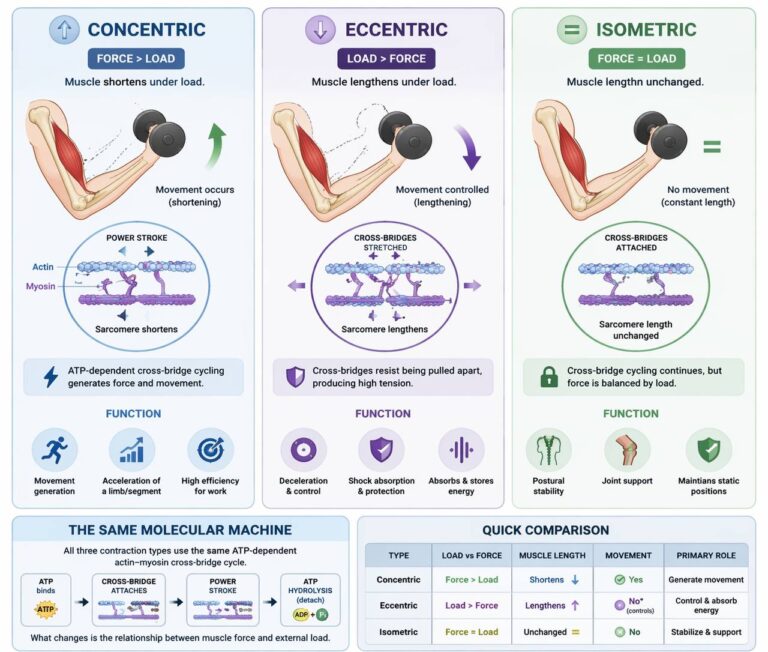
Muscle movement occurs through distinct mechanical contraction states, defined by the relationship between muscle-generated tension and the external load acting on the muscle–tendon unit.
In isometric contraction, muscle tension equals external load (force = load), resulting in no change in muscle length and providing joint stabilization and postural control.
In concentric contraction, muscle tension exceeds the external load (force > load), leading to shortening of the muscle and active displacement of skeletal elements.
In eccentric contraction, the external load exceeds muscle tension (load > force), causing the muscle to lengthen while remaining active, enabling controlled deceleration and absorption of mechanical energy.
These contraction states represent mechanical variations of the same ATP-dependent actin–myosin cross-bridge cycle, allowing skeletal muscle to generate, modulate, and resist force under different loading conditions.
Exam Question
Explain how the relationship between muscle-generated tension and external load defines isometric, concentric, and eccentric contractions, and how each contributes to movement, stabilization, and control
Force Generation
Skeletal muscle contraction is mediated by the sliding filament mechanism, in which cyclic, ATP-dependent interactions between actin and myosin within sarcomeres generate contractile tension and sarcomere shortening.
This microscopic force is transmitted through two coordinated pathways:
Longitudinal transmission along myofibrils
Lateral transmission via the intramuscular connective tissue network (endomysium → perimysium → epimysium)
This integrated system ensures uniform distribution of mechanical stress and prevents localized overload within the muscle.
The connective tissue framework converges into tendons or aponeuroses, enabling efficient transfer of force to the skeletal system. As a result, linear contractile force is converted into rotational force (torque) at joints, forming the fundamental link between molecular contraction and macroscopic movement.
Exam Question
Explain how force generated at the sarcomere is transmitted through muscle tissue to produce movement at joints, including the roles of longitudinal and lateral transmission and the contribution of connective tissue structures.
Biomechanics
The expression of muscle-generated force as movement depends on the mechanical relationship between muscle and joint geometry.
Torque generation is determined by:
Line of pull of the muscle relative to the joint
Moment arm (perpendicular distance to the axis of rotation)
Axis of rotation and anatomical plane of motion
Movements occur according to defined plane–axis relationships:
Sagittal plane / mediolateral axis → flexion–extension
Frontal plane / anteroposterior axis → abduction–adduction
Transverse plane / longitudinal axis → internal–external rotation
Mechanical efficiency is further influenced by the moment arm, which determines mechanical advantage, and by muscle architecture, which affects the balance between force production and range of motion.
Together, these principles establish the biomechanical framework through which skeletal muscle contraction produces precise, controlled, and efficient movement.
Exam Question
Explain how the line of pull, moment arm, and joint axis determine torque generation, and how these factors influence the direction, efficiency, and range of movement.
MUSCLE CONTRACTION TYPES
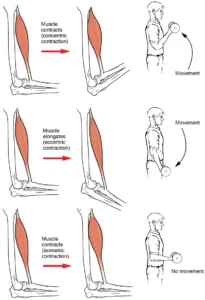
”1015 Types of Contraction”-OpenStax College, Anatomy&Physiology via Wikimedia Commons.
Licensed under CC BY 4.0
AI-Generated Illustiaton MyoAnatomy
Concentric
In concentric contraction, muscle fibers shorten while generating tension, occurring when muscle force exceeds the external load acting on the muscle–tendon unit. This results in the active displacement of skeletal elements in the direction of the muscle’s line of pull.
At the molecular level, concentric contraction is driven by ATP-dependent actin–myosin cross-bridge cycling, in which repeated power strokes produce sarcomere shortening. This process converts chemical energy into mechanical work, generating movement at joints.
Functionally, concentric contractions are responsible for the initiation and execution of voluntary movement, particularly during phases requiring acceleration of a limb or body segment. Their efficiency depends on factors such as motor unit recruitment, contraction velocity, and muscle architecture.
Exam Question
Explain the mechanical and molecular basis of concentric contraction, including the relationship between muscle force and external load, the role of cross-bridge cycling, and how this contraction contributes to movement generation.
Eccentric
In eccentric contraction, the muscle lengthens while actively generating tension, occurring when the external load exceeds the force produced by the muscle. Rather than producing movement, this contraction acts to control, decelerate, or resist motion.
At the molecular level, actin–myosin cross-bridges remain attached while being forcibly elongated, resulting in high tension per cross-bridge and increased mechanical stress within muscle fibers. This contributes to the muscle’s ability to absorb energy and regulate movement velocity.
Functionally, eccentric contractions play a critical role in movement control, shock absorption, and joint protection, particularly during activities involving deceleration or external forces. Due to the high mechanical stress generated, they are also associated with structural microdamage and delayed-onset muscle soreness (DOMS).
Exam Question
Explain the mechanical and molecular characteristics of eccentric contraction, including how the relationship between load and muscle force determines muscle lengthening, and discuss its role in movement control and mechanical stress within muscle tissue.
Isometric
In isometric contraction, muscle fibers generate tension without a change in muscle length, occurring when muscle force equals the external load (force = load). As a result, no visible movement occurs at the joint, and the joint angle remains constant.
At the molecular level, actin–myosin cross-bridge cycling continues, but the generated force is balanced by opposing load, preventing sarcomere shortening or lengthening. This maintains steady-state tension within the muscle.
Functionally, isometric contractions are essential for postural stabilization, joint support, and maintenance of static positions.
Exam Question
Explain the mechanical and molecular basis of isometric contraction, including the relationship between muscle force and external load, and discuss its role in joint stabilization and maintenance of posture
FUNCTIONAL ROLE
Functional Muscle Group
Skeletal muscles operate within coordinated neuromechanical systems, where force production is distributed across functionally specialized groups. Agonists generate primary movement, while antagonists modulate and decelerate motion, preventing excessive joint excursion. Synergists refine force vectors and suppress unwanted movements, and fixators stabilize proximal segments, enabling efficient distal force transmission.
This integrated organization is governed by reciprocal inhibition and controlled co-contraction, ensuring smooth transitions between opposing actions. As a result, muscle groups function not as isolated units but as dynamically coordinated systems, optimizing precision, efficiency, and joint stability.
Lever Systems
Skeletal movement is executed through biological lever systems, in which bones act as rigid levers, joints serve as fulcrums, and muscles generate effort forces. These systems convert linear muscle contraction into rotational torque, forming the mechanical basis of movement.
Lever classification depends on the spatial relationship between fulcrum, effort, and load:
First-class → balance between force and range
Second-class → mechanical advantage for force production
Third-class → mechanical disadvantage but optimized for speed and range
These configurations determine how force, distance, and velocity interact, with human movement predominantly relying on third-class levers, favoring precision and rapid motion over maximal force efficiency.
Boomechanical Optimization
Muscle performance is determined by key biomechanical variables, including moment arm, line of pull, and muscle architecture. The moment arm defines the efficiency of torque generation, while the line of pull governs the direction and functional components of force.
Muscle architecture establishes the balance between force production and contraction velocity: pennate arrangements increase force via greater physiological cross-sectional area, whereas parallel fibers enhance excursion and speed.
Dynamic modulation of joint position, lever geometry, and recruitment patterns enables continuous optimization of mechanical output, allowing the musculoskeletal system to adapt to varying functional demands.
Neuromuscular Control
Movement is regulated by the central nervous system, which precisely modulates muscle activity through motor units. Each motor unit consists of a motor neuron and its innervated fibers, forming the fundamental unit of force control.
Force gradation is achieved through:
Motor unit recruitment (size principle)
Rate coding (frequency modulation)
Agonist–antagonist coordination via reciprocal inhibition and co-contraction
Integration of proprioceptive feedback from muscle spindles, Golgi tendon organs, and joint receptors enables continuous adjustment of force and position. This results in highly precise, adaptive, and stable movement control.
Functional Integration
Skeletal muscle function represents a multilevel integration of molecular, structural, and mechanical processes, linking sarcomere contraction to whole-body movement. Force generated at the microscopic level is transmitted through myofibrils, connective tissues, and tendons to the skeletal system.
Both longitudinal and lateral force transmission pathways ensure coordinated distribution of mechanical stress and effective conversion of contractile activity into joint motion.
This hierarchical integration enables synchronized, multi-segmental movement, efficient load transfer, and maintenance of structural integrity under varying physiological demands.
Functional Significance
Skeletal muscle activity fulfills essential roles in the musculoskeletal system by generating and regulating forces required for movement, stability, and load management.
Locomotion → coordinated propulsion and segmental control
Postural control → continuous tonic activity maintaining alignment against gravity
Joint stabilization → dynamic co-contraction reinforcing structural integrity
Load distribution → absorption and redistribution of mechanical forces
Collectively, these functions ensure mechanical efficiency, structural resilience, and adaptive responsiveness, enabling the execution of both sustained postural tasks and complex, high-precision movements.