Synovial Joint
MYO CORE
Types
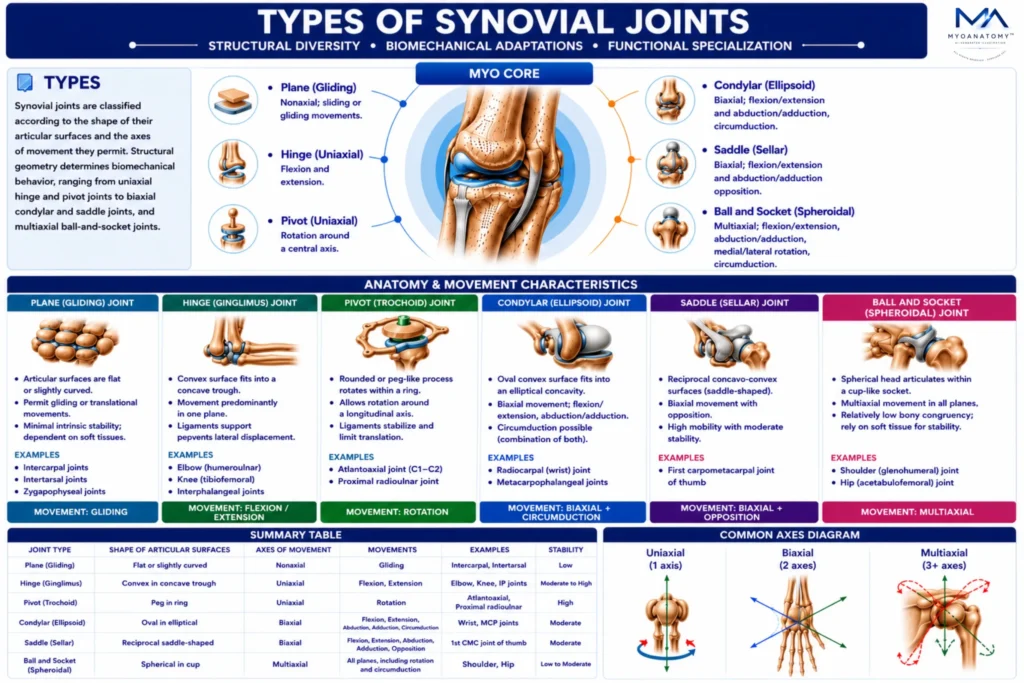
Synovial joints are classified according to the shape of their articular surfaces and the axes of movement they permit. Structural geometry determines biomechanical behavior, ranging from uniaxial hinge and pivot joints to biaxial condylar and saddle joints, and multiaxial ball-and-socket joints.
OVERVIEW
Synovial joint types illustrate one of the most important principles of musculoskeletal anatomy: structural design determines functional capability. The morphology, orientation, and degree of congruency of opposing articular surfaces govern the number of movement axes, range of motion, mechanical stability, and patterns of force transmission across the joint.
As articular geometry becomes increasingly specialized, each joint acquires distinct biomechanical characteristics that optimize specific functional demands while imposing corresponding mechanical limitations.
Consequently, the classification of synovial joints provides a fundamental framework for understanding normal movement, joint stability, load distribution, and the biomechanical adaptations that enable the diverse repertoire of human locomotion and manipulation.
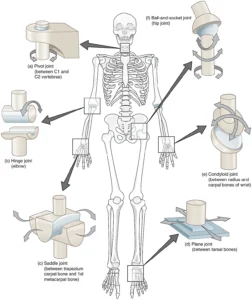
“Types of Synovial Joints” by OpenStax College, from Anatomy & Physiology, via Wikimedia Commons. Licensed under CC BY 3.0
How does progressive specialization of articular surface morphology among synovial joint types influence the degrees of freedom, biomechanical stability, and functional capabilities of human movement?
Exam Question
ANATOMY
Plane (Gliding) Joint
Plane joints are characterized by relatively flat or slightly curved articular surfaces that permit small translational movements between adjacent bones.
Although individual movements are limited in magnitude, the cumulative effect of multiple articulations can produce substantial regional mobility. The close congruency of opposing surfaces provides intrinsic stability while allowing controlled gliding in various directions.
These joints are particularly important in regions requiring subtle positional adjustments, such as the intercarpal, intertarsal, and zygapophyseal joints, where they facilitate coordinated movement while maintaining structural integrity and efficient load distribution.
Exam Question
How does the morphology of a plane synovial joint simultaneously permit multidirectional gliding while preserving intrinsic stability, and why is this arrangement biomechanically advantageous in regions such as the intercarpal and zygapophyseal joints?
Hinge (Ginglimus) Joint
Hinge joints possess a highly specialized morphology in which a convex cylindrical articular surface articulates with a corresponding concave trough.
This configuration restricts movement predominantly to a single axis, allowing flexion and extension while minimizing rotational and lateral displacement. The articular geometry, reinforced by strong collateral ligaments, provides exceptional stability during movement.
Hinge joints are biomechanically optimized for powerful, predictable motion in one plane and are exemplified by the elbow, interphalangeal, and talocrural joints.
Exam Question
Analyze how the convex–concave articular architecture and associated ligamentous reinforcement of a hinge joint optimize uniaxial flexion–extension while restricting rotational and translational movements.
Pivot (Trochoid) Joint
Pivot joints are specialized uniaxial articulations in which a rounded osseous process rotates within an osteoligamentous ring formed by bone and supporting ligaments.
This arrangement permits rotational movement around a longitudinal axis while restricting other motions. The unique morphology allows efficient transmission of rotational forces with minimal compromise of stability.
Classic examples include the proximal radioulnar joint, which enables pronation and supination of the forearm, and the median atlantoaxial joint, which facilitates rotation of the head.
Exam Question
Explain how the osteoligamentous ring configuration of a pivot joint enables efficient axial rotation, and discuss the biomechanical significance of this design in the proximal radioulnar and median atlantoaxial joints.
Condylar (Ellipsoid) Joint
Condylar joints consist of an oval convex articular surface articulating with a complementary elliptical concavity.
This morphology permits biaxial movement, including flexion-extension and abduction-adduction, with circumduction resulting from the combination of these motions. Although mobility is greater than in uniaxial joints, articular geometry limits true axial rotation, thereby preserving stability.
Condylar joints represent an effective compromise between movement versatility and structural support and are exemplified by the radiocarpal and metacarpophalangeal joints.
Exam Question
How does the ellipsoid articulation of condylar joints permit biaxial mobility while preventing true axial rotation, and why is this compromise important for balancing movement versatility with joint stability?
Saddle ( Sellar) Joint
Saddle joints possess reciprocally concavo-convex articular surfaces, with each articulating partner being concave in one plane and convex in the perpendicular plane.
This highly congruent arrangement permits extensive biaxial mobility while maintaining substantial intrinsic stability. The reciprocal architecture enhances joint congruency throughout movement, allowing precise and coordinated motion.
The first carpometacarpal joint of the thumb represents the most specialized example, enabling opposition and contributing significantly to the dexterity and manipulative capabilities of the human hand.
Exam Question
Evaluate how the reciprocal concavo-convex morphology of a saddle joint enhances joint congruency throughout movement and enables highly specialized functions such as thumb opposition and precision manipulation.
Ball and Socket ( Spheroidal)
Ball-and-socket joints exhibit the most complex and mobile synovial architecture, consisting of a spherical articular head articulating within a cup-shaped socket.
This configuration allows multiaxial movement in all anatomical planes, including flexion, extension, abduction, adduction, medial and lateral rotation, and circumduction. The degree of mobility is influenced by socket depth, capsuloligamentous support, and surrounding musculature.
The shoulder prioritizes mobility through a relatively shallow socket, whereas the hip sacrifices some mobility to achieve superior stability and weight-bearing capacity. These joints represent the highest expression of synovial mobility within the musculoskeletal system.
Exam Question
Discuss how the spherical head–socket configuration of ball-and-socket joints maximizes multiaxial mobility, and compare the structural adaptations that differentiate the highly mobile shoulder joint from the more stable weight-bearing hip joint.
SUMMARY TABLE