Directional Terms
Are the standardized relational descriptors used to define the position of one structure relative to another in the anatomical position.
In musculoskeletal anatomy, they provide the essential language for describing the location, orientation, and relationships of bones, joints, muscles, fasciae, vessels, and nerves.
Their principal function is to eliminate ambiguity: structures are not described using imprecise terms such as “above,” “below,” or “to the side,” but by precise anatomical terms that remain constant regardless of the patient’s posture during examination or imaging.
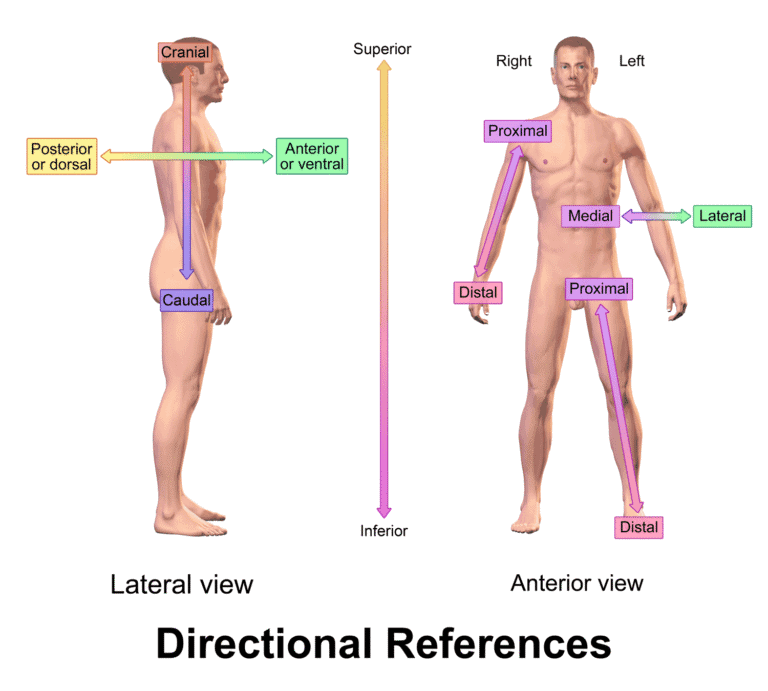
“Directional References” by BruceBlaus ( Blausen Medical), via Wikimedia Commons. Licensed under CC BY -SA 3.0
AXIAL ORINETATION
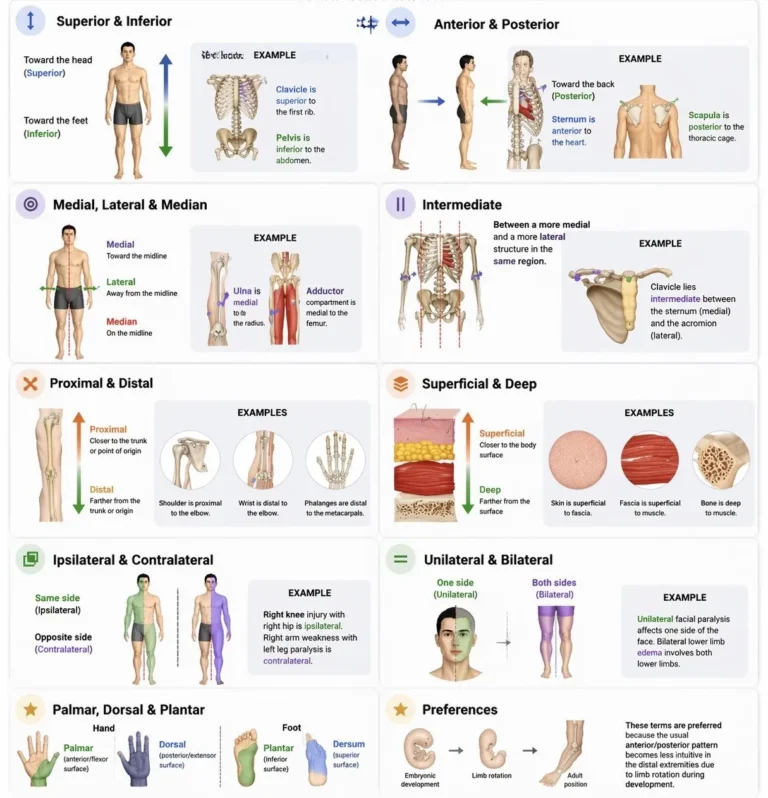
AI -generated illustration (MyoAantomy)
Superior & Inferior
Superior and inferior describe vertical relationships within the body, indicating position toward the head or toward the feet in the anatomical position.
Commonly used equivalents are cranial(cephalic)for superior, and caudal for inferior.
For example: clavicle is superior to the first rib and the pelvis is inferior to the abdomen.
Exam Question
With a first rib fracture, which directional relationship is required to correctly orient the clavicle relative to the injury?
Anterior & Posterior
Anterior and posterior describe relationships to the front and back of the body.
Commonly used equivalents are ventral for anterior, dorsal for posterior in anatomical terminology.
For example: the sternum is anterior to the heart, the scapula is posterior to the thoracic cage.
Exam Question
In anterior thoracic access, which directional relationships between the sternum, heart, and scapula determine correct spatial orientation?
MIDLINE RELATIONSHIPS
Medial, Lateral & Median
The terms medial, lateral, and median describe relationships relative to the body’s midline. A structure closer to the midline is described as medial, whereas one farther from the midline is lateral. A structure located precisely in the midline is termed median.
For example, in the anatomical position, the ulna is medial to the radius in the forearm. In the thigh, the adductor compartment is medial relative to the femur.
Exam Question
In a forearm injury, which directional relationship distinguishes the ulna from the radius relative to the body’s midline?
Intermediate
Intermediate describes a structure positioned between a more medial and a more lateral structure within the same region.
For example, the clavicle lies intermediate between the sternum (medial) and the acromion (lateral).
Exam Question
In the shoulder region, which directional relationship defines the clavicle relative to the sternum and the acromion within the same anatomical plane?
LIMB RELATIONSHIPS
Proximal & Distal
Proximal and distal describe positions relative to the trunk or to the point of origin of a structure, particularly in the limbs.
Proximal indicates a position closer to the trunk or origin, whereas distal indicates a position farther from the trunk or origin.
For example, the shoulder is proximal to the elbow, the wrist is distal to the elbow, and the phalanges are distal to the metacarpals. These terms may also be applied to vessels, nerves, and tendons as they extend away from their origin.
In musculoskeletal anatomy, these terms are essential because limb mobility alters spatial orientation, making descriptors such as superior and inferior less reliable.
Exam Question
In a limb injury, which directional relationship determines the position of the wrist relative to the elbow along the limb axis?
Superficial & Deep
Superficial and deep describe the relative depth of structures from the body surface, ranging from external layers to internal structures.
Superficial indicates a position closer to the body surface, whereas deep indicates a position farther from the surface.
For example, the skin is superficial to fascia, fascia is superficial to muscle, and bone is deep to muscle.
In musculoskeletal anatomy, this relationship is clinically significant, as it reflects the layered organization of tissues encountered during dissection, palpation, trauma assessment, and surgical exposure.
Related descriptors such as external and internal may also be used, particularly in relation to cavities, walls, or layered compartments; however, superficial and deep remain the primary terms in the locomotor system.

Exam Question
During dissection, which directional relationship defines the position of muscle relative to skin and bone within layered structures?
SLIDE REALTIONSHIPS
Ipsilateral & Controlateral
Exam Question
In a neurological assessment, which directional relationship defines structures on the same side versus the opposite side of the body?
Unilateral & Bilateral
Unilateral refers to the presence or involvement of a structure or condition on one side of the body only, whereas bilateral refers to involvement on both sides.
For example, unilateral facial paralysis affects one side of the face, whereas bilateral lower limb edema involves both lower limbs.
Exam Question
In clinical evaluation, which directional relationship distinguishes involvement of one side of the body from both sides?
REGIONAL TERMS
Palmar, Dorsal & Contralateral
Certain region-specific directional terms are used for the distal upper and lower limbs.
In the hand, palmar refers to the anterior (flexor) surface, whereas dorsal refers to the posterior (extensor) surface.
In the foot, plantar refers to the inferior surface, whereas the dorsum of the foot refers to the superior surface.
Exam Question
In limb examination, which directional relationships distinguish the palmar and dorsal surfaces of the hand, and the plantar and dorsal surfaces of the foot?
Preferences
These terms are preferred because the usual anterior/posterior pattern becomes less intuitive in the distal extremities due to limb rotation during embryological development and the functional position of the limbs in adult anatomy.
Exam Question
In anatomical description of the limbs, which directional relationships are preferred over anterior and posterior, and why are they required for accurate spatial orientation?
FINAL SUMMARY
Final Summary
Taken together, directional terms form the core descriptive framework of musculoskeletal anatomy.
They are not merely vocabulary to be memorized, but conceptual tools that organize anatomical knowledge, guide spatial reasoning, and enable precise communication in clinical examination, imaging, operative anatomy, and biomechanical analysis.
Mastery of these terms is therefore fundamental to the rigorous study and clinical application of the human musculoskeletal system. They provide a universal reference system that ensures consistency across anatomical, clinical, and radiological practice.