Anatomical Position

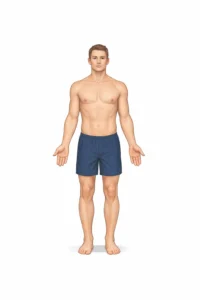
 The anatomical position is the standardized reference posture used in human anatomy to describe the spatial relationships of structures within the body.

 AI-generated illustration (MyoAnatomy)

FOUNDATION

Conceptual Framework

All anatomical descriptions of the musculoskeletal system, including bones, joints, muscles, vessels, and nerves, are defined relative to this standardized orientation

Scientific Purpose

In the anatomical position,  use of a universal reference posture ensures clarity, precision, and consistency in anatomical communication across medical, scientific, and clinical disciplines.

STRUCTURAL ORGANIZATION

Body Orientation

The body is positioned upright, with the head held level and the gaze directed anteriorly. This establishes a standardized spatial orientation of the skull relative to the vertebral column, serving as the reference for anatomical description.

Limb Position

The upper limbs are positioned at the sides of the trunk, with the elbows fully extended and the forearms supinated, such that the palms face anteriorly and the thumbs are directed laterally. In this position, the radius and ulna lie parallel, reflecting the neutral anatomical alignment of the forearm.

The lower limbs are extended at the hips and knees, with the feet parallel and the toes directed anteriorly, forming a stable base that supports the body’s vertical alignment.

BIOMECHANICS & FUNCTION

ALIGNEMNT & LOAD

From a musculoskeletal perspective, the anatomical position represents a state of neutral skeletal alignment and standardized joint orientation.

The vertebral column maintains its physiological curvatures while supporting the head and trunk in an upright posture. The scapulae rest against the posterior thoracic wall, and the humerus lies in slight lateral rotation within the glenoid cavity.

In the lower limb, the femur, tibia, and fibula are aligned to transmit body weight through the hip, knee, and ankle joints, ensuring mechanical stability and an efficient distribution of forces.

FUNCTION & MOVEMENT

The anatomical position serves as the reference configuration for describing joint movement and muscular function. Movements such as flexion, extension, abduction, adduction, and rotation are defined relative to this neutral alignment, allowing precise biomechanical analysis.

Movements are interpreted in relation to the principal anatomical planes intersecting the body in the anatomical position. The sagittal plane is associated with flexion and extension, the coronal plane with abduction and adduction, and the transverse plane with rotational movements.

Accordingly, the anatomical position provides the fundamental framework for anatomical terminology and musculoskeletal analysis, enabling accurate description of structural relationships, joint mechanics, and clinical localization.

Scroll to Top