Synovial Joint
MYO CORE
Biomechanics
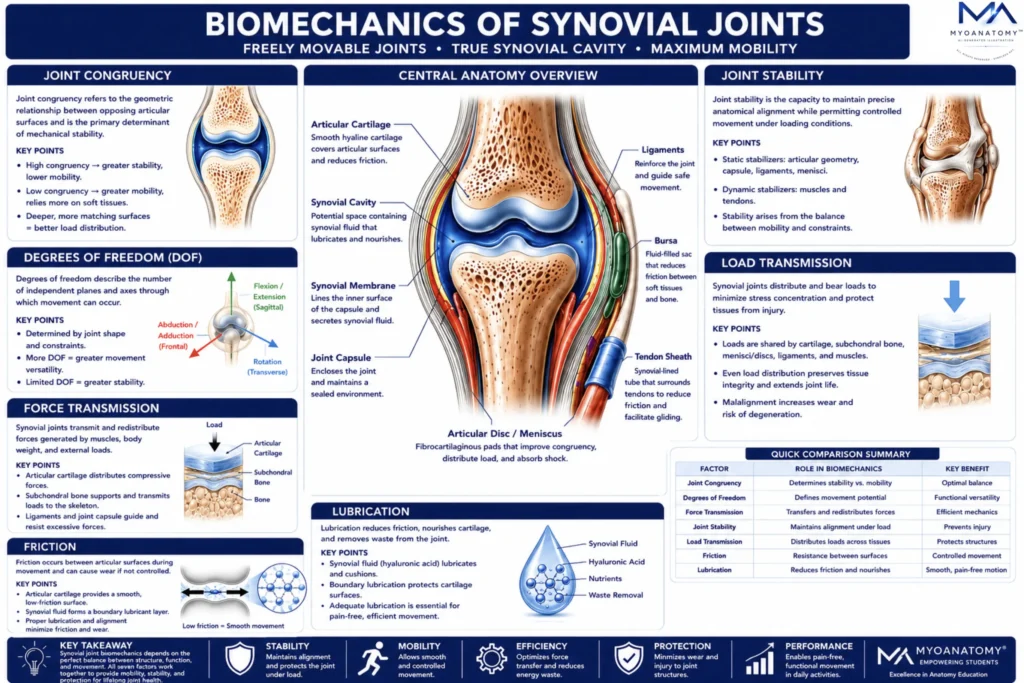
The biomechanics of synovial joints examines how joint architecture governs movement, stability, and force transmission. Through the coordinated interaction of articular surfaces, cartilage, synovial fluid, ligaments, and muscles, synovial joints facilitate efficient motion while minimizing friction, distributing loads, and preserving mechanical integrity.
OVERVIEW
The biomechanics of synovial joints examines how joint architecture governs movement, stability, force transmission, and load distribution within the musculoskeletal system. As the principal sites of skeletal motion, synovial joints convert muscular force into controlled movement while maintaining mechanical efficiency and structural integrity.
Joint function is determined by the interplay between articular surface geometry, joint congruency, capsule-ligament support, and dynamic muscular stabilization. Articular cartilage and synovial fluid minimize friction, dissipate mechanical stress, and optimize load transfer across joint surfaces. The morphology of each synovial joint ultimately dictates its range of motion, degrees of freedom, stability profile, and biomechanical performance.
Biomechanical analysis evaluates torque generation, leverage, joint reaction forces, stress distribution, and movement efficiency to explain how synovial joints balance mobility with stability. These principles provide the foundation for understanding normal movement, locomotion, athletic performance, joint degeneration, orthopedic pathology, and clinical rehabilitation.
AI Generated Illustration MyoAnatomy
How do articular geometry, congruency, stabilization mechanisms, force transmission, and load distribution interact to optimize synovial joint function while balancing mobility, stability, and long-term structural integrity?
Exam Question
ANATOMY
Joint Congruency
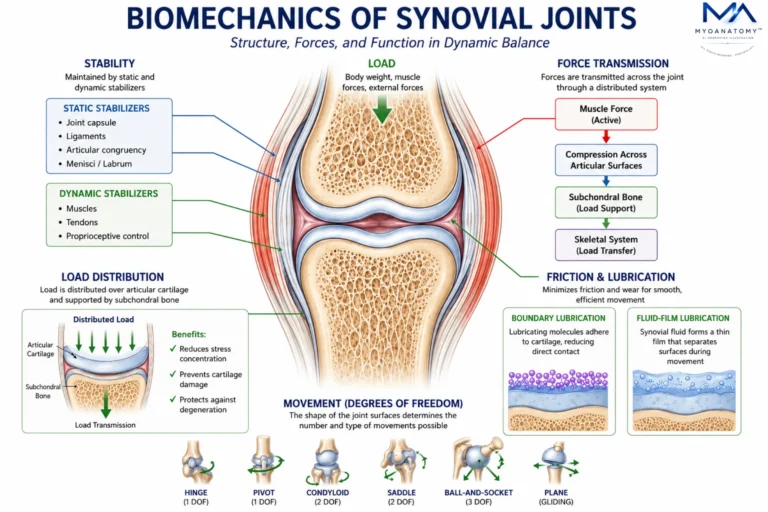
Joint congruency refers to the geometric relationship between opposing articular surfaces and represents a primary determinant of mechanical stability. Highly congruent joints distribute forces over a larger contact area, reducing localized stress and enhancing load-bearing capacity.
Conversely, joints with lower congruency permit greater mobility but depend more heavily on ligaments, capsules, and muscles for stabilization. The interplay between congruency and mobility underlies the functional specialization of every synovial joint.
Analyze how variations in articular congruency influence joint stability, force distribution, mobility, and susceptibility to injury. Discuss the biomechanical consequences of both high and low congruency joints.
Exam Question
Degrees of Freedom
Degrees of freedom describe the number of independent planes and axes through which movement can occur. Joint morphology, articular surface configuration, and ligamentous constraints collectively determine the extent and direction of motion.
As degrees of freedom increase, movement versatility expands, but the mechanical demand for stabilization also rises. Consequently, biomechanical complexity reflects a balance between movement potential and structural control.
Evaluate the relationship between degrees of freedom and biomechanical specialization in synovial joints. How does increasing movement potential alter stabilization requirements and functional performance?
Exam Question
Force Transmission
Synovial joints function as dynamic mechanical interfaces that transmit and redistribute forces generated by muscular contraction, body weight, and external loads. These forces are conveyed through articular cartilage, subchondral bone, and surrounding connective tissues, ensuring efficient energy transfer throughout the kinetic chain.
Optimal load distribution prevents excessive stress concentration, preserves tissue integrity, and minimizes the risk of mechanical failure. Alterations in alignment, joint congruency, or cartilage integrity can significantly modify force pathways and accelerate degenerative change.
Explain how synovial joints transmit and redistribute mechanical forces generated during movement and weight-bearing. Discuss the roles of cartilage, subchondral bone, ligaments, and surrounding musculature in maintaining mechanical efficiency.
Exam Question
Joint Stability
Joint stability is the capacity to maintain precise anatomical alignment while permitting controlled movement under physiological loading conditions. Stability arises from the coordinated interaction of static stabilizers, including articular geometry, the joint capsule, ligaments, menisci, and labra, together with dynamic stabilizers provided by neuromuscular control and muscular activity.
Simultaneously, articular cartilage and synovial fluid minimize friction, absorb mechanical stress, and optimize movement efficiency. This integration of mobility, stability, and friction control allows synovial joints to sustain repetitive loading while preserving long-term structural integrity and functional performance.
Critically examine the mechanisms responsible for maintaining synovial joint stability. How do static and dynamic stabilizers interact to preserve alignment while permitting physiological movement?
Exam Question
Load Distribution
Load distribution refers to the dispersion of compressive, tensile, and shear forces across synovial joint surfaces during movement and weight-bearing.
Articular cartilage functions as the primary load-bearing tissue, distributing mechanical stresses over a wider contact area, while the subchondral bone provides structural support and transmits forces to the underlying skeleton.
Effective load distribution minimizes focal stress concentration, preserves tissue integrity, enhances mechanical efficiency, and protects the joint from premature degeneration.
Discuss the biomechanical importance of load distribution in synovial joints. How do articular cartilage and subchondral bone cooperate to minimize stress concentration and preserve long-term structural integrity?
Exam Question
Friction Lubrication
Friction and lubrication mechanisms enable smooth, efficient, and low-resistance movement within synovial joints. Synovial fluid serves as the principal lubricant, while boundary lubrication forms a protective molecular layer on articular surfaces and fluid-film lubrication creates a thin fluid barrier that separates opposing cartilages during motion.
Together, these mechanisms reduce friction, minimize mechanical wear, decrease energy expenditure, and preserve long-term joint function and cartilage health.
Analyze the mechanisms by which synovial joints minimize friction during movement. Compare boundary lubrication and fluid-film lubrication and explain their significance in protecting articular cartilage from mechanical wear.
Exam Question
SUMMARY TABLE