
Cartilaginous Joints
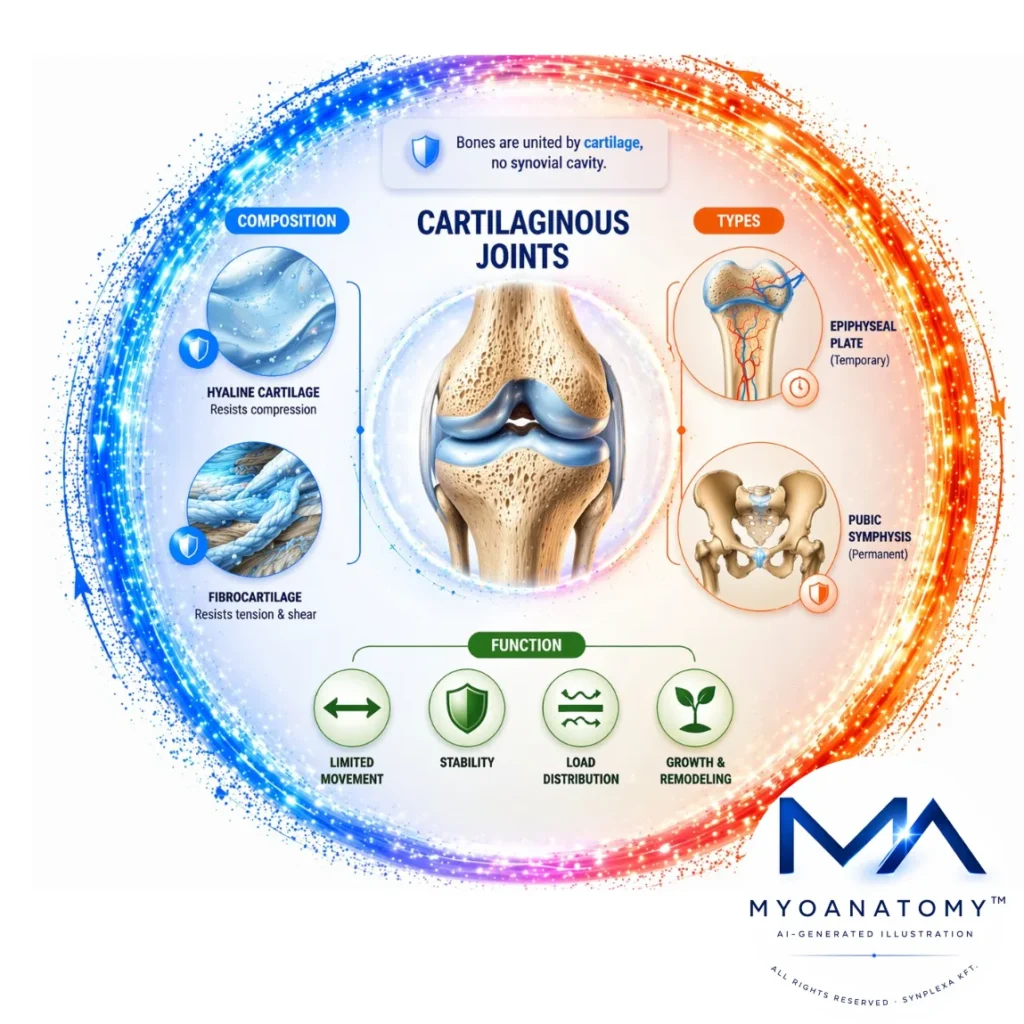
Cartilaginous joints are articulations in which adjacent bones are united by cartilage without a synovial cavity, forming continuous load-bearing interfaces that combine stability with controlled compliance. Structurally, they consist of hyaline cartilage, which resists compression via a hydrated proteoglycan-rich matrix, or fibrocartilage, which provides additional tensile and shear resistance through dense type I collagen.
Functionally, they permit limited, tightly regulated movement, preventing excessive displacement while adapting to mechanical loading. Their viscoelastic properties allow deformation under force with recovery, dissipating energy and reducing focal stress concentration. Biomechanically, they act as semi-rigid, energy-dissipating systems that distribute loads across skeletal segments, maintaining alignment and integrity under dynamic conditions, particularly within the axial skeleton.
They also play a key role in skeletal growth and remodeling, where cartilage functions as a transitional or permanent structural interface, optimizing durability and functional resilience under repetitive mechanical demand.
SYNCHONDROSIS
AI-Generated Illustration-MyoAantomy
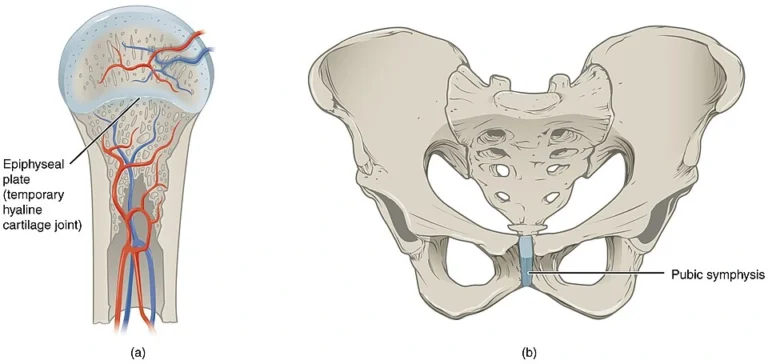
“Cartilaginous Joints” by OpenStax College, from Anatomy & Physiology, via Wikimedia Commons.
Licensed under CC BY 3.0
Definition
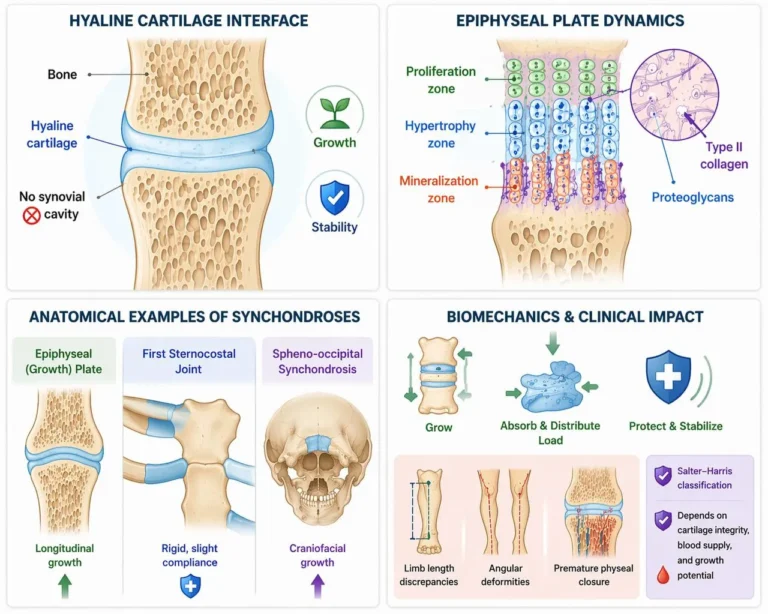
Synchondroses are primary cartilaginous joints in which adjacent bones are united by a continuous layer of hyaline cartilage, forming a structurally integrated, load-bearing interface without a synovial cavity.
They function predominantly as temporary developmental articulations, serving as essential growth centers that permit longitudinal skeletal expansion while preserving mechanical continuity and alignment between adjacent skeletal segments.
Exam Question
How does the structural continuity of a synchondrosis enable longitudinal bone growth while maintaining stability between adjacent skeletal elements?
Structure
In a synchondrosis, articulating bone surfaces are connected by hyaline cartilage composed of type II collagen and a proteoglycan-rich matrix specialized for resistance to compressive forces.
In growth plates, this cartilage is organized into distinct zones of chondrocyte proliferation, hypertrophy, and matrix mineralization, driving endochondral ossification. With maturation, vascular invasion and ossification progressively replace cartilage with bone, resulting in synostosis.
The intrinsic stiffness of hyaline cartilage limits motion, ensuring structural stability during growth.
Exam Question
Explain how the zonal organization of hyaline cartilage within a synchondrosis supports endochondral ossification and influences its mechanical behavior.
Types
The epiphyseal (growth) plate is the principal example of a synchondrosis, located between the epiphysis and metaphysis of long bones, where regulated chondrocyte activity enables longitudinal growth until physeal closure.
The first sternocostal joint represents a permanent synchondrosis, providing rigid yet slightly compliant attachment between the first rib and the manubrium, contributing to thoracic stability.
The spheno-occipital synchondrosis at the cranial base functions as a critical growth site in craniofacial development and undergoes fusion during adolescence.
Exam Question
Compare temporary and permanent synchondroses in terms of structure, function, and their contribution to skeletal growth and stability
Functional & Clinical
Functionally, synchondroses are specialized for controlled skeletal growth and load transmission, allowing bone elongation while maintaining alignment and distributing compressive forces.
Their viscoelastic cartilage matrix dissipates mechanical stress and prevents focal overload during development.
Clinically, injury to synchondroses – particularly the epiphyseal plate – can disrupt normal endochondral ossification, leading to limb length discrepancies, angular deformities, or premature physeal closure. These injuries are classified using the Salter–Harris system, reflecting the relationship between cartilage integrity, vascular supply, and growth potential.
Exam Question
Analyze how injury to a synchondrosis alters normal bone growth and biomechanical load distribution, and explain the clinical significance of Salter-Harris system.
PUBIC SYMPHYSIS
AI-Generated illustration-MyoAantomy
Definition
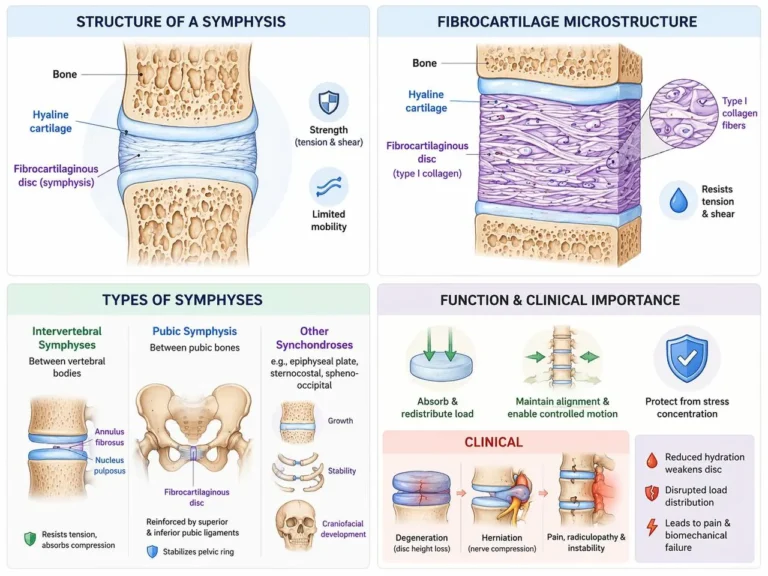
Symphyses are secondary cartilaginous joints in which adjacent bones are united by a fibrocartilaginous disc interposed between hyaline cartilage–covered articular surfaces.
They are permanent articulations specialized for load transmission, combining high tensile strength with limited, controlled mobility, thereby forming semi-rigid, energy-dissipating interfaces in weight-bearing regions.
Exam Question
Explain how the composite tissue organization of a symphysis enables it to function as a load-transmitting yet minimally mobile joint?
Structure
A symphysis consists of opposing bone surfaces covered by hyaline cartilage, connected by a central fibrocartilaginous disc rich in type I collagen fibers arranged in lamellar patterns to resist tensile and shear forces.
In structures such as the intervertebral disc, the annulus fibrosus forms concentric collagen layers with alternating fiber orientation, conferring multidirectional tensile resistance, while the nucleus pulposus, a proteoglycan-rich hydrated core, behaves as a hydrostatic unit that redistributes compressive loads radially.
Surrounding ligaments reinforce the joint, and the entire complex exhibits viscoelastic behavior, allowing deformation under load and recovery upon unloading.
Exam Question
Analyze how the interaction between annulus fibrosus fiber orientation and the hydrostatic properties of the nucleus pulposus determines the mechanical behavior of a symphysis.
Types
Intervertebral symphyses are located between vertebral bodies, where the annulus fibrosus resists tensile forces and constrains deformation, while the nucleus pulposus converts axial compression into circumferential tension, enabling load distribution and controlled spinal mobility.
The pubic symphysis consists of a fibrocartilaginous disc reinforced by superior and inferior pubic ligaments, providing limited movement while stabilizing the pelvic ring under dynamic loading conditions such as gait and parturition.
These variations reflect region-specific adaptations to differing mechanical demands.
Exam Question
Compare the biomechanical roles of the intervertebral symphysis and pubic symphysis, relating structural differences to their functional adaptations.
Functional & Clinical
Functionally, symphyses act as viscoelastic joints that absorb, redistribute, and dampen mechanical loads, preventing stress concentration while maintaining alignment of skeletal segments.
The hydrostatic behavior of the nucleus pulposus and tensile resistance of fibrocartilage enable efficient energy dissipation under repetitive loading.
Clinically, degeneration of symphyses – particularly intervertebral discs – leads to reduced hydration, loss of disc height, and structural failure of the annulus fibrosus, allowing herniation of nuclear material. This disrupts normal load distribution and may compress adjacent neural structures, producing radiculopathy and progressive biomechanical instability.
Exam Question
Explain how degenerative changes in fibrocartilage and nucleus pulposus alter load distribution in a symphysis and lead to neural compression syndromes.
FUNCTIONAL ROLE
Bone Growth
Cartilaginous joints, particularly synchondroses, function as dynamic growth interfaces that enable longitudinal bone development through highly regulated endochondral ossification. Within the epiphyseal plate, spatially organized zones of chondrocyte proliferation, hypertrophy, and matrix mineralization generate progressive elongation while maintaining structural continuity.
This tightly controlled process determines final bone length and morphology, integrating cellular activity with mechanical loading conditions during growth.
Shock Absorption
Cartilaginous joints act as viscoelastic biomechanical buffers, particularly within the axial skeleton. Fibrocartilaginous structures, such as intervertebral discs, combine a tensile-resistant collagen network with a hydrated, proteoglycan-rich matrix that exhibits hydrostatic behavior under compression.
This allows redistribution of forces across broader surfaces, reducing peak stress and protecting osseous structures from repetitive mechanical fatigue and microdamage.
Controlled Flexibility
These joints provide a precise balance between rigidity and mobility, permitting limited, controlled deformation while preserving structural stability. Their viscoelastic properties enable adaptive compliance under load, preventing excessive stiffness characteristic of fibrous joints and excessive mobility seen in synovial joints.
This controlled flexibility ensures maintenance of alignment and functional adaptability in weight-bearing regions under dynamic mechanical conditions.
Force Integration
Cartilaginous joints function as integrative mechanical interfaces that link adjacent skeletal segments into continuous load-bearing systems. By coordinating the transmission and distribution of forces across regions such as the vertebral column and pelvic ring, they ensure uniform stress dispersion and biomechanical coherence during movement, posture maintenance, and load-bearing activities.
This integration minimizes localized overload and supports long-term structural integrity.
CLINICAL RELEVANCE
Growth Disorders
Damage to synchondroses, particularly the epiphyseal plates, disrupts normal endochondral ossification, leading to growth arrest, limb length discrepancies, or angular deformities.
These injuries are clinically critical in pediatric populations due to their long-term impact on skeletal development.
Disk Degeneration
Degeneration of fibrocartilaginous symphyses, such as intervertebral discs, is characterized by loss of proteoglycan content, reduced hydration of the nucleus pulposus, and structural disorganization of the annulus fibrosus. This leads to diminished hydrostatic pressure, decreased disc height, and compromised load distribution.
Progressive weakening predisposes to annular tears and disc herniation, which may compress adjacent neural structures, resulting in pain, radiculopathy, and functional impairment.
Pelvic Instability
Alterations in the pubic symphysis, including ligamentous laxity, fibrocartilaginous degeneration, or mechanical disruption, can compromise the integrity of the pelvic ring. This leads to abnormal force transmission across the pelvis, particularly during dynamic loading conditions such as gait or pregnancy.
Increased joint compliance results in instability, altered biomechanics, and impaired weight-bearing efficiency, with potential effects on posture and locomotion.
Load Failure
Compromise of cartilaginous joints disrupts their viscoelastic buffering capacity, leading to inefficient energy dissipation and increased stress concentration at adjacent osseous and articular structures. This promotes microdamage accumulation, accelerates degenerative processes, and predisposes to overuse injuries.
The resulting loss of coordinated force transmission reduces overall biomechanical efficiency and contributes to progressive musculoskeletal dysfunction.